
Quick answer: A wolf tattoo means loyalty, freedom, and family. Wolves are one of the few animals that manage to be both fiercely independent and completely devoted to their pack, and that tension is exactly why people get them inked. A howling wolf leans toward freedom and finding your own voice. A pack, a pair, or a wolf with its cubs leans toward loyalty — the people you would cross a frozen forest for, no questions asked.
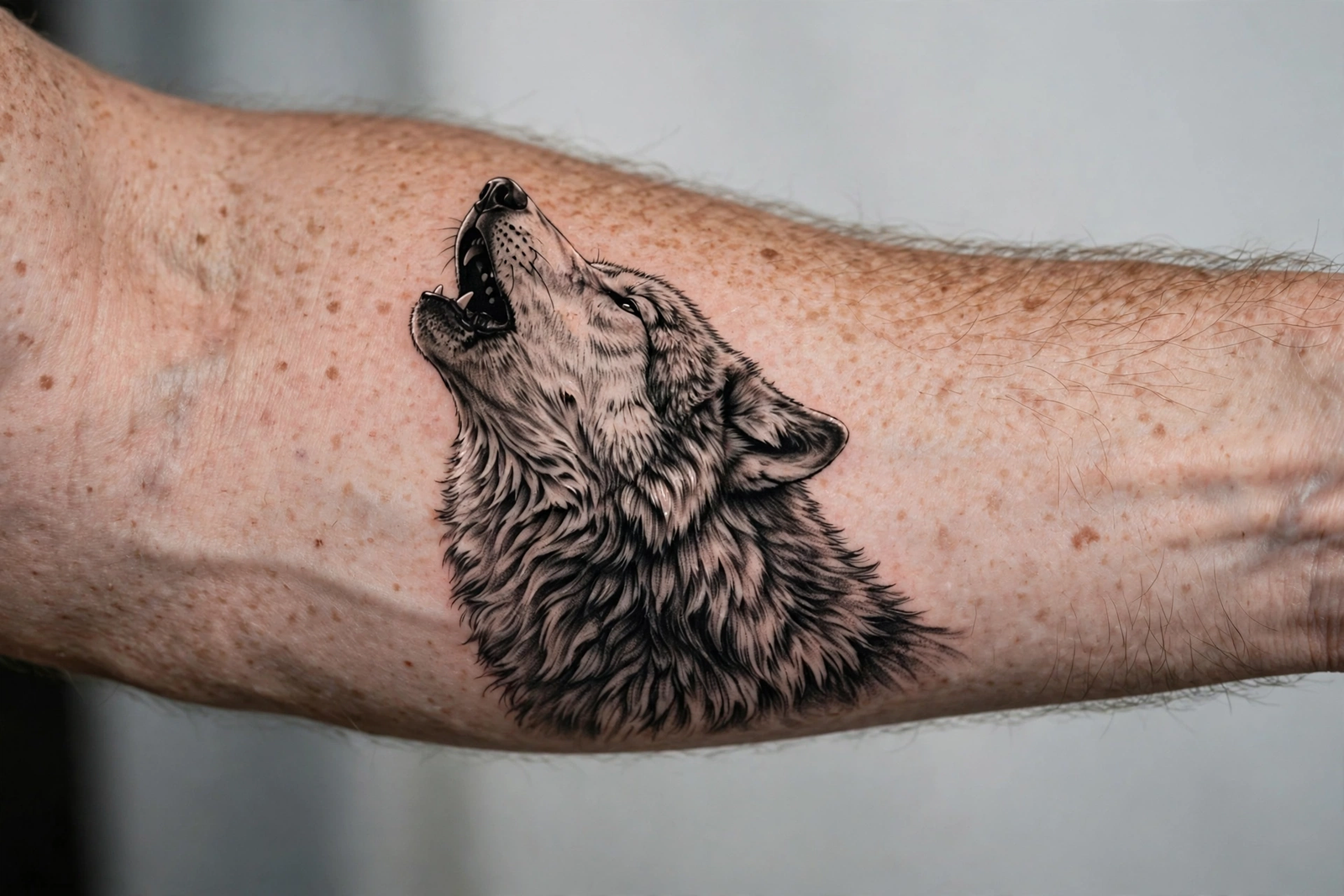
I still remember the first wolf tattoo I ever saw up close. Not in a magazine, not on Instagram — on the forearm of a guy waiting for a bus in Leeds, years ago, rain coming down sideways. It was a grey wolf mid-howl, head thrown back, and it was not a tidy little flash design. It was big, it was slightly battered by time, and it had clearly been there through a few chapters of his life. We got talking because, well, buses in the rain make strangers chatty, and he told me he’d got it the week his daughter was born. “She’s my pack now,” he said, and then laughed at himself for sounding like a film quote. But he wasn’t wrong, and I’ve never forgotten it. That is the wolf in a nutshell: it sounds dramatic until it is suddenly, completely personal.
That is what this guide is for. Not a list of Pinterest captions, but the real story behind the wolf: what it means when it howls and what it means when it doesn’t, why a lone wolf and a pack wolf are almost opposite tattoos, the designs people actually live with for decades, where they put them, what they hurt like, and what they cost. By the end you should be able to walk into a studio and say, with some confidence, “this is my wolf” — and mean it.
What Does a Wolf Tattoo Mean?
Ask ten people with wolf tattoos and you will get ten different answers, but almost all of them circle the same three ideas. Wolves hunt together, raise their young together, and defend each other to the point of absurdity. They also roam enormous territories, sometimes alone, following instincts most of us have trained ourselves to ignore. Hold those two truths side by side and you have the whole symbolism.
Loyalty that doesn’t need announcing
Wolf loyalty is not the sentimental kind. In a real pack, loyalty looks like sharing food when you are hungry, standing between danger and the pups, and staying when leaving would be easier. People who get wolf tattoos for loyalty usually mean exactly that version. I once met a woman with three small wolf paws tattooed along her collarbone, one for each of her brothers. She told me they had not all been in the same room for four years, but the tattoo was her way of saying the distance didn’t change anything. No names, no dates, just paws. That is loyalty done quietly, which suits the wolf far better than a banner ever could.
Freedom — and the price of it
Freedom is the other half of the wolf, and it is messier than the posters suggest. A wild wolf is free, yes, but it is also cold, hungry, and constantly making decisions with real consequences. That is why the wolf appeals to people at a crossroads: someone who left a job, a town, a relationship, a whole version of their life. They are not celebrating that it was easy. They are marking that they chose it anyway. If your wolf means freedom, ask yourself which kind — freedom from something, or freedom to become something? The design will change depending on your answer.
Family, in the pack sense
Here is a fact that surprises people: wolf packs are usually just families. A breeding pair and their offspring from a few years, travelling and hunting together. So a “pack” tattoo is often, at heart, a family tattoo that refuses to look like one. No hearts, no infinity symbols, no script that says “family first” in curly letters. Just wolves, together, doing what families actually do — moving through hard country as a unit. For parents, for siblings, for chosen family, that lands harder than anything cute ever could.
Instinct and intuition
Wolves survive by reading signs most of us walk straight past: a shift in wind, a sound that doesn’t belong, the feeling that something is off. A wolf tattoo can stand for trusting that inner alarm. I have heard this one most from people who work in high-stakes jobs — nurses, soldiers, firefighters — and from people who ignored their gut once and paid for it. Their wolf is a reminder, worn where they can see it: next time, listen sooner.
Lone Wolf vs Pack Wolf: Almost Opposite Tattoos
This is the decision that matters most, so let’s not rush it. A lone wolf and a pack wolf share an animal but they do not share a message. Pick the wrong one and you will spend years explaining a tattoo that says the opposite of what you meant.
The lone wolf
The lone wolf tattoo belongs to the person who walks their own path, by choice or by necessity. Sometimes it is a badge of independence — the artist, the traveller, the one who left home at eighteen and never really moved back. Sometimes it is sadder than that: a period of being genuinely alone, survived rather than celebrated. Both readings are valid, and a good design can hold both. A lone wolf standing on a ridge at dusk, looking out rather than howling, tends to read as thoughtful solitude. A lone wolf mid-howl reads as defiance, a voice in the dark. Which one is yours? The answer is in the posture, not the species.
One honest warning, though. “Lone wolf” has been borrowed by so many motivational posters that it can sound like a cliché if the design is generic. The way around that is specificity. Give your wolf a landscape, a season, a scar, a direction it is looking in. Make it a particular wolf in a particular place, and the cliché falls away. Generic wolves say “I like wolves.” Specific wolves say “this happened to me.”
The pack wolf
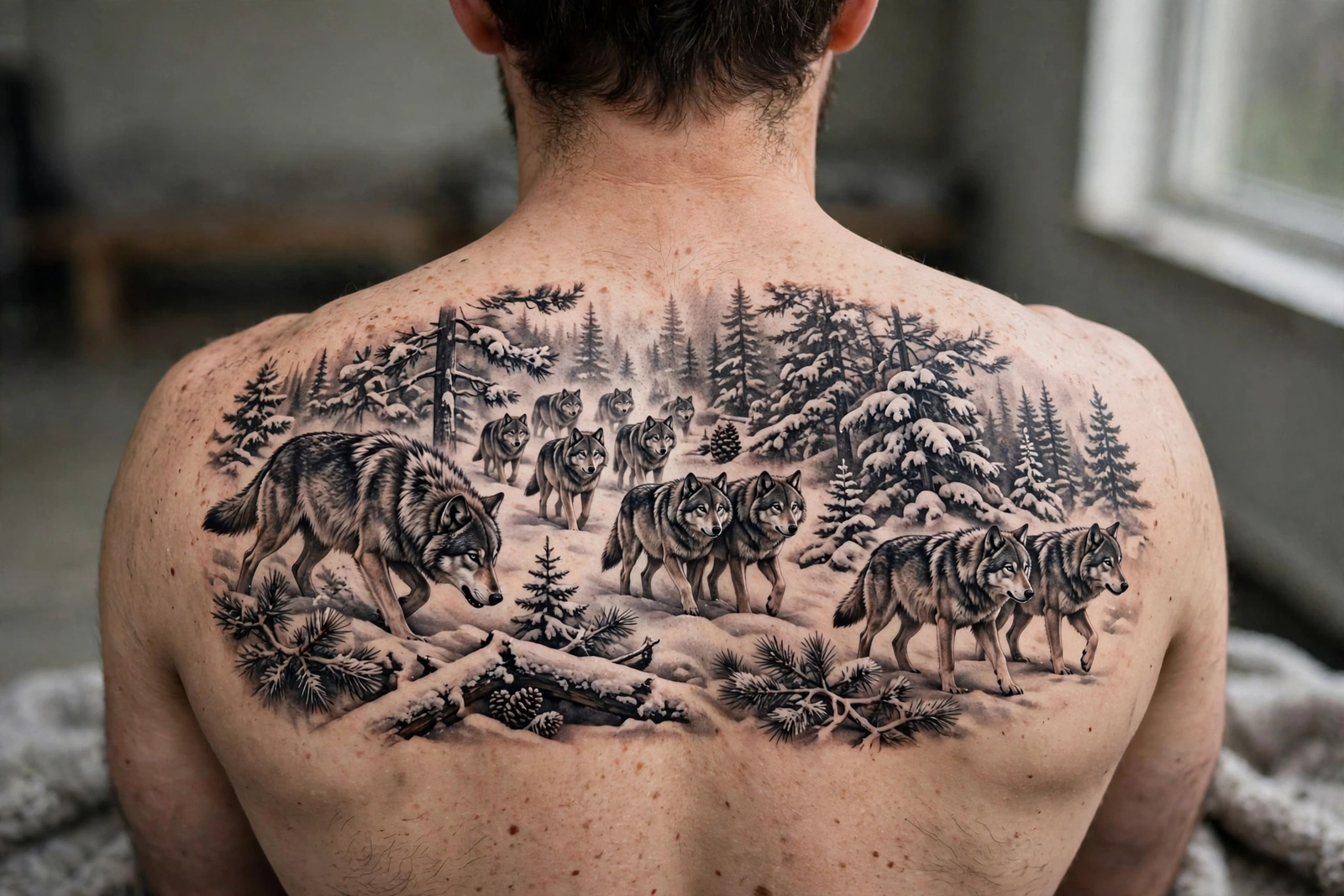
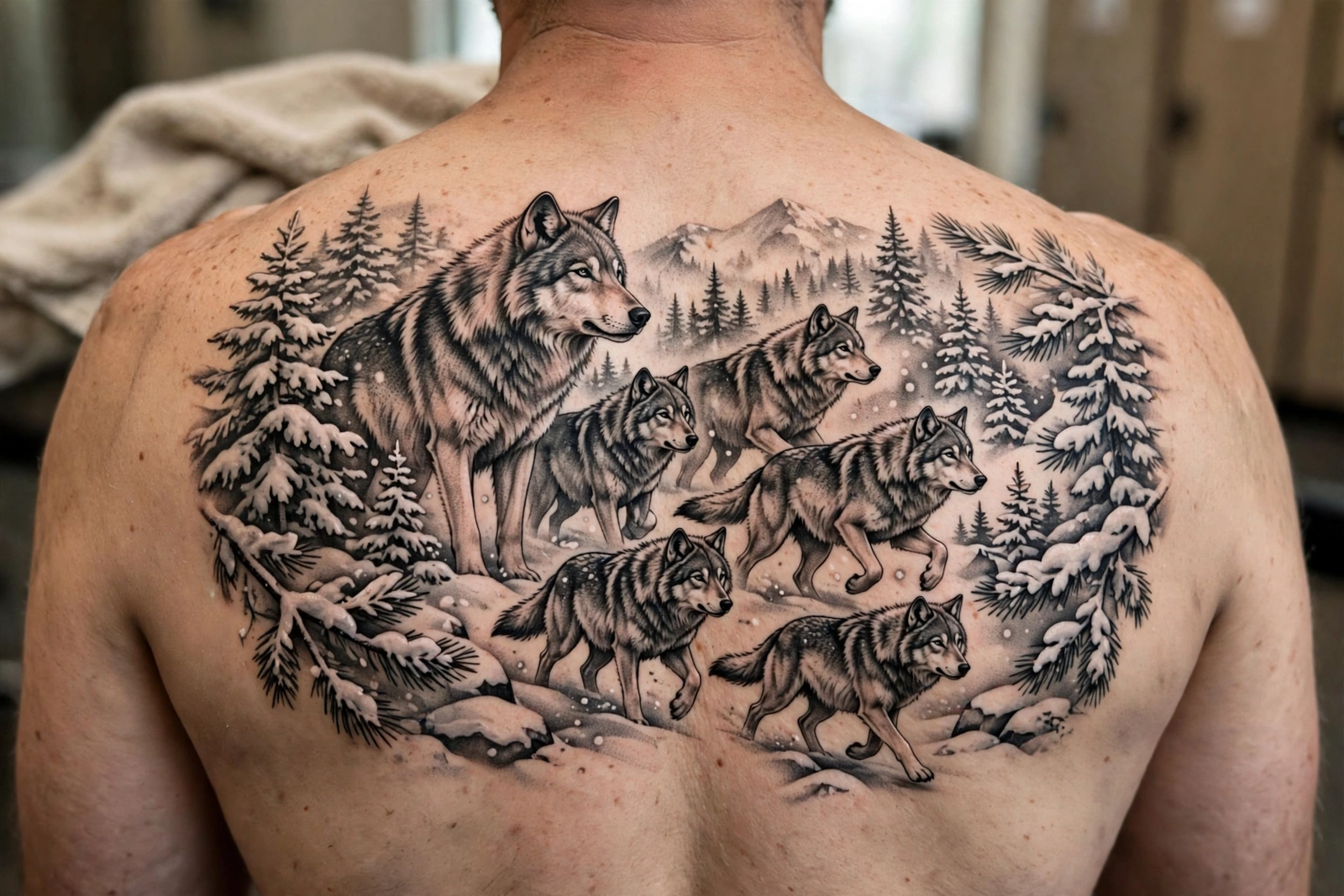
Pack tattoos come in two main forms. The first is literal: several wolves together, often a larger one flanked by smaller ones, or a line of wolves crossing a snowy ridge. The second is subtler: one wolf, but with paw prints, or a second pair of eyes in the background, or cubs tucked close. Both say the same thing — I am not doing this alone — but the subtle version ages better for people who worry about a big scene feeling busy in ten years.
There is also a middle ground that I love: the wolf pair. Two wolves, side by side or nose to nose, for a partner, a best friend, a sibling, a parent and child. It says loyalty without needing a whole crowd on your skin. Couples get matching wolf pairs more often than you might think, and unlike matching names, a wolf pair still looks great if life takes you in different directions. It was a bond, not a contract.
Wolves in Culture: Why the Symbol Runs So Deep
Wolves have lived in human stories for thousands of years, and those stories still colour what a wolf tattoo says today — whether the wearer knows it or not. Worth knowing before you commit.
Native American traditions
In many Native American traditions, the wolf is a teacher and a guide: loyal to family, a skilled hunter, a creature of strong social bonds and sharp instinct. Wolf stories often frame the animal as a pathfinder, someone who shows the way through difficult territory. This is worth treating with real respect. If you are borrowing from a specific tradition that is not your own, do it thoughtfully — learn what the symbol means in that culture, and don’t reduce a living tradition to an aesthetic. A wolf tattoo can honour that teaching without claiming a heritage you don’t hold, but the line matters, and a decent artist will help you walk it.
Norse mythology: Fenrir and Geri and Freki
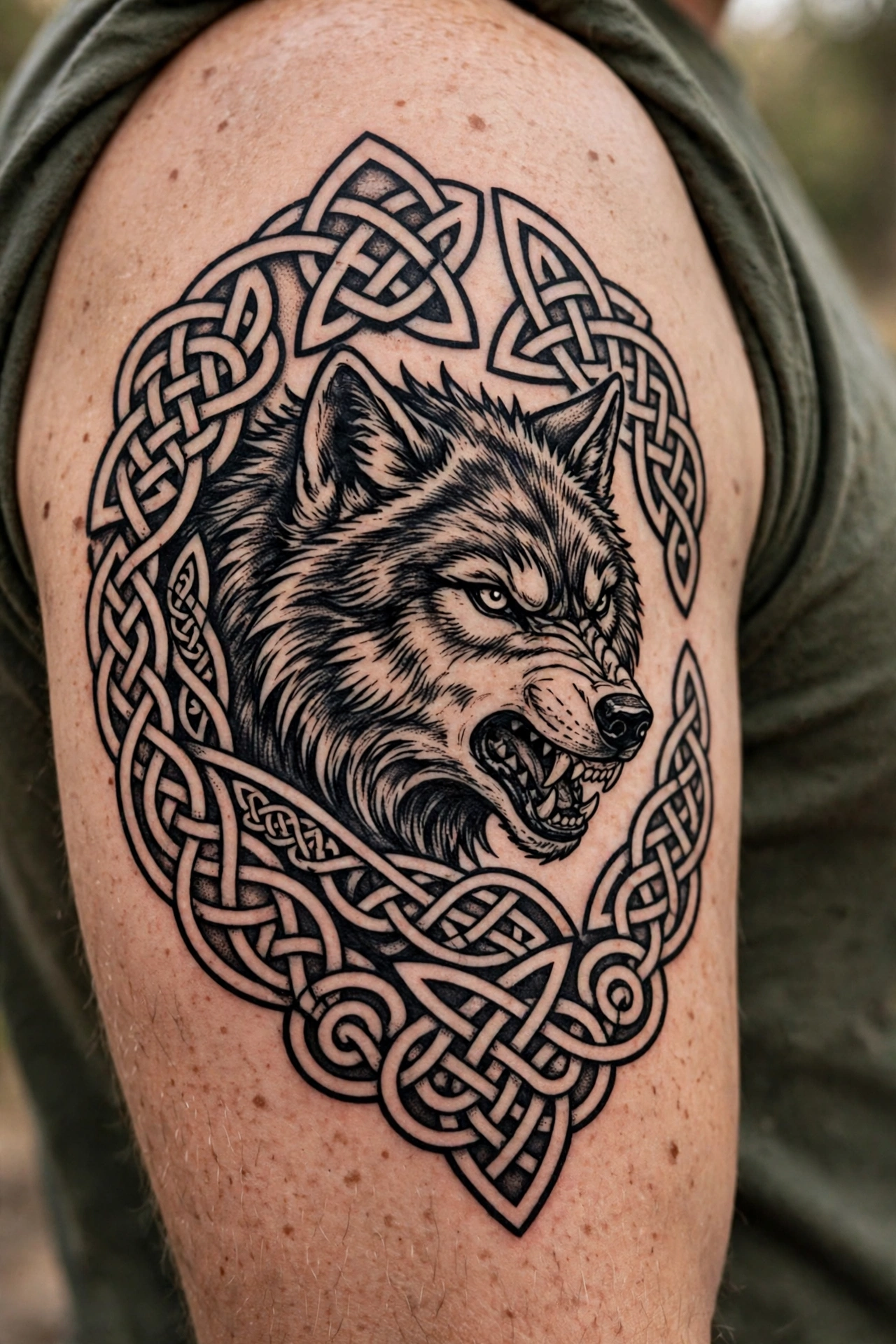
Norse myth gives us two very different wolves. Odin’s companions Geri and Freki — whose names roughly mean “the ravenous” and “the greedy one” — embody loyalty and ferocity in service of something greater. Fenrir, the monstrous wolf chained by the gods, embodies wild power that cannot be tamed and the fear of what happens when it breaks loose. Norse-inspired wolf tattoos, often paired with runes or knotwork, tend to lean into strength, fate, and the idea that some forces are bigger than us. If you go this route, check your runes twice. Misspelled runes are the wolf-tattoo equivalent of a typo on a wedding invitation — permanent and avoidable.
Rome, Celtic lands, and the wolf as founder
Rome famously begins with a wolf: the she-wolf who suckled Romulus and Remus, founders of the city. A Roman-style wolf tattoo can therefore mean origin, protection, and the fierce mothering instinct — the wolf that raises what the world abandoned. Celtic art, meanwhile, gives us wolves as guardians of the wild and guides between worlds, often in swirling, interlaced designs that suit forearms and calves beautifully. Both traditions pull the wolf toward guardianship rather than aggression, which suits a lot of wearers better than the snarling version.
The wolf in modern stories
Modern stories have added their own layers: the wolf as outsider, as survivor, as the creature in the woods that is more afraid of you than you are of it. Think of how often a wolf appears at the moment a character chooses to be brave. That pop-culture layer is not shallow — it is how most of us first met the wolf, and it is a perfectly good reason to get one. Just know which story is yours. Is your wolf the guardian, the wanderer, the survivor, or the wild thing? Naming it will make the design ten times easier.
Wolf Tattoo Designs That Actually Work
Right, designs. This is where people either fall in love with their tattoo or end up with a grey blob they cover with a sleeve. Wolves are hard to tattoo well — fur, eyes, snouts, all in a small space — so design choice matters more than with simpler animals.
Howling wolf
The classic, and still the most requested. Head thrown back, mouth open, usually with a moon behind it. It works because it is instantly readable: this wolf has something to say. Placement tip: howling wolves need vertical room, so forearms, calves, and the upper back suit them better than wide, flat spots. And please, have the moon placed deliberately — a moon slapped behind a wolf as an afterthought looks like a sticker, not a scene.
Realistic portrait
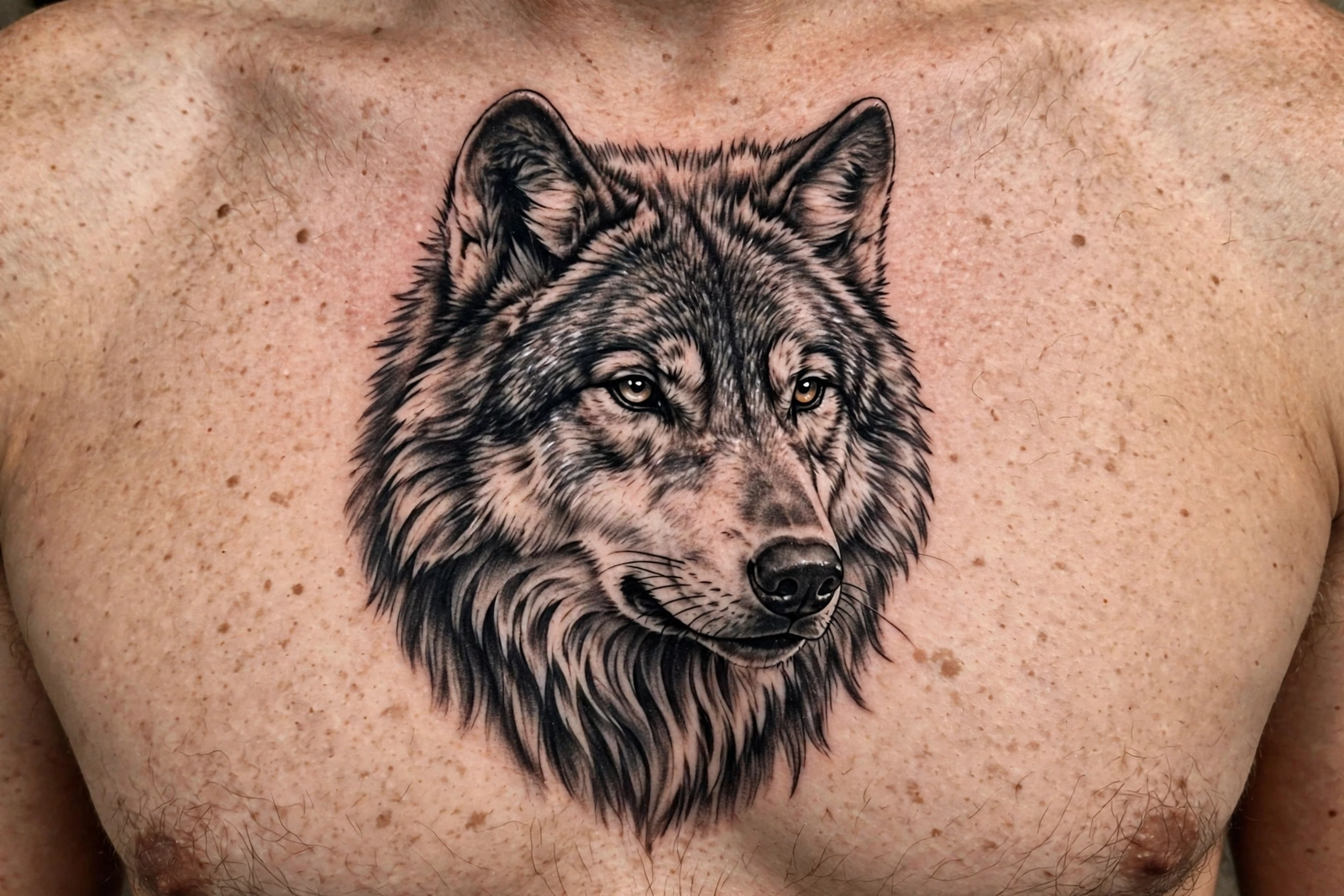
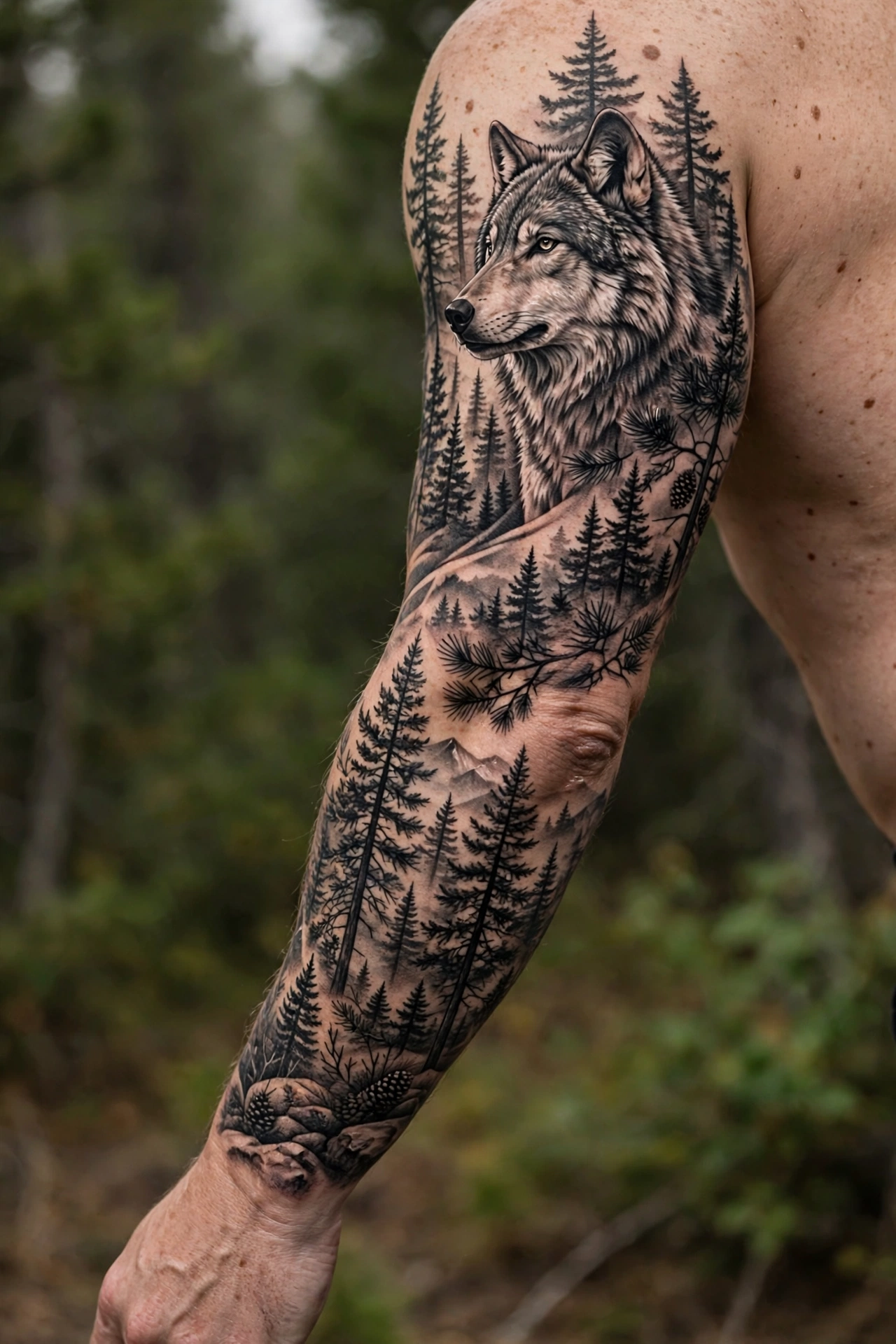
A single wolf face, rendered in grey realism with detailed fur and eyes that actually look alive. This is the design that separates great artists from good ones. The eyes carry the whole piece: get them slightly wrong and the wolf looks confused rather than intense. Look for an artist whose portfolio includes healed realism — fresh realism always looks impressive, healed realism tells the truth. Realistic portraits suit the chest, thigh, and upper arm, where there is room for the fur texture to breathe.
Geometric wolf
Sharp lines, triangles, and polygons forming a wolf’s head, sometimes half-geometric and half-realistic down the middle. The geometric wolf says structure and instinct in the same image — the wild thing, understood. It is popular with people who like clean, modern design, and it ages well because bold geometric lines hold up better than fine fur detail. One caveat: geometric work shows every wobble. Pick an artist who does linework all day, not someone trying it for the first time on you.
Watercolour wolf
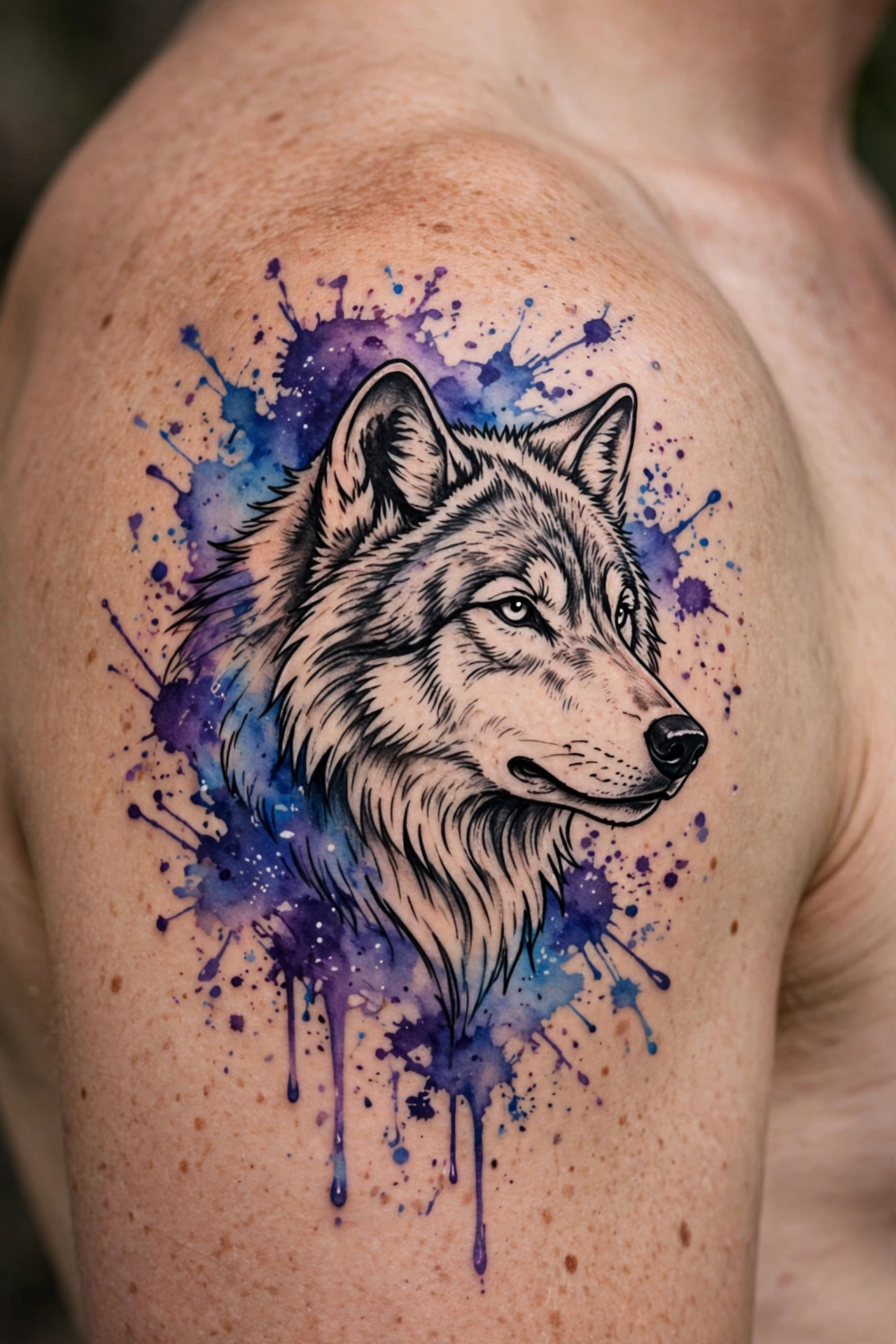
A wolf silhouette or outline with splashes of watercolour — blues and purples for night, oranges and reds for sunset. Beautiful, expressive, and a little risky: watercolour without a strong black outline fades faster than traditional work. If you love this style, ask for a solid outline underneath the colour. Your future self, looking at the tattoo in fifteen years, will be grateful.
Wolf and moon
The most natural pairing in wolf tattooing, and for good reason. The moon gives the wolf a reason to howl, a light source for the scene, and a symbol of cycles and change layered on top. Crescent moons suit smaller, subtler pieces; full moons suit big, dramatic back or chest scenes. Our tattoo meanings library has more on moon symbolism if you want to layer the two meanings deliberately rather than by accident.
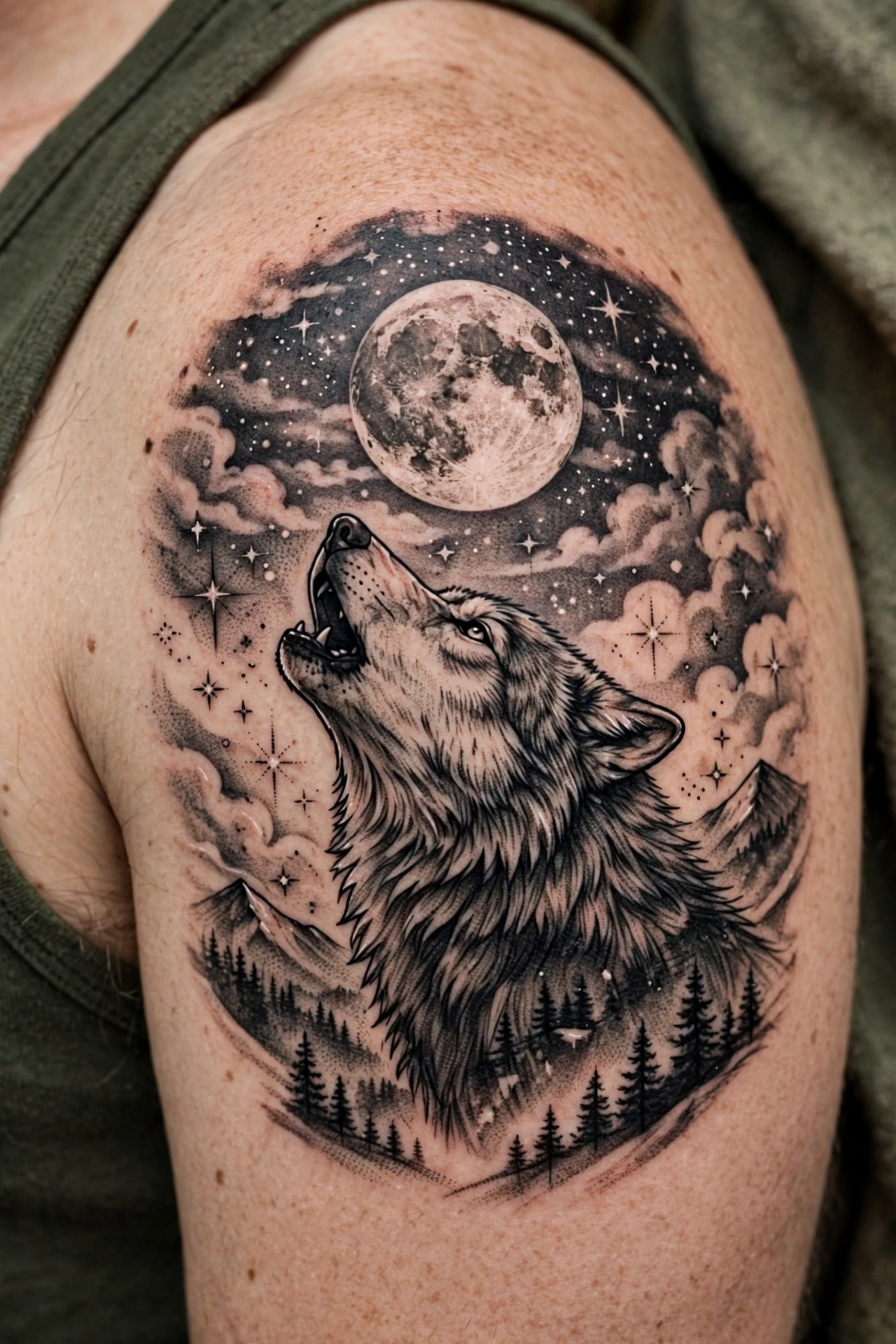
Tribal and traditional wolf
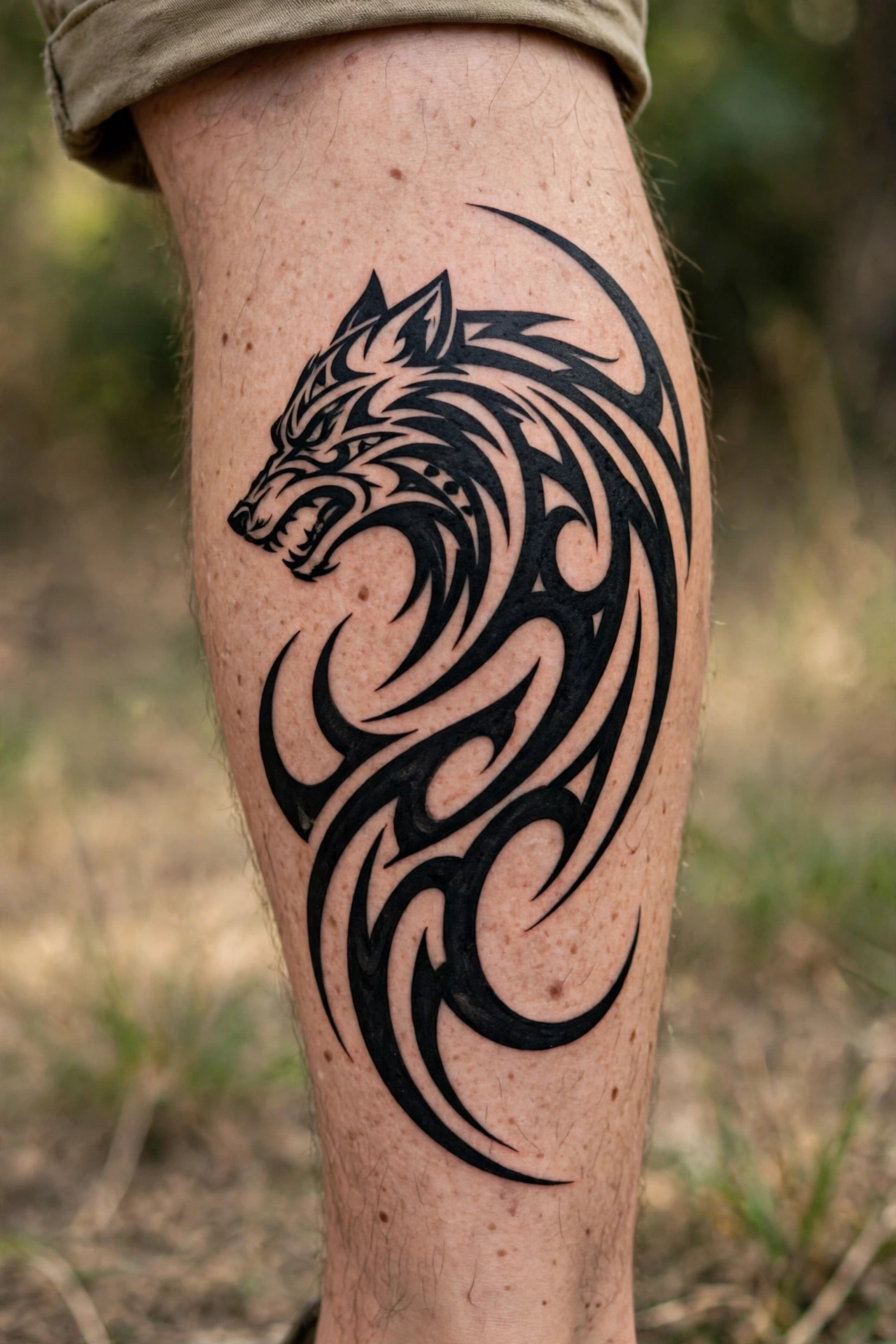
Bold black tribal wolves, with sweeping curves instead of fur detail, carry an older, more graphic energy. Traditional American-style wolves — bold outlines, limited colour, a snarling or stoic face — have a similar punch and age superbly. Both styles suit people who want the wolf to read from across the room rather than reward close inspection. They also cover well and touch up easily, which is worth considering if this is your first large piece.
Wolf with flowers, forest, or mountains
Adding a landscape changes the whole story. Pine trees and mountains make the wolf a creature of place — home, wilderness, the territory you belong to. Flowers soften it: wildflowers for freedom, roses for love protected fiercely, lavender for calm after a storm. I have seen a wolf with a small sprig of lavender behind its ear, done for a grandmother who loved the scent, and it was one of the most moving tattoos I have ever seen. Small details like that are what turn a good wolf into your wolf.
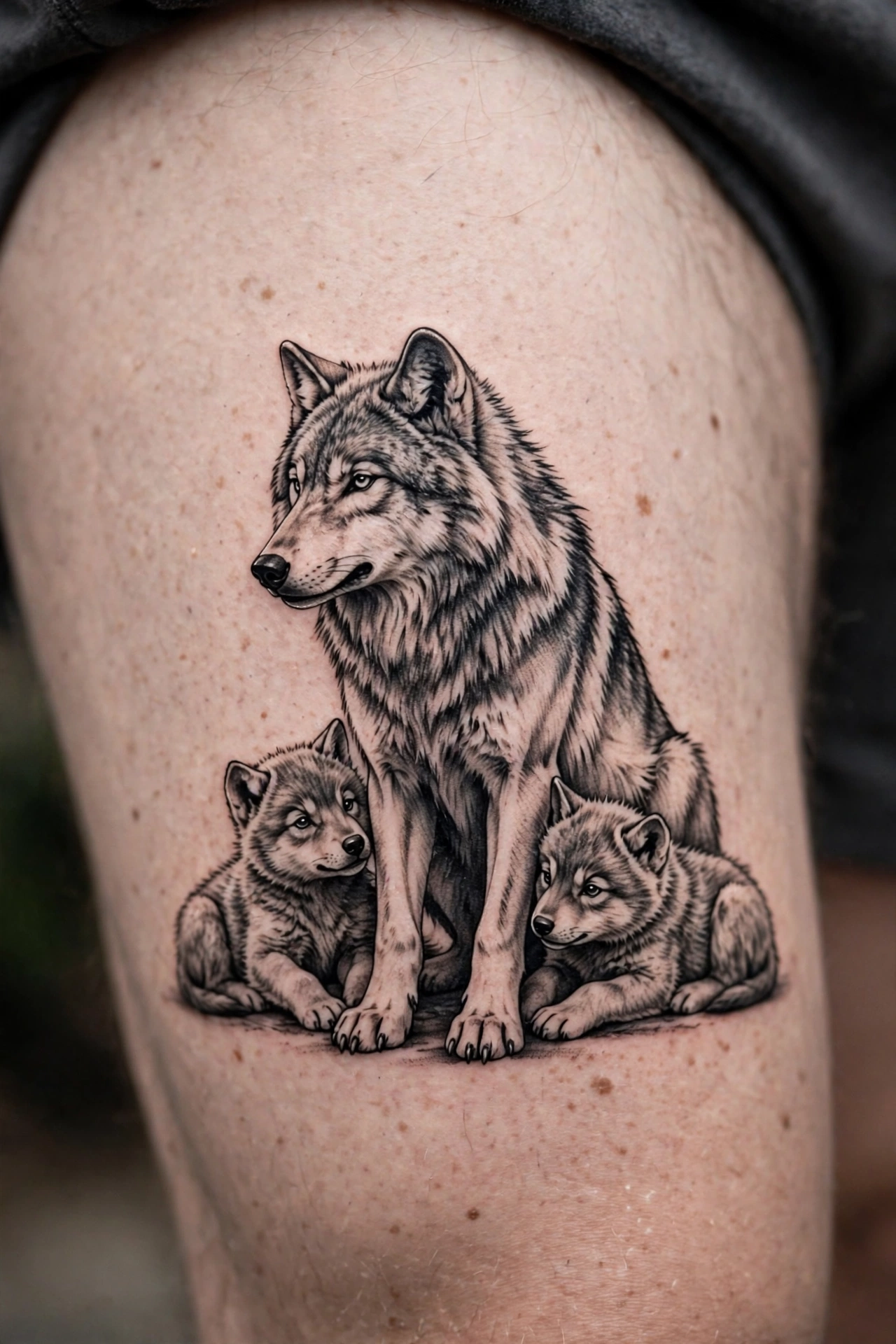
Wolf cubs and family scenes
A mother wolf with cubs, or a large wolf sheltering smaller ones, is the family tattoo for people who don’t want a family tattoo. It reads as protection without sentimentality. Keep the composition simple — one adult, one or two cubs, plenty of space — or the scene turns muddy. And think about scale: cubs need to be recognisably cubs, not just small wolves, so the piece needs enough size for their proportions to read.
Wolf and raven: the unlikely partnership
Here’s a pairing we’re seeing more of lately, and I like it a lot. In the old Norse stories, Odin’s ravens flew ahead and reported back what they saw, while his wolves stayed close and guarded him — brains and loyalty working as a team, not rivals. A wolf with a single raven perched on a branch above it, or circling just behind its head, carries that same idea: intelligence paired with devotion, the watcher and the protector in one piece. It works best in blackwork, where the raven’s solid black shape gives the wolf’s grey fur something to push against, and it suits people who feel like two things at once — the thinker and the loyal friend. Keep it to one raven, though. A whole flock turns a striking design into a busy sky, and the wolf deserves to stay the star of its own tattoo.
Best Placements for a Wolf Tattoo
Wolves need room. That is the single most useful placement rule, and it overrides almost everything else. A wolf squeezed into a tiny space loses its fur texture, its eyes, and its expression — the three things that make it a wolf rather than a grey dog-shaped smudge. So think in terms of canvas size first, visibility second.
Forearm
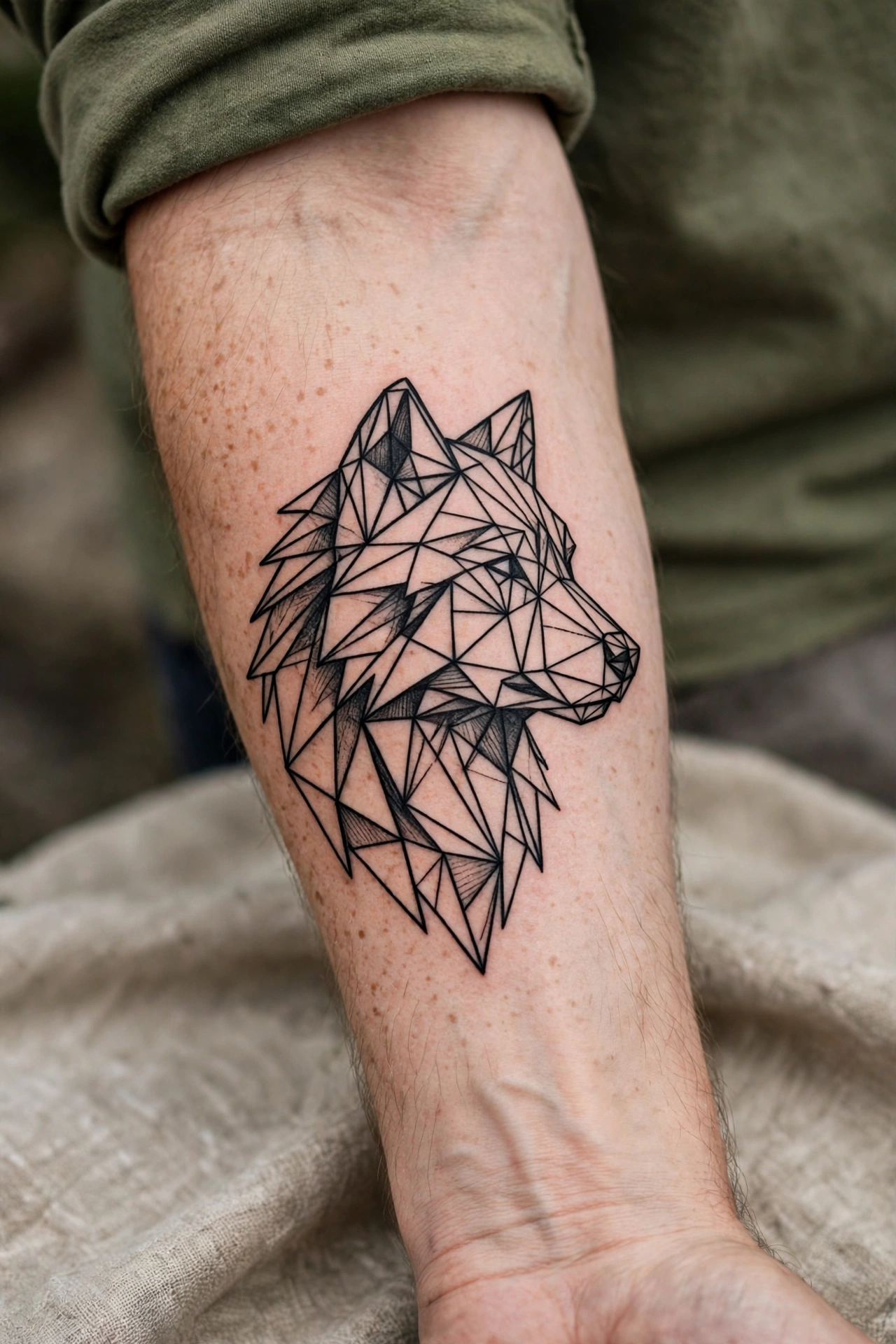
The most popular wolf placement, for good reason. A medium wolf head or a howling wolf fits the forearm’s shape naturally, it is easy to show and easy to cover, and it heals well. Pain is around 3/10. The forearm also lets you build: a wolf now, a moon above it later, a forest scene growing over years. If you are not sure where to start, start here. Browse our placements guide to compare it against the spots below.
Upper arm and shoulder
The shoulder’s curve suits a wolf head beautifully — the snout can follow the muscle, the ears can sit near the top, and the whole piece moves naturally with the arm. Pain is gentle, around 2–3/10. This is a great spot for a first large wolf, especially a realistic portrait, because the flat-ish area on the outer arm gives the artist room to work without fighting a tricky curve.
Chest
A wolf across the chest reads as bold and protective — the animal guarding your heart, if you like that symbolism, or simply a big, confident statement piece. Pain is higher here, roughly 4–5/10, more near the sternum and collarbones. Chest wolves suit people who want the piece visible in summer and don’t mind it being a conversation starter. One practical note: chest pieces stretch and shift more than arm pieces over a lifetime, so bold lines and solid shading age better here than ultra-fine detail.
Back
The back is where the epic wolf scenes live: a pack crossing a ridge, a lone wolf on a mountain under a huge moon, a full forest scene. Pain on the upper back is mild (3/10), rising near the spine and shoulder blades (5/10). The trade-off is obvious — you can’t see it without a mirror — but for a piece this size, that is often the point. It is a private landscape, not a billboard.
Calf and thigh
Calves suit vertical howling wolves perfectly, and the pain is mild (3/10). Thighs suit the biggest, most detailed work — realistic portraits, family scenes, full landscapes — with the gentlest pain of any large placement (2–3/10) and easy concealment. Thigh wolves also age well, because the skin there sees less sun and moves less than arms do. If you want a wolf you can stare at in detail for years, the thigh is hard to beat.
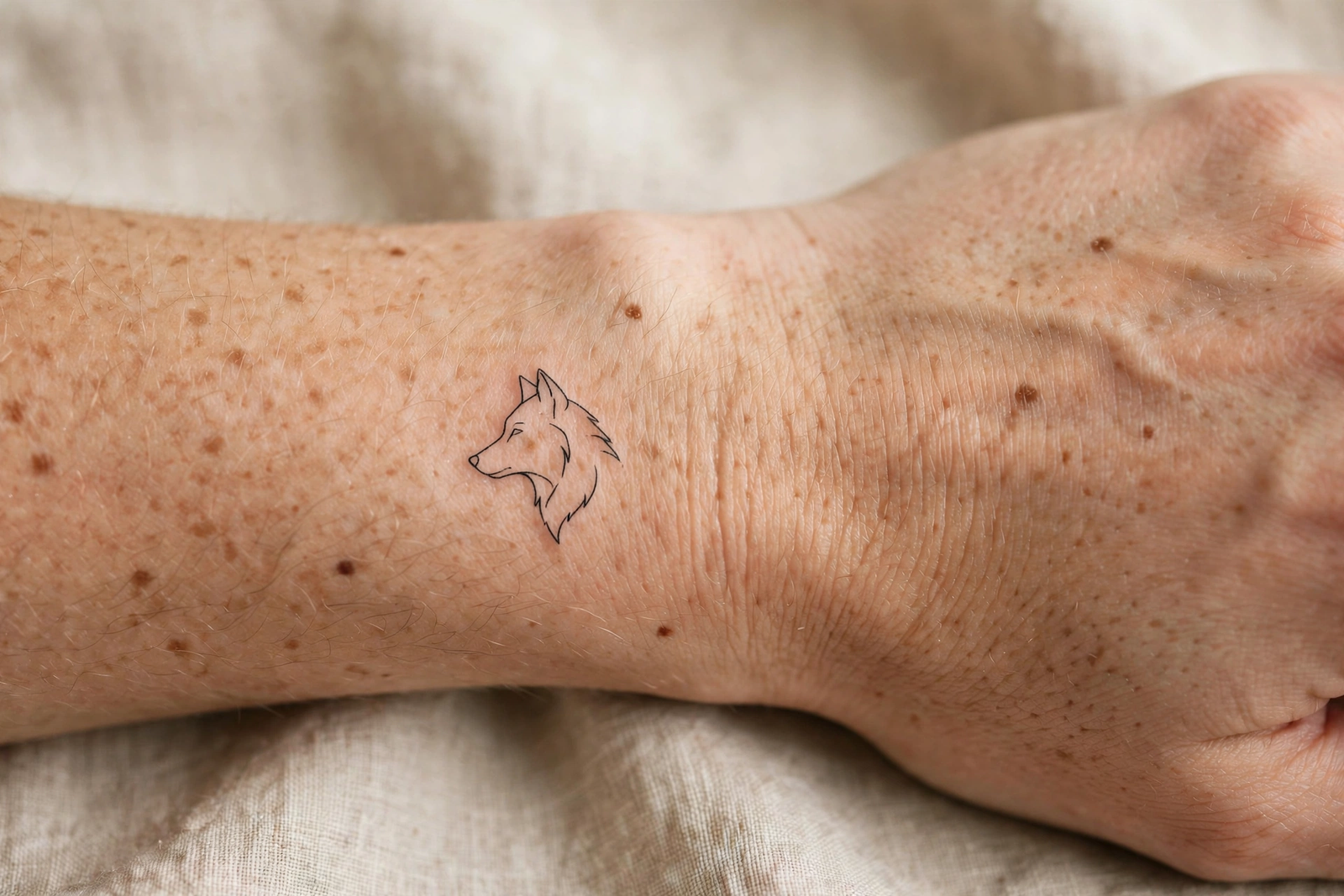
Hand, wrist, and smaller spots
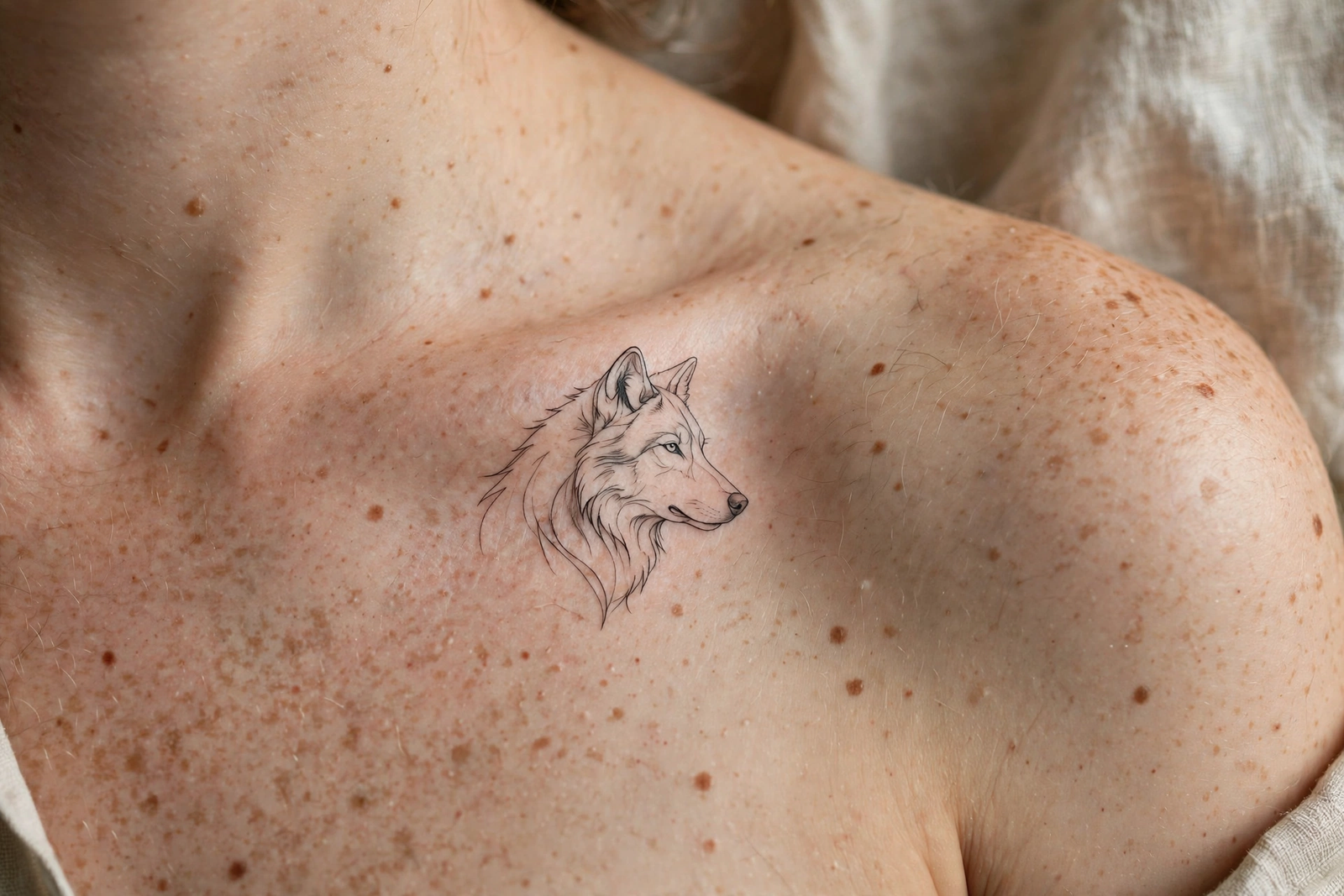
Can you get a small wolf on a wrist or hand? Yes, but keep it simple: a minimal outline, a paw print, a tiny geometric head. Detail at this size is a promise your skin can’t keep, and hands in particular fade and blur faster because of constant use and washing. Pain on the hand is sharper (5–6/10), and hand tattoos can complicate some jobs. A small wolf here works best as a symbol, not a portrait — the idea of the wolf, worn where you can glance at it daily.
Wolf Tattoo Styles Compared
Style is not just a look; it is a decision about how your tattoo will age, how much it will cost, and how it will read from a distance. Here is the honest comparison we give people across the counter.
Realism is stunning and demanding. It needs a specialist artist, a larger canvas, and a higher budget, and it rewards you with a wolf that looks alive. It also needs touch-ups sooner than bolder styles, because fine fur detail softens over time. If you choose realism, budget for a touch-up in five to eight years and wear sunscreen religiously.
Blackwork — solid black, bold shapes, sometimes with dotwork shading — is the workhorse. It reads clearly from across the room, ages superbly, and suits both howling wolves and geometric designs. If you want a wolf that still looks sharp at sixty, blackwork is a very safe bet.
Traditional brings bold outlines and a limited colour palette, often with a snarling or stoic wolf face. It has a vintage, storybook punch that suits people who like their tattoos to look like tattoos, not photographs. It also covers old work well, if you are layering a wolf over something you have outgrown.
Fine-line is delicate and modern: thin lines, minimal shading, elegant rather than imposing. Beautiful on forearms and collarbones, but fragile — fine lines spread, and a fine-line wolf needs enough size and a skilled hand to survive a decade looking crisp. Our tattoo styles guide breaks down how each style ages, if you want to dig deeper before booking.
Size, Cost and Pain — Honestly
Prices vary wildly by city and artist, but these ranges are a fair starting point for the US and UK. Always get a quote from your actual artist — a famous realism specialist and a local walk-in shop are not charging the same rate, and neither is wrong.
Small (3–5 cm): a minimal wolf outline, paw print, or tiny geometric head on the wrist or ankle. Cost: roughly $80–$150, often the shop minimum. Pain: mild except on the hand or foot.
Medium (8–15 cm): a wolf head or howling wolf on the forearm, shoulder, or calf, with some shading or background. Cost: roughly $150–$400. Pain: 3/10 on the forearm and calf, a little more on the shoulder blade.
Large (15 cm+): a realistic portrait, pack scene, or full landscape on the chest, back, or thigh. Cost: roughly $400–$1,000+, and multi-session realism can run well beyond that. Pain: 3–5/10 depending on the spot, with bony areas stinging more.
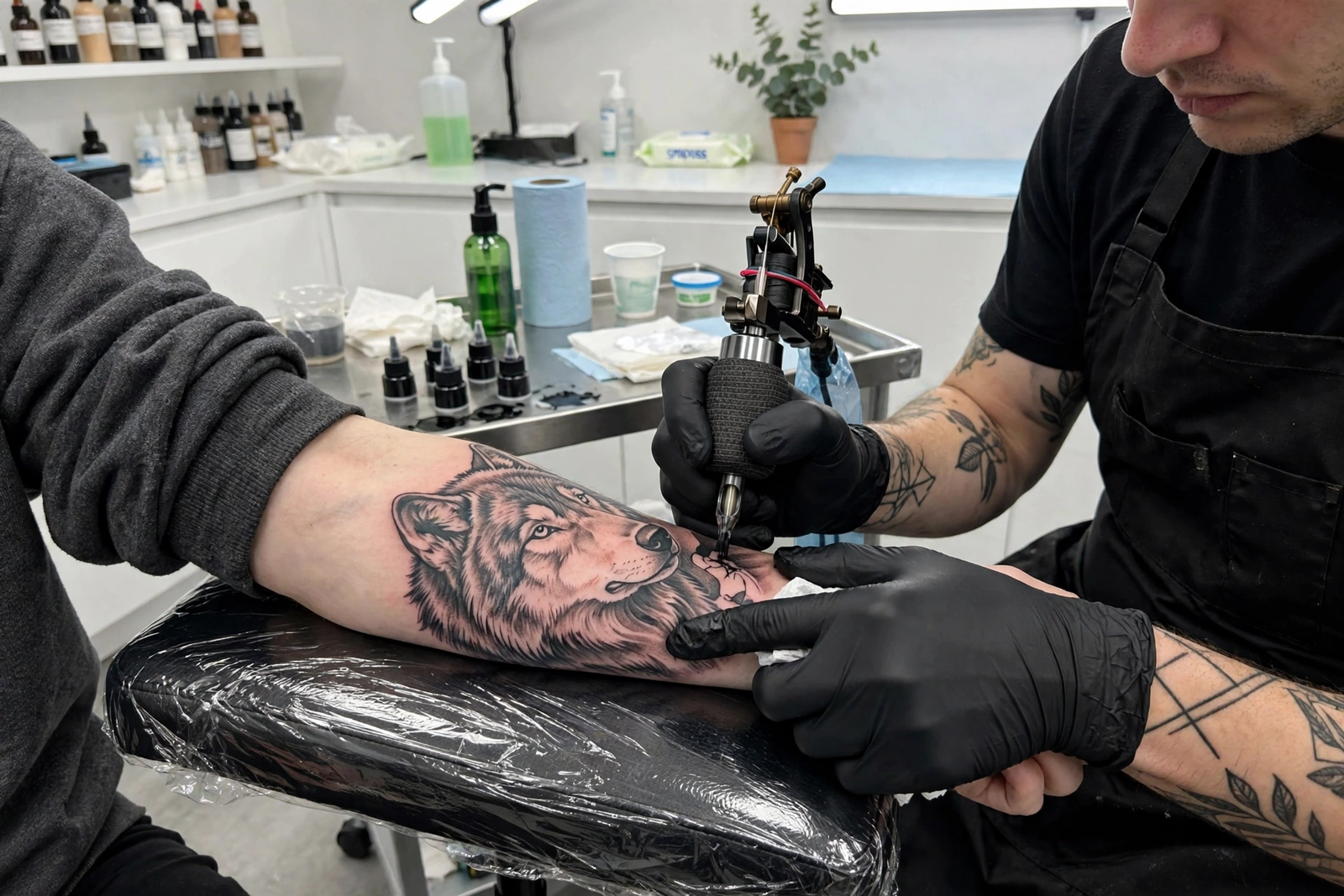
One thing people underestimate is session length. A large realistic wolf is not a lunch-break tattoo. It can take four to eight hours, sometimes split across sessions, and the shading phase — the part that makes fur look like fur — is slow, repetitive work. Bring water, eat beforehand, and don’t book anything important afterwards. Your artist will thank you, and so will your skin.
Choosing an Artist for a Wolf
Wolves punish sloppy work more than most animals. The face is symmetrical, the eyes have to match, the fur has to flow in one direction, and a snout that is slightly off makes the whole animal look wrong in a way people notice without knowing why. So this is not the tattoo to get from whoever has a free slot on Saturday.
Look at healed work, not just fresh photos. Fresh tattoos always look sharp; healed tattoos tell you whether the lines held, whether the shading stayed smooth, and whether the eyes still look alive after a year. Ask specifically: “Do you have a healed wolf I can see?” A good wolf artist will have one and be proud to show it. If they only show fresh work, or if their wolves all look like slightly different dogs, keep looking.
Bring references of real wolves, not just other people’s tattoos. A photo of a grey wolf in snow, a timber wolf mid-howl, a wolf pup — these tell your artist what animal you actually mean. Tattoos of tattoos drift further from the real animal each time, like a photocopy of a photocopy. Start from the source.
And talk about expression before the needle starts. Do you want your wolf calm or snarling? Looking at the viewer or looking away? Howling or silent? These choices change the whole feeling, and they are much easier to change on paper than on skin. A fifteen-minute conversation here saves years of “it’s fine, I guess.”
I’ll never forget watching a friend’s wolf stencil go on. The artist stuck it on his forearm, stepped back, and it looked fine — until my friend twisted his arm the way he actually holds a steering wheel, and suddenly the wolf’s head tilted at a daft angle, like it was listening to a joke. They shifted it barely two centimetres, turned it a fraction, and the whole animal came alive again. That’s the lesson: never approve a stencil while you’re standing stiffly to attention. Bend the arm, walk a few steps, check it in the mirror from a normal distance, not nose-to-glass. A good artist expects this fiddling and will offer it without being asked. If someone rushes the stencil stage, that’s your cue to slow the whole appointment down.
Wolf Tattoos for Different Stories
Not every wolf means the same thing, and it helps to see the range before you settle. Here are the stories we hear most, and the designs that fit them.
For a parent or guardian
A mother wolf with cubs, or a large wolf standing protectively in front of smaller ones. The message is protection, not sentimentality — the wolf that would do anything for its young. Thigh or back placements give this scene the room it needs.
For someone who left and made it
A lone wolf on a ridge, or a wolf walking away from a forest toward open ground. The story is not “I am alone” but “I chose my own direction.” Keep the landscape open — sky, distance, a path — rather than closed and dark.
For a sibling group or close friends
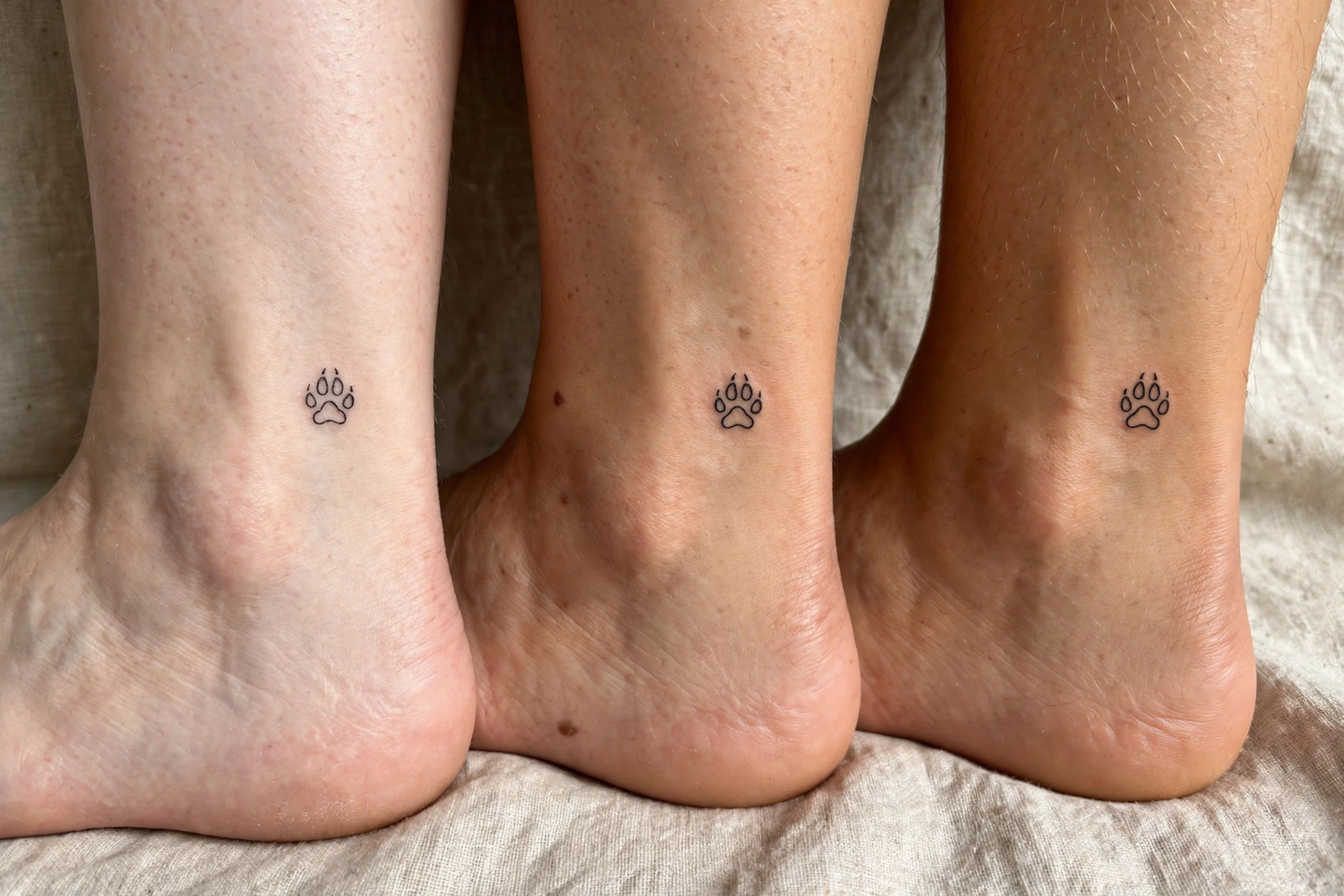
A line of wolves, one for each person, or matching wolf paws. Some groups get the same small wolf in different placements; others get one big pack piece split across… no, one big pack piece each, with a detail that ties them together. Either way, agree on the design together, and make sure each person’s version works on its own too. Friendships change; good tattoos survive that.
For grief and remembrance
Wolves appear in memorial tattoos more than people expect, often for someone who was fiercely loyal or fiercely independent — or both. A wolf with a single star, a date woven into a forest scene, or a wolf looking toward a moon that represents the person lost. Keep it restrained. Grief tattoos carry enough weight without extra decoration, and restraint ages with dignity.
For a fresh start
A wolf at dawn, or a wolf stepping out of shadow into light. The dawn version is hopeful without being naive: the night happened, the wolf survived it, and now it is moving. Watercolour dawn skies suit this story beautifully, provided there is a solid outline underneath.
Aftercare in Brief
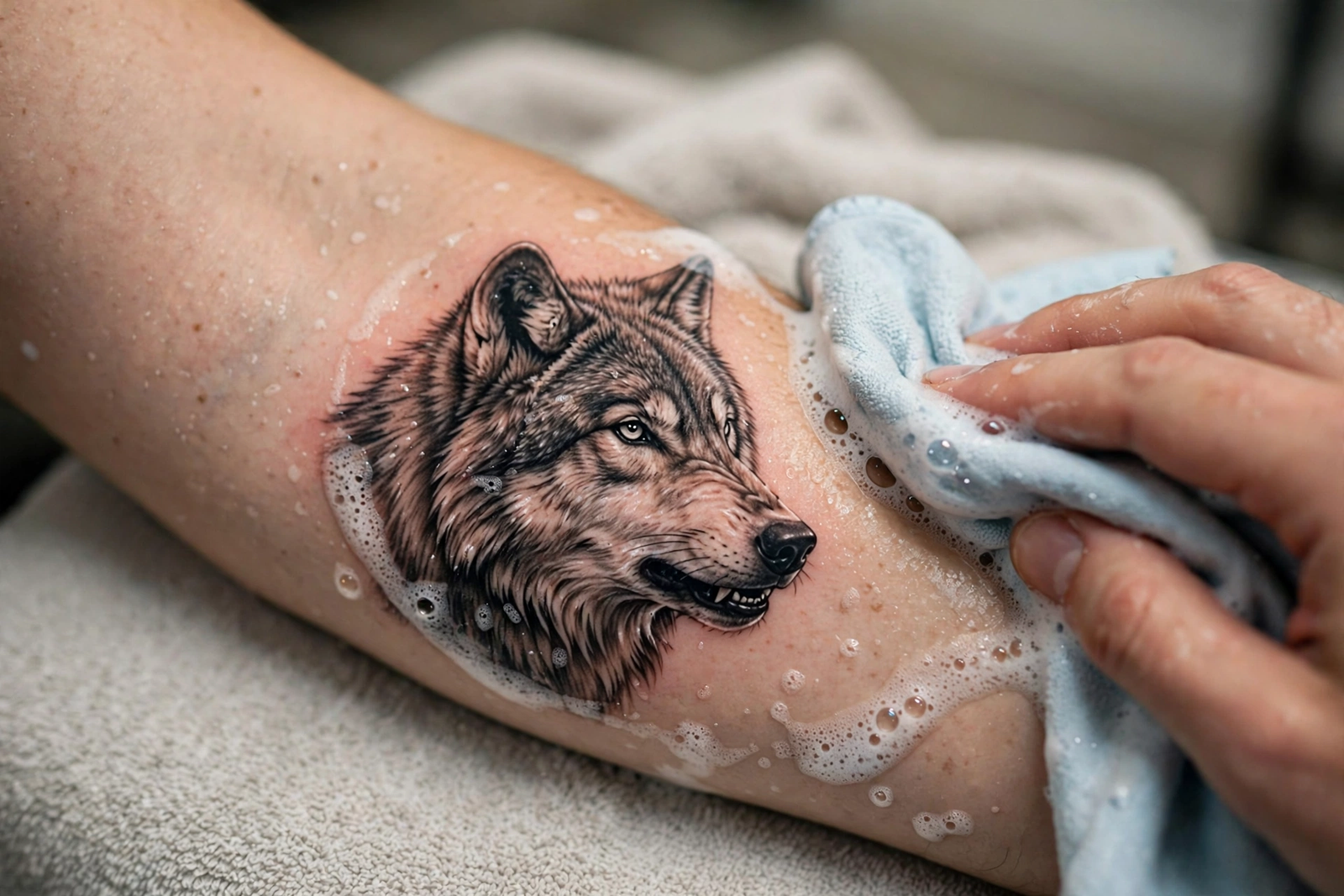
Wash gently twice a day with mild soap, moisturise thinly — thin, greasy is not better — don’t pick the flakes, and keep it out of pools, baths, and direct sun while it peels. Wolf fur detail shows fading faster than bold traditional work, so sunscreen after healing isn’t optional. It is the difference between a wolf with texture and a grey shape in five years. The full day-by-day routine is in our tattoo aftercare guide, and our tattoo ideas library can help if you are still narrowing the design.
Frequently Asked Questions
What does a wolf tattoo mean?
Loyalty, freedom, and family. Wolves are devoted to their pack and fiercely independent at the same time, so a wolf tattoo usually honours one side of that tension — or both.
What does a lone wolf tattoo mean?
Independence, self-reliance, and walking your own path. It can celebrate chosen solitude or mark a period of being alone and surviving it. The posture matters: a wolf looking out reads as thoughtful, a wolf howling reads as defiant.
What does a howling wolf tattoo mean?
Finding your voice, calling your people, and refusing to stay silent. The howl is communication across distance, so it often marks a moment of speaking up or reconnecting.
Is a wolf tattoo aggressive?
It doesn’t have to be. A calm or watchful wolf reads as loyalty and protection; a snarling wolf reads as ferocity and defiance. Most wolf tattoos people actually get are calm, watchful, or howling — not snarling.
What does a wolf and moon tattoo mean?
Instinct, cycles, and guidance in the dark. The moon gives the wolf its light source and layers in change and intuition on top of loyalty and freedom.
Where is the best placement for a wolf tattoo?
The forearm for a medium wolf head or howling wolf, the thigh or back for large detailed scenes, and the shoulder for a portrait. Wolves need room, so match the size to the spot and don’t squeeze a portrait into a tiny space.
How much does a wolf tattoo cost?
Small minimal wolves run about $80–$150; medium pieces $150–$400; large realistic or pack scenes $400–$1,000 or more, depending on the artist and the hours involved.
Do wolf tattoos fade quickly?
Bold blackwork and traditional wolves age very well. Fine-line and realistic fur detail soften sooner, especially in sun-exposed spots — sunscreen and a touch-up every few years keep them sharp.
Run With Your Own Pack — Or Alone, Proudly
Here is the thing I keep coming back to with wolves. Most tattoo symbols ask you to pick one meaning and stick to it. The wolf refuses. It says you can be loyal and free, devoted and independent, part of a pack and entirely yourself, all at the same time. That is not a contradiction. That is just what a real life looks like, if you are lucky.
So choose your wolf like you mean it. Lone or pack, howling or silent, realistic or geometric — make it specific, give it room, and find an artist whose healed wolves you would trust with your own story. The man at the bus stop in Leeds had it right, rain and all. His pack was his daughter. Yours might be family, friends, a partner, a version of yourself you fought to become, or simply the wild part of you that refuses to be tamed. Whatever it is, a wolf carries it well.
Still deciding between animals? Our tattoo meanings library covers owls, moths, and more, and the styles guide will help you match your wolf to the style that will age best on your skin.
Leave a Reply