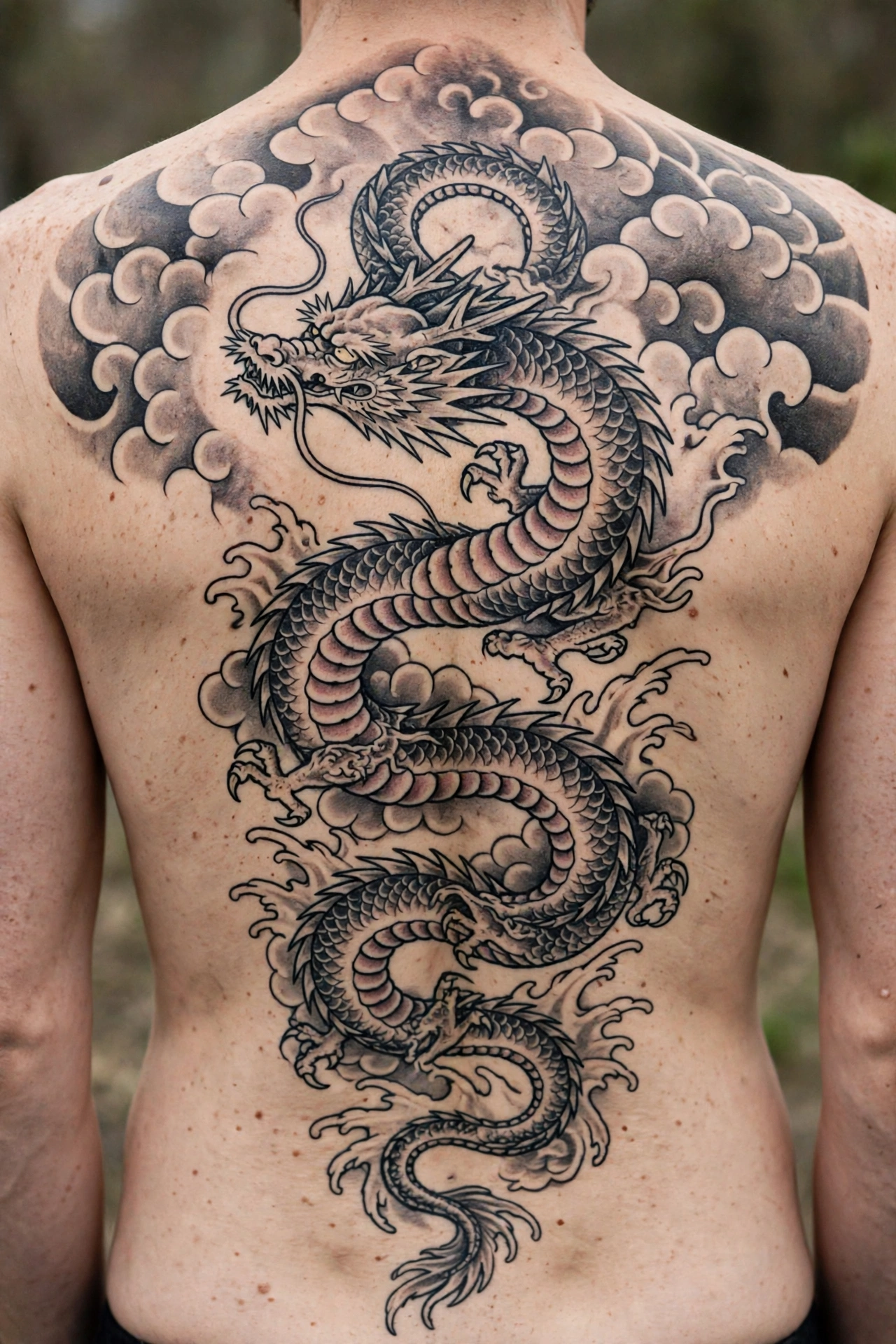
Quick answer: A dragon tattoo means power, good luck, protection and wisdom — but ask ten people and you will get ten different dragons. In China the dragon brings rain and fortune, and emperors claimed it as their own. In Japan it guards water and balances wild strength with discipline. In the West it hoards gold in a cave and waits to be slain. Same word, almost opposite stories. Before you pick a dragon, pick a culture. That one choice decides what your tattoo actually says.
I learned that the embarrassing way. Years ago I walked into a studio with a printout of a dragon I thought looked cool — big wings, fire, the full medieval package — and told the artist I wanted it because dragons meant luck. He put his pencil down, very politely, and said, “That one doesn’t mean luck. That one means you’re about to get eaten.” He was right. The dragon I had picked was a Western fire-breather, the kind knights kill in stories. The luck dragon I was thinking of was Chinese, long and serpentine, no wings at all, swimming through clouds. Two completely different animals wearing the same name. I went home, did the reading I should have done first, and came back a week later with a much better idea. If you are reading this before your appointment, you are already ahead of where I was.
So here is the full story, the way we would tell it across a studio counter: what a dragon tattoo means culture by culture, what the colours change, which designs actually work on skin, where to put a long winding body, what it costs, how much it hurts, and how to pick an artist who can genuinely draw a dragon rather than just trace one.
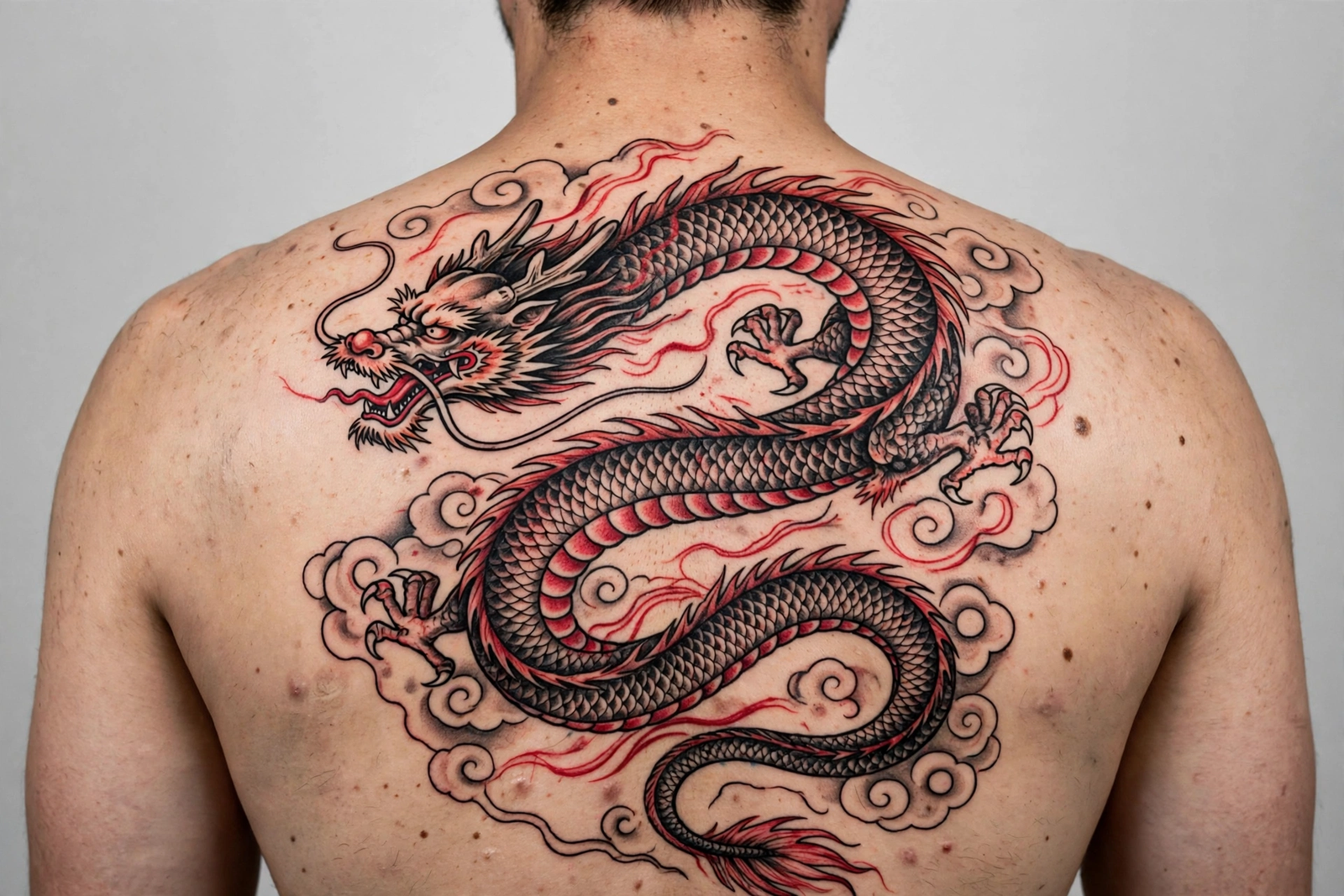
What Does a Dragon Tattoo Mean?
Strip away the details and, in almost every culture that has one, a dragon stands for power bigger than ordinary life. Not gym power or boss power. The kind of power that moves weather, guards treasure, rules rivers or ends kingdoms. When someone gets a dragon tattoo they are usually claiming a piece of that, or asking for its protection. But the flavour of that power changes wildly depending on where your dragon comes from, and that is where most people trip up.
The Chinese dragon: luck, rain and imperial power
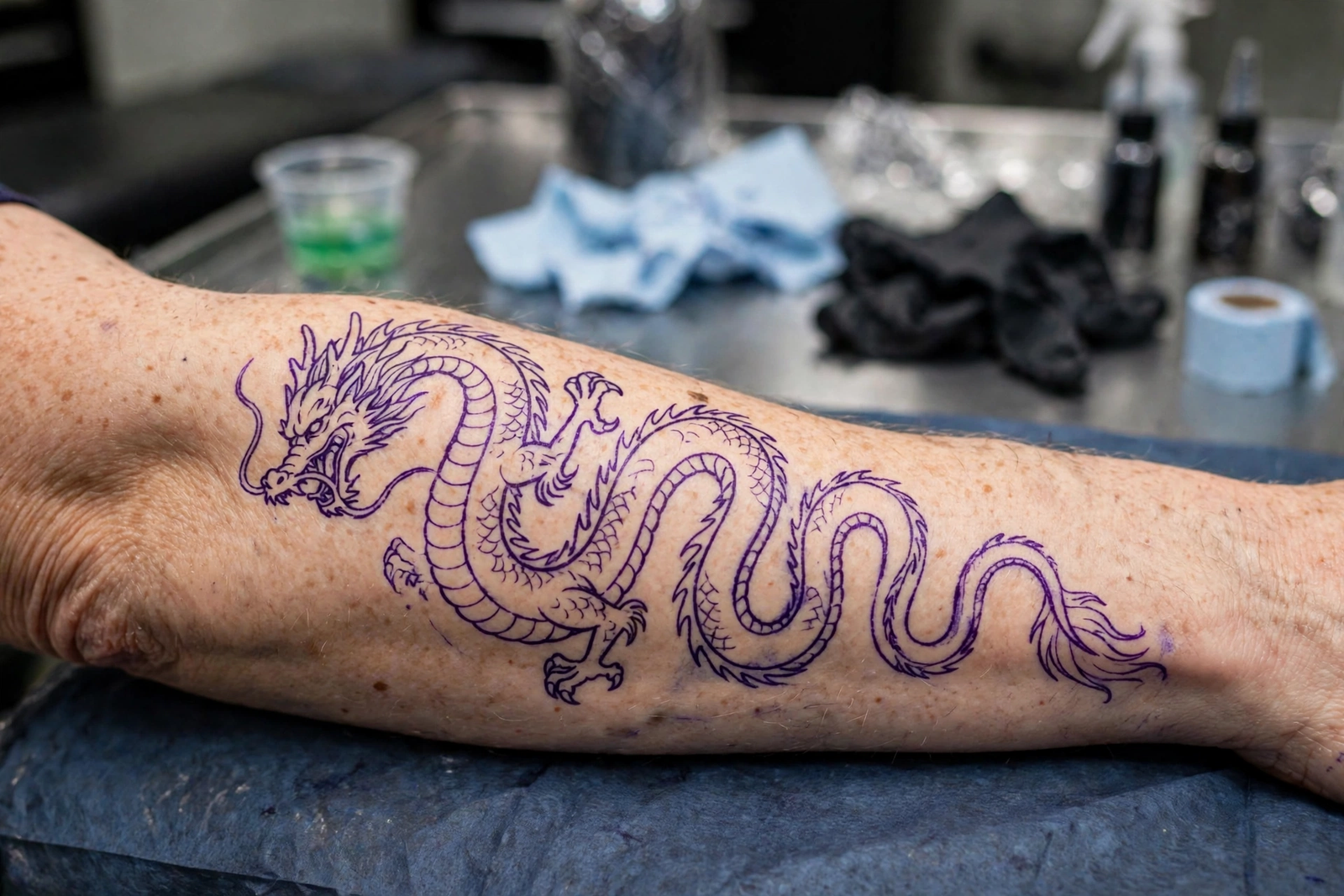
The Chinese dragon, the long, is the oldest and most tattooed dragon in the world, and it is almost entirely good news. It has no wings. It flies anyway, because it rides wind and cloud. It controls rain, rivers and seas, which in a farming country meant it controlled whether people ate. Emperors put five-clawed dragons on their robes — commoners were forbidden from using five claws, which tells you how seriously this symbol was taken — and ordinary people prayed to dragons for rain in drought and thanked them after a good harvest.
A Chinese dragon tattoo usually means good fortune, strength, wisdom and protection, with a strong undercurrent of ambition. People get them at turning points: a new business, a move abroad, a degree finished against the odds. I know a man who got a red Chinese dragon on his ribs the week he opened his restaurant. He told me, only half joking, that he wanted something on his side that was luckier than he felt. Three years on the restaurant is still open, and he still touches the spot when he talks about the early months. Is that the dragon working? Who knows. Did it help him believe he could survive those months? He says yes, and honestly, that is enough.
Direction matters in traditional Chinese art, by the way. A dragon climbing upward traditionally suggests ambition and rising fortune, while one descending can suggest a blessing coming down. Modern tattooing is looser about this, and most artists outside China will not police it. But if Chinese heritage matters to you, mention it to your artist. A good one will know, or will look it up with you.
The Japanese dragon: water, balance and hard-won wisdom
Japanese dragons, ryu, are cousins of the Chinese dragon — long, serpentine, clawed, tied to water — but the Japanese telling adds something the Chinese version softens: danger, kept under control. In Japanese folklore dragons live in rivers, lakes and seas, and they can be generous or terrifying depending on how they are treated. They are not pets. They are forces you respect.
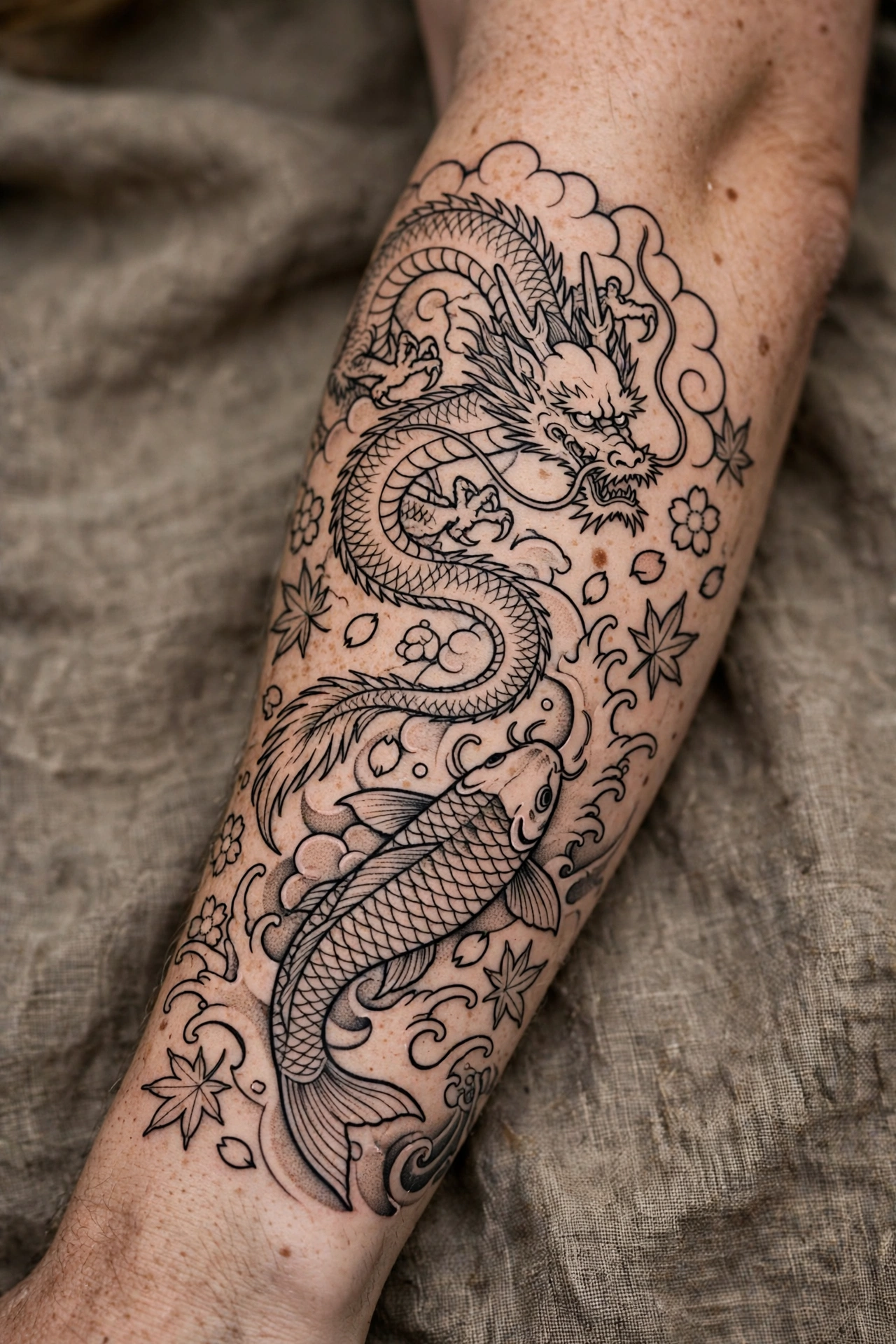
In tattooing that becomes a very particular meaning: strength balanced by wisdom, power that has been earned and disciplined. That is why Japanese dragons show up so often in large back pieces, alongside waves, clouds, cherry blossoms or koi. The dragon is not alone in those compositions. It is part of a world, and the world keeps it in balance. A koi swimming upstream becomes a dragon at the top of the waterfall, in the old legend, which is why you will see koi and dragons paired so often. The story is literally about effort turning into power. If you have ever worked for years toward something and finally got there, you can see why that pairing hits home.
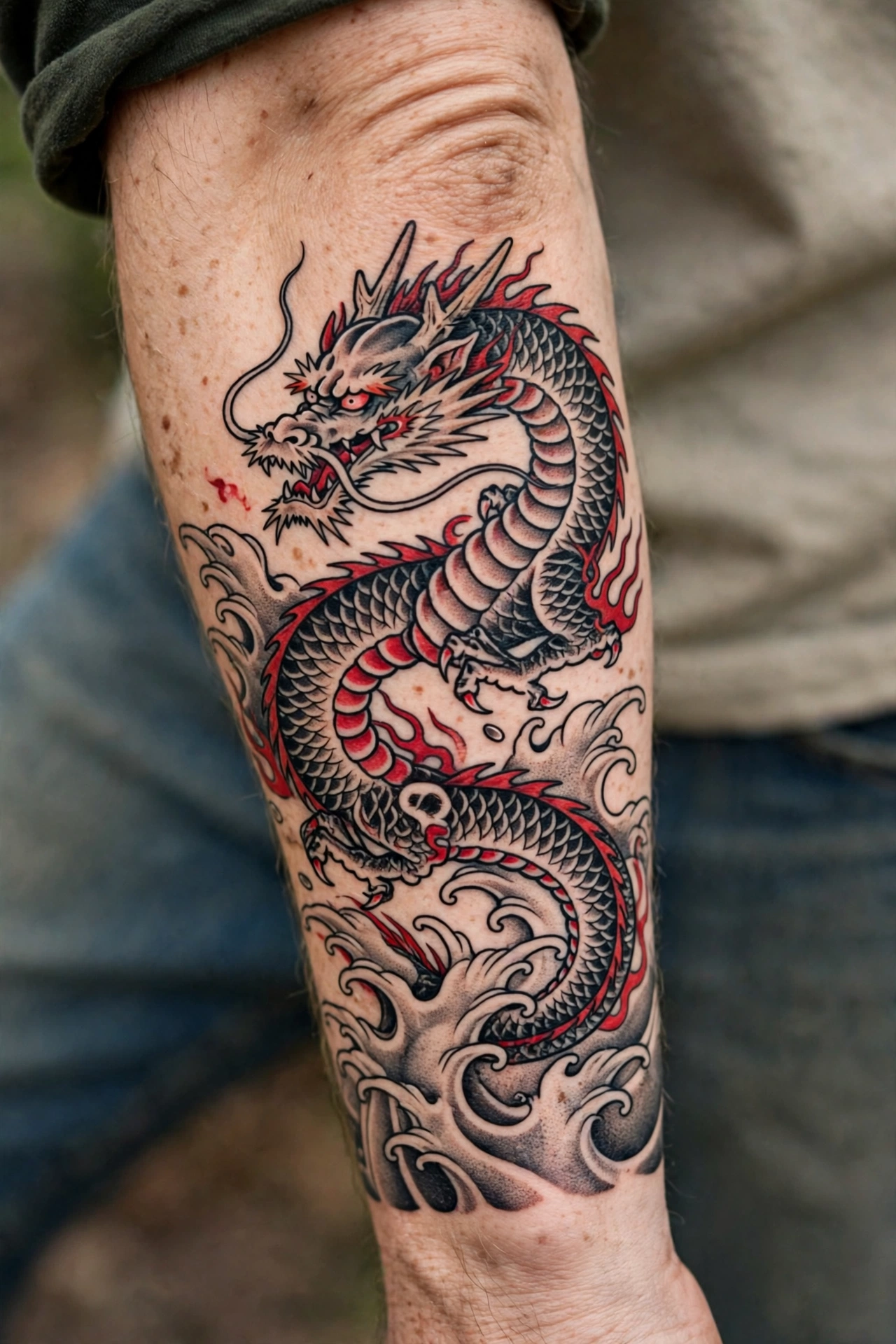
The Western dragon: treasure, fire and the fight
Now the dragon most of us grew up with in Europe and North America. Big bat wings, four legs, breathes fire, sleeps on a pile of gold, and sooner or later a knight shows up to kill it. In medieval stories the Western dragon is greed, destruction and chaos — the thing a hero proves himself against. That sounds like a strange thing to tattoo on yourself, until you flip it around, which is exactly what a lot of wearers do.
Some people get a Western dragon because they are the dragon in their own story. Not the villain, exactly, but the person who refuses to be small, polite and easy to manage. The one guarding something precious — family, work, boundaries — and willing to breathe fire if anyone comes for it. Others get one because they slayed their own dragon: addiction, an illness, a bad marriage, a period of life they had to fight their way out of. The dragon on their skin is the thing they beat, worn as proof. Same image, opposite reading, and both are honest.
Western dragons also carry a fantasy weight Eastern dragons mostly do not. If you grew up on Tolkien or on long-running fantasy television, a Western dragon might be nostalgia as much as symbolism. That is fine. Tattoos are allowed to be about love for a story. Just know the split: show a Chinese dragon fan your Western fire-breather and they will read menace where you meant magic.
The Welsh dragon and other local dragons
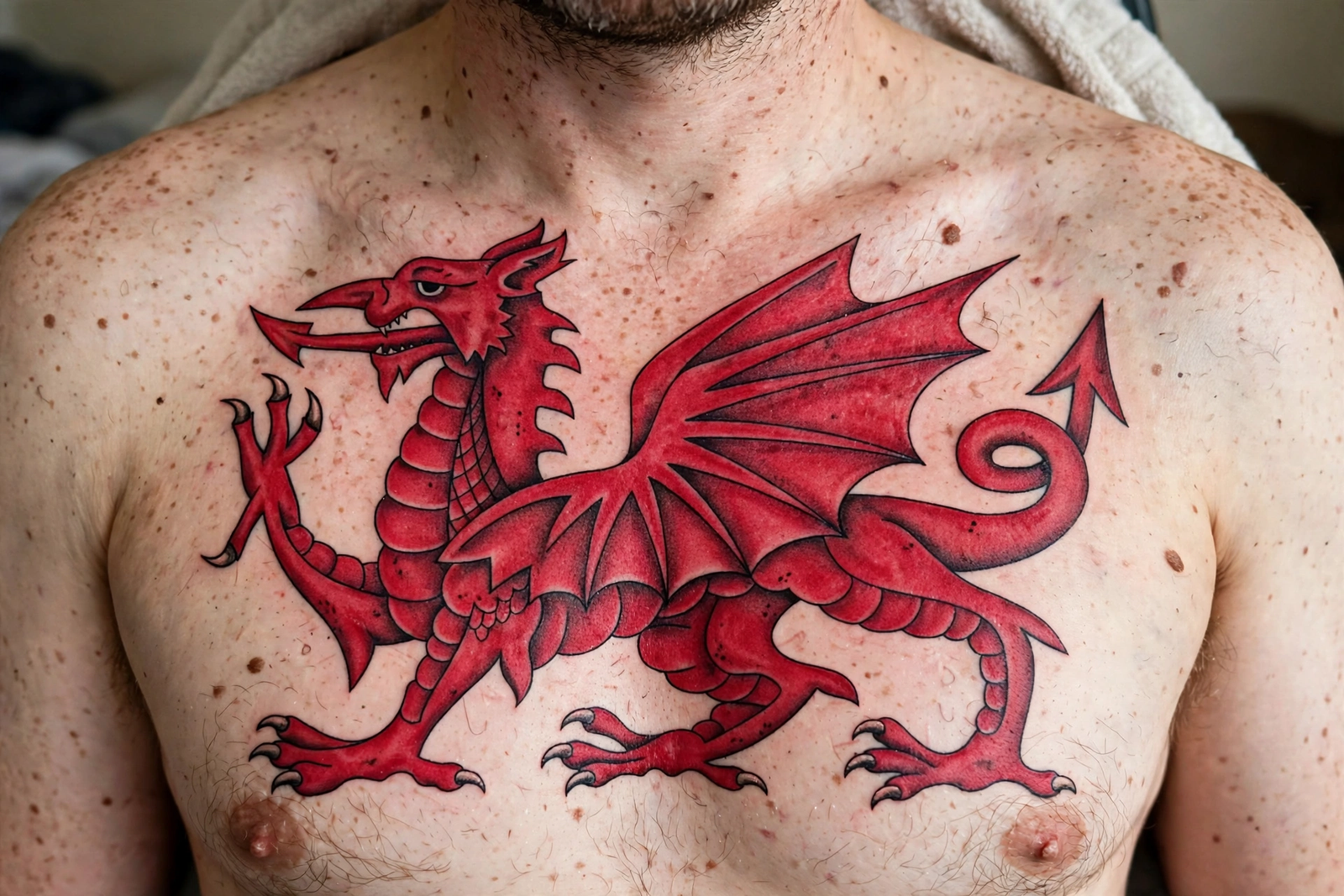
Do not forget the smaller traditions, because for some people they are the whole point. The red dragon of Wales, Y Ddraig Goch, has been on Welsh banners for centuries and stands for Welsh pride, courage and identity. If you are Welsh, or your family is, a Welsh dragon tattoo is not a generic fantasy choice. It is a flag you wear. Elsewhere you find Norse dragons on Viking ships and in sagas, the feathered serpent Quetzalcoatl of Mesoamerica, and the water dragons of Korean and Vietnamese art, close cousins to the Chinese long but with their own details. If any of these is your heritage, find an artist who knows that tradition specifically. A generic “Asian dragon” from a flash sheet can mash together Chinese, Japanese and Korean details into something that belongs nowhere.
What Colour Is Your Dragon? It Changes the Meaning
Colour is not decoration on a dragon tattoo. In the Eastern traditions especially, colour is half the message. Pick a colour that fights your meaning and you will spend years explaining yourself.
Red dragons: passion, luck and fierce protection
Red is the most popular dragon colour in tattooing, and for good reason. In China red means luck, joy and celebration. A red dragon doubles down on that: passionate, lucky, fiercely protective. It is also the boldest choice visually. Red ink pops on most skin tones and holds up well when it is done with enough saturation. If you want a dragon that announces itself, red is your colour. Just know it announces itself. A red dragon is not a quiet tattoo.
Black dragons: wisdom, experience and the unknown
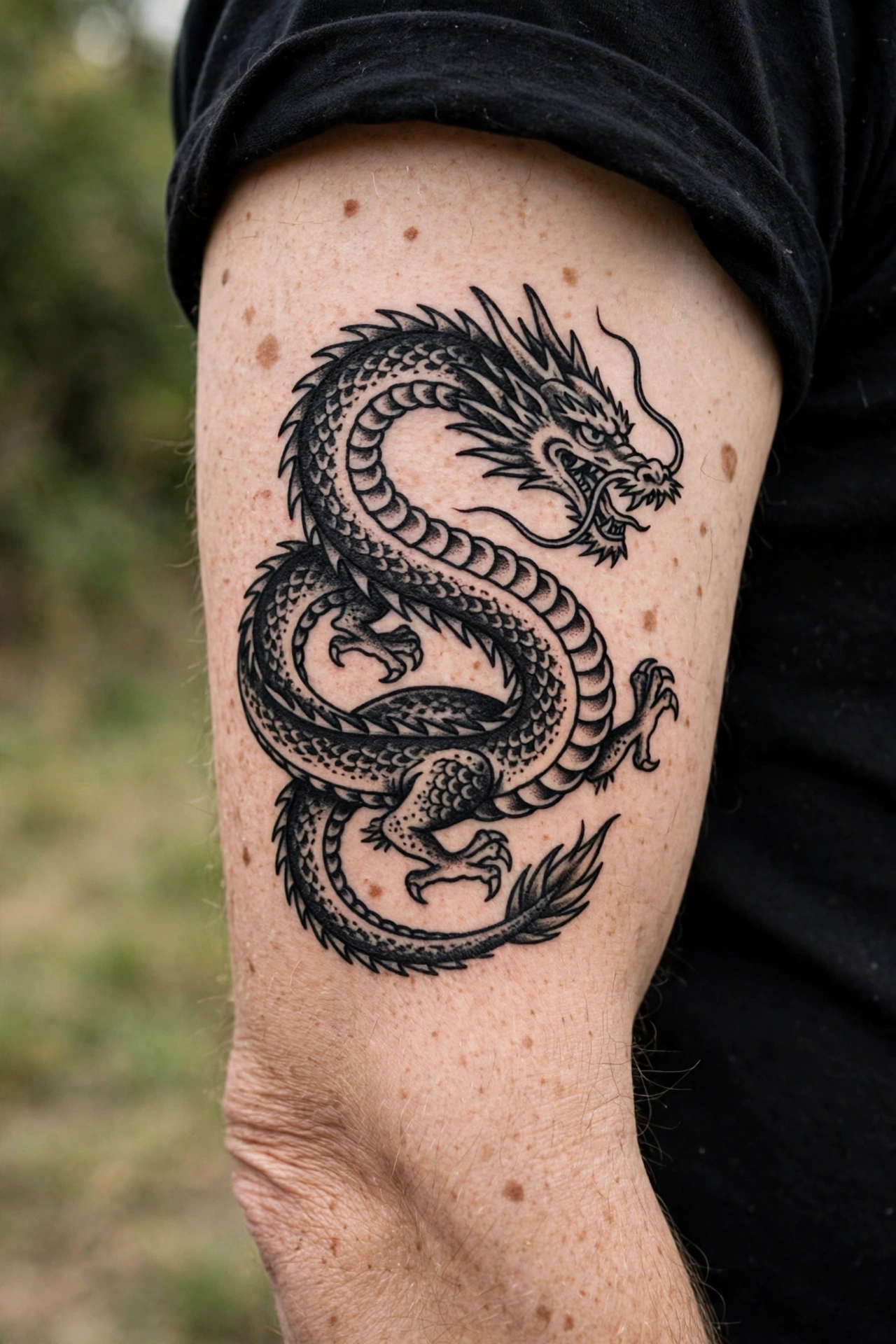
Black dragons are the quiet ones, and I have a soft spot for them. In Chinese tradition the black dragon is tied to the north, winter and deep water — the dragon of experience, of things learned the hard way, of wisdom that does not need to shout. In tattooing, black dragons also age better than any colour dragon, because blackwork holds its shape for decades while colours soften. A black dragon says I have been through things and I carry them with me without needing a paragraph to explain it. If longevity matters more to you than brightness, start here.
Gold dragons: wealth, wisdom and nobility
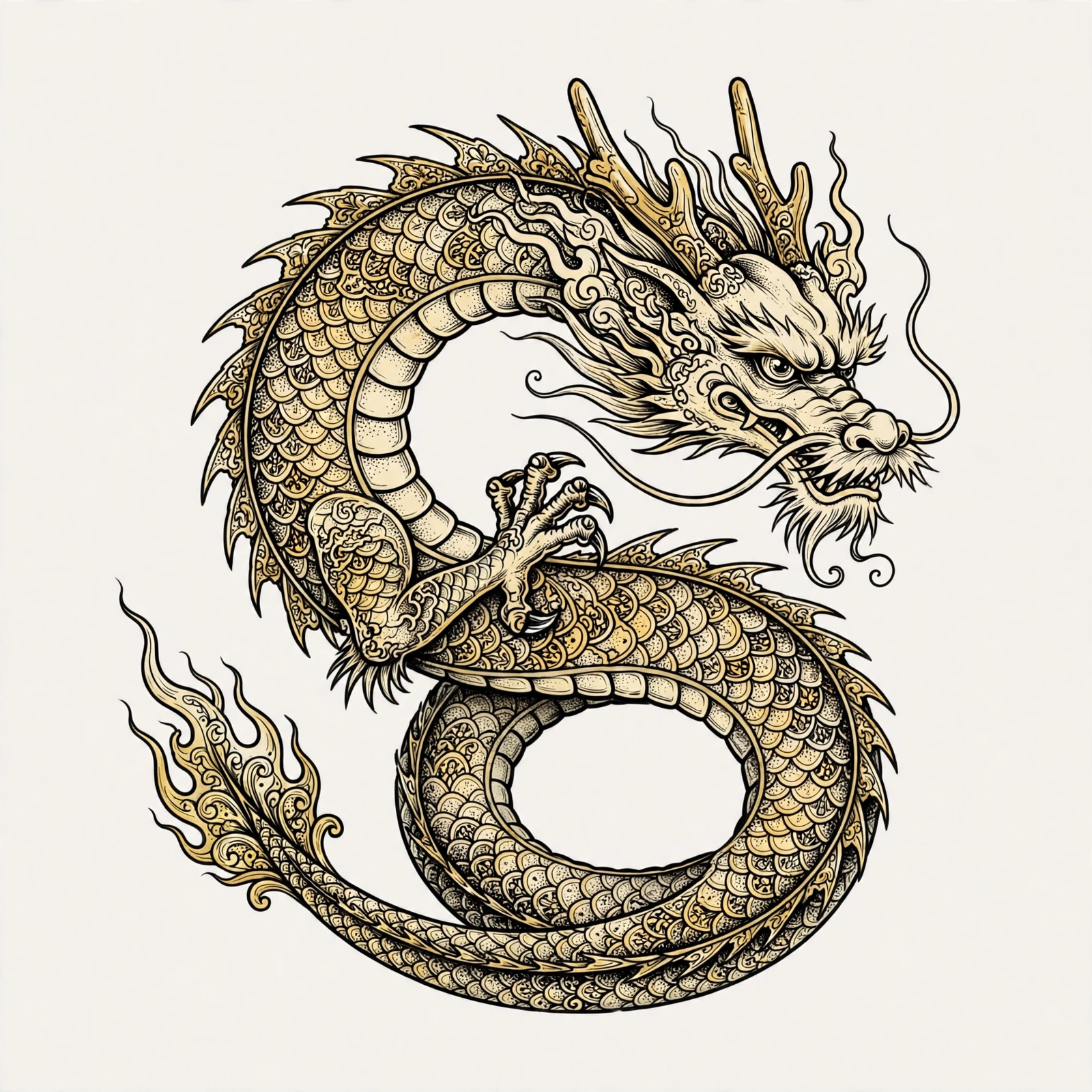
Gold dragons sit at the top of the old hierarchy. Yellow was the emperor’s colour in China, and a gold dragon suggests prosperity, nobility and generous wisdom — wealth used well rather than hoarded. Gold ink is tricky, though, and any honest artist will tell you so. True metallic gold does not exist in tattoo ink the way it does in paint. Artists fake the glow with yellows, oranges and careful shading. Done well it looks rich. Done cheaply it looks mustardy. If you want gold, pay for an artist who can show you healed gold work, not just fresh photos.
Green and blue dragons: growth and calm
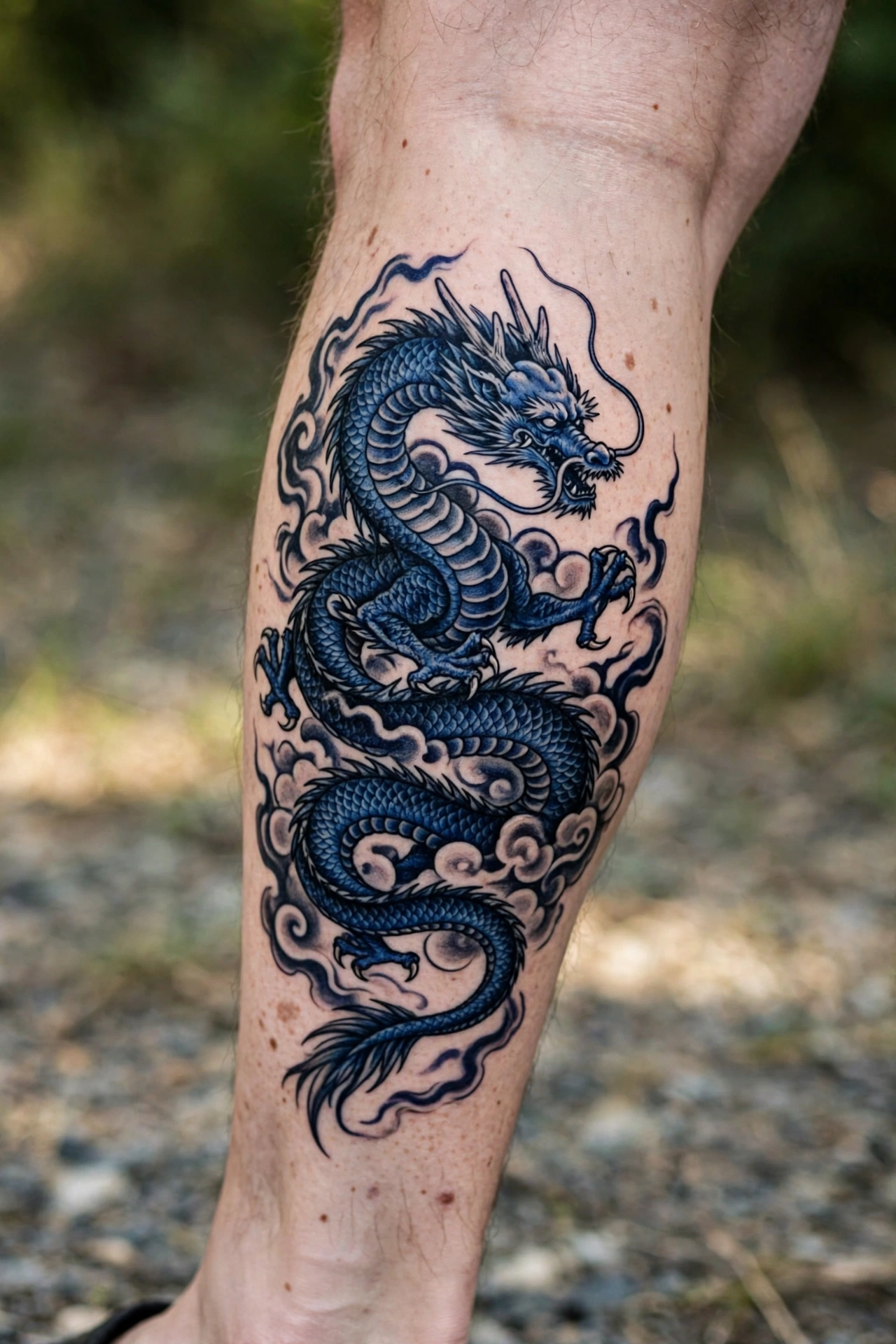
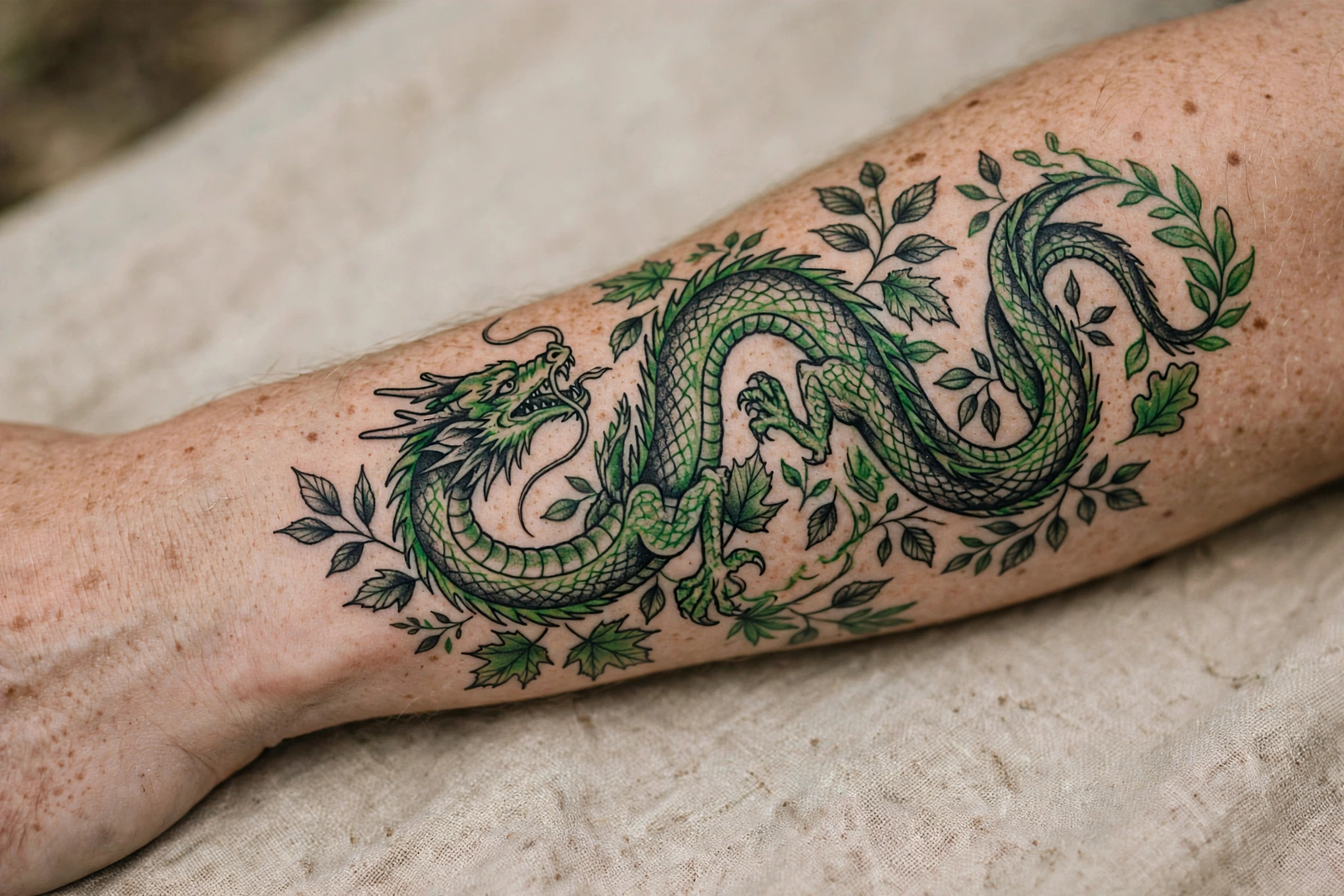
Green dragons belong to spring, forests and growing things. A green dragon leans toward growth, harmony with nature, health and renewal — strength without aggression, a dragon that grows rather than guards. Blue dragons, sometimes called azure dragons, are the calmest of the family, linked to water and sky, and they tend to mean peace, compassion, forgiveness and open-mindedness. A blue dragon is the one you get after the fight is over, when you want to carry power without carrying anger anymore. In practice blue ink can fade faster than black or red, especially lighter blues, so talk to your artist about going a shade deeper than you think you want.
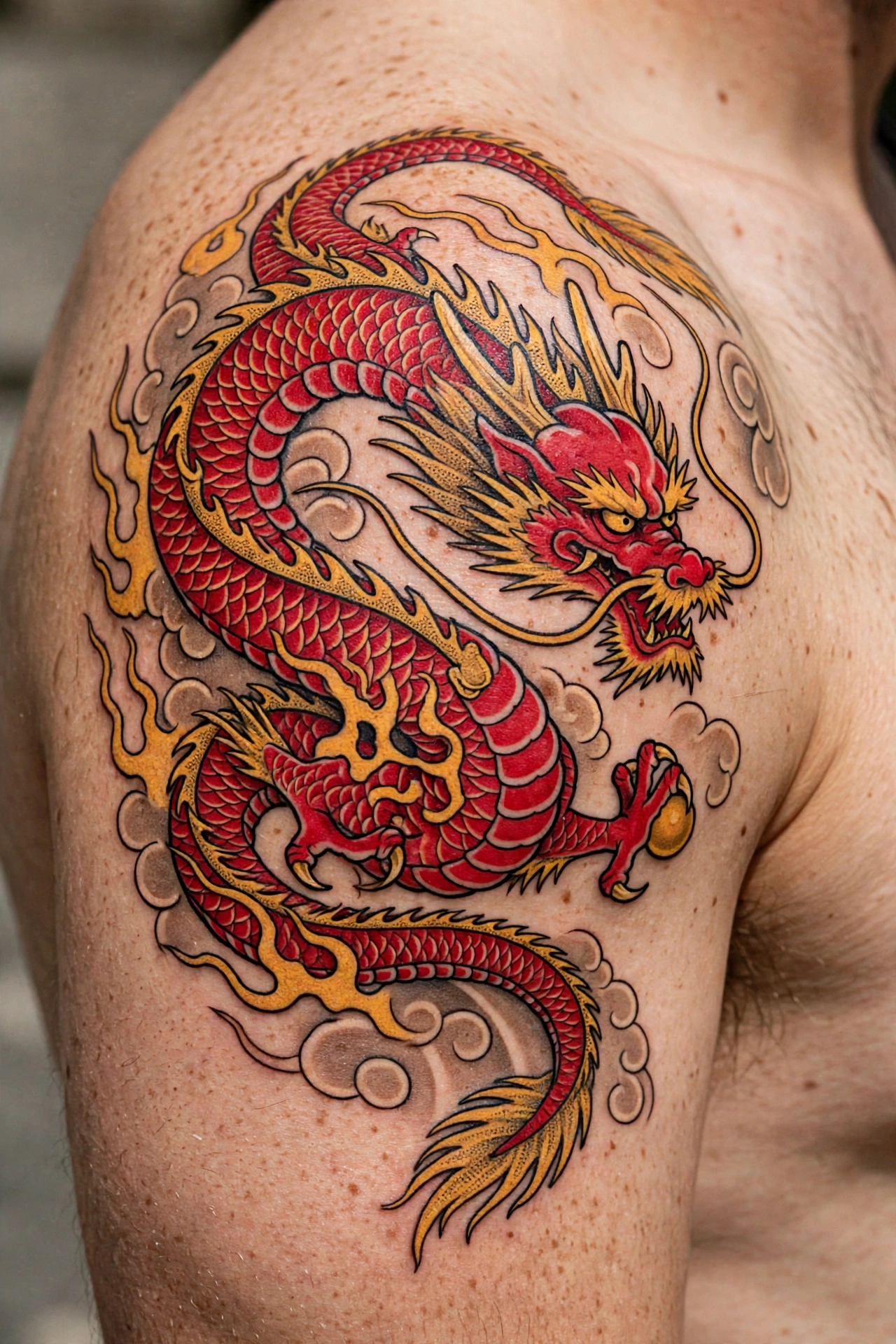
Dragon Tattoo Designs That Actually Work
The full back piece: the dragon’s natural home
If one placement was made for dragons, it is the back. A long serpentine dragon can wind from one shoulder to the opposite hip, head over one shoulder blade, tail curling around the other, with clouds and waves filling the space between. It is the classic Japanese bodysuit panel, and it is classic for a reason: the back is the only flat canvas big enough to let a dragon be a dragon, with room for the body to coil, twist and breathe. The downside is obvious — cost, time and pain over multiple sessions. A full back dragon is not a Saturday impulse. It is a project, often six to ten sessions over months. People who finish one tend to talk about it the way people talk about running a marathon. They are not exaggerating.
The sleeve: dragon wrapping the arm
Arms are the most popular dragon placement in the West, and the design logic is simple: a serpentine dragon wraps naturally around an arm the way it wraps around a pillar in a temple carving. A half sleeve with a dragon head on the shoulder and the body winding down to the elbow is strong and readable. A full sleeve lets you add waves, cherry blossoms, a pearl or a second creature. One practical tip from artists: let the dragon’s body follow the muscle, not fight it. A dragon that flows with the arm looks alive. One that cuts across it at a weird angle looks like a sticker someone slapped on.
Dragon and pearl: wisdom, chased and held
The flaming pearl, sometimes called the pearl of wisdom, is the small ball you see Eastern dragons chasing or holding. It represents wisdom, enlightenment, sometimes the moon itself. A dragon and pearl design says the pursuit of wisdom — not that you have it, but that you are chasing it, which is a much more honest tattoo for most of us. It also solves a design problem: the pearl gives the composition a focal point, a place for the eye to land, which a long winding body on its own sometimes lacks. If your dragon feels like it is wandering, add a pearl.
Dragon and koi: effort becoming power
We touched on this above, but it deserves its own entry because it is one of the most meaningful pairings in tattooing. The legend says a koi that swims upstream and climbs the waterfall at the Dragon Gate becomes a dragon. So a koi and dragon together, or a half-koi-half-dragon in transition, means perseverance, ambition and transformation through effort. It is the tattoo equivalent of a graduation speech that actually means something. People get it after finishing degrees, beating illnesses, building businesses, or leaving situations that took years to leave. If your story is about grinding, not about being born powerful, this is your design.
Dragon head only, and small dragons
Not everyone wants a whole dragon. A dragon head alone — jaws open, whiskers flying, eyes fierce — is a compact way to get the power without the real estate. It works well on the chest, shoulder or thigh. The risk is that a head alone can look like a mask rather than a creature, so detailing matters enormously: teeth, scales around the snout, expression in the eyes. A dragon head with dull eyes looks like a toy. A dragon head with eyes that actually look at you is unsettling in the best way.
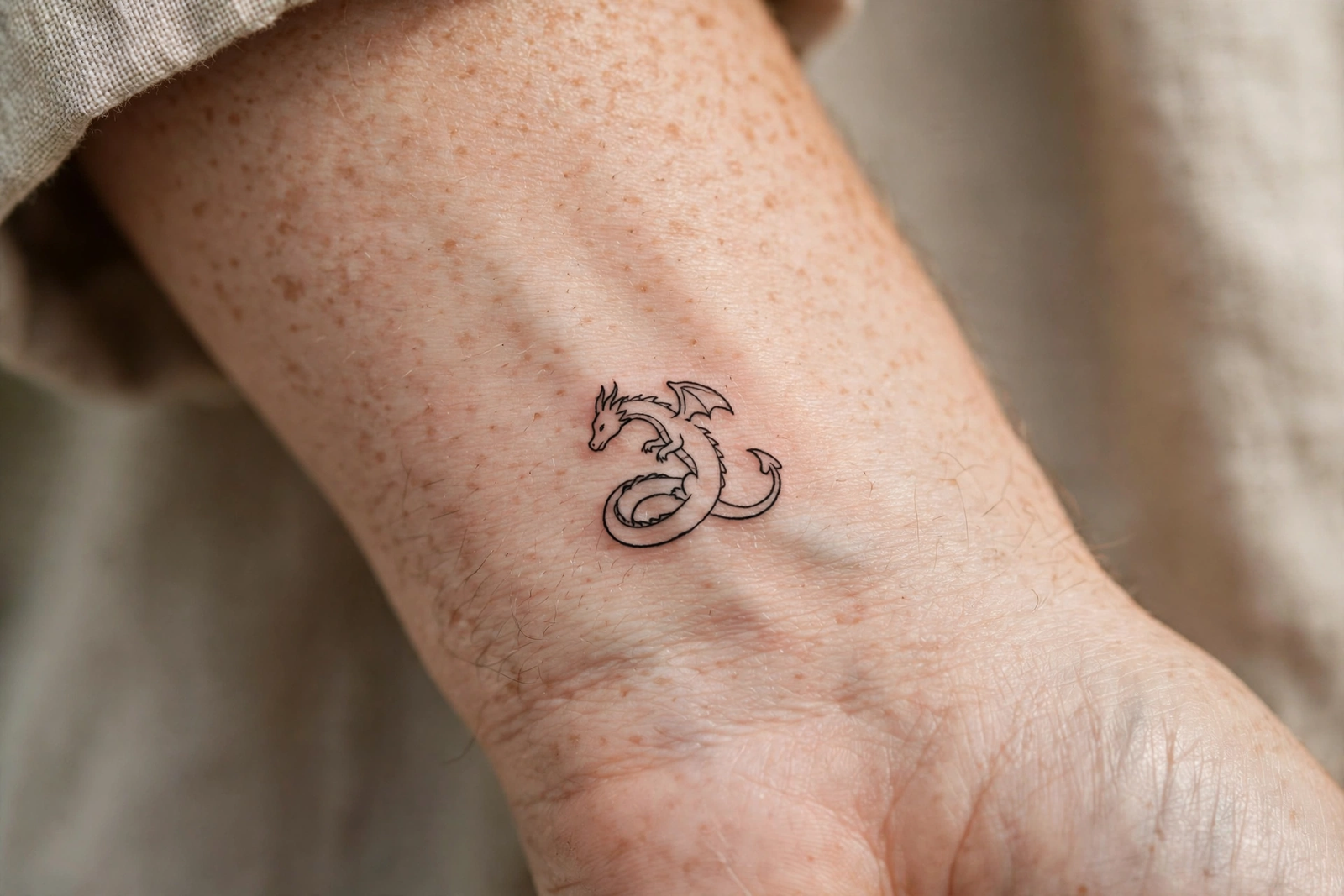
Can you get a small dragon? Yes, with rules. Dragons are detail-heavy — scales, claws, whiskers, teeth — and detail at small sizes blurs into mush within a few years. The small dragons that age well are simplified: a clean silhouette, a single coil, a minimal line dragon that suggests the creature rather than illustrating every scale. Think of it like a logo rather than a painting. If your heart is set on a small dragon, go for bold lines and open space, and accept that it will be a symbol of a dragon rather than a portrait of one. That is not a compromise. Some of the best dragon tattoos I have seen were the simplest.
Best Placements for a Dragon Tattoo
Back and shoulders
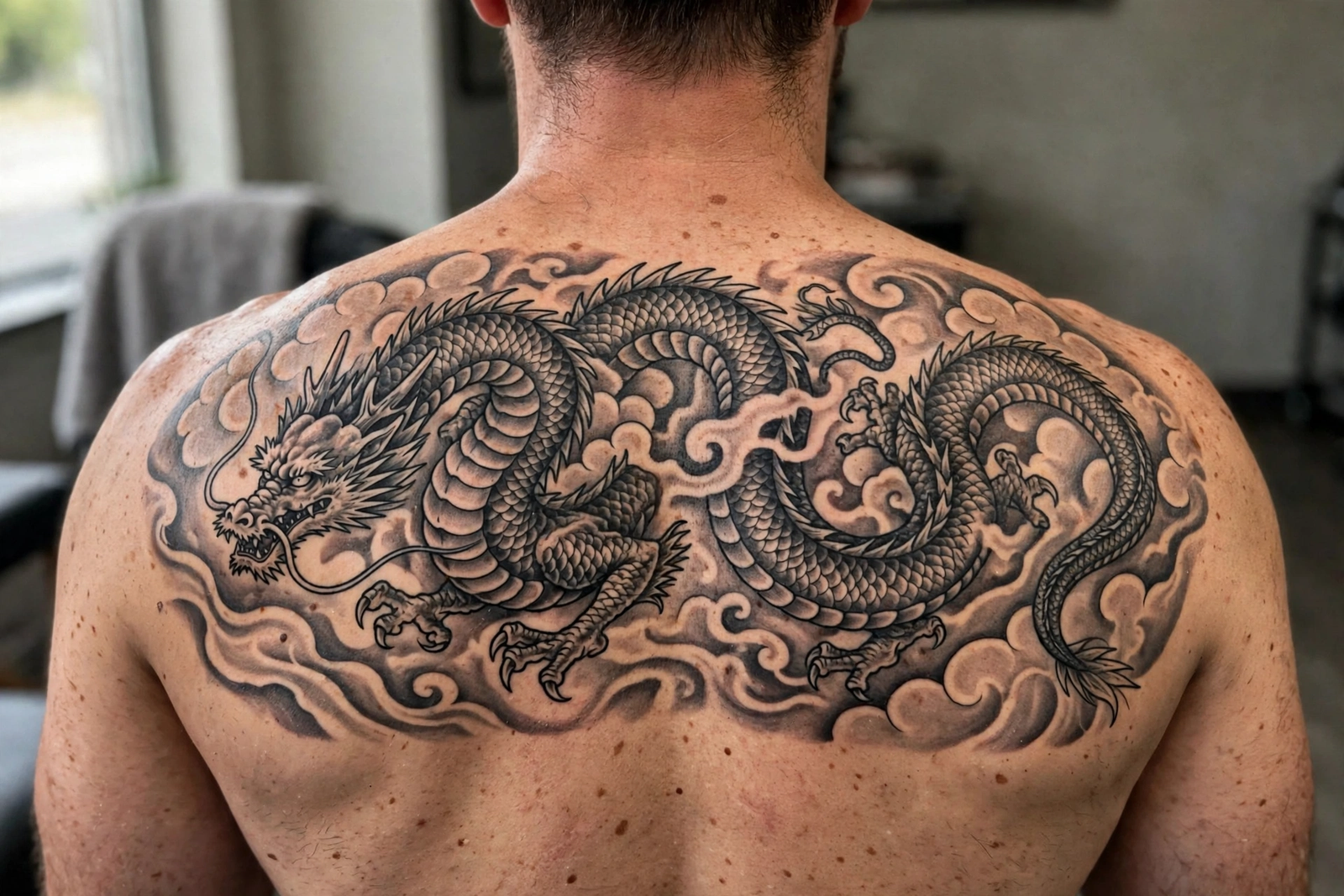
The gold standard. Room for the full coil, the clouds, the waves, everything. Pain is moderate — shoulder blades sting a bit, the middle back is gentler, the spine is the spicy part, about 5–6/10 for most people. The back also hides easily for work and reveals dramatically when you want it to. If you are planning a dragon you want to grow over years, start on the back. It is the canvas that never runs out of room.
Full and half sleeves
The most visible dragon placement, and the one strangers will comment on. A dragon sleeve reads from across a room, which is either the point or a problem depending on your job and your temperament. Pain: outer arm 3/10, inner arm and elbow ditch 5–6/10 — the elbow ditch is famously tender, and a dragon sleeve will cross it eventually. Budget for that session and bring snacks. Seriously. Long sessions go better fed.
Chest
A dragon across the chest, head on one side and body winding toward the other side or down the ribs, is a powerful option. It is also one of the more painful large placements, especially near the sternum and collarbone, around 6/10. Chest dragons suit people who want the piece for themselves more than for display — visible to you in a mirror, less so to the world under a shirt. There is something fitting about that: a dragon you carry close.
Legs and thighs
Underrated, and artists love them. The thigh is a big, relatively painless canvas — about 2–3/10 — that takes a large dragon beautifully and hides under trousers. The calf works well for a vertical dragon, head up near the knee and tail winding down toward the ankle. Leg dragons age well too, because legs get less sun than arms in most people’s lives. If you want a big dragon but you work somewhere conservative, a thigh dragon is the smartest move you can make.
Ribs and side
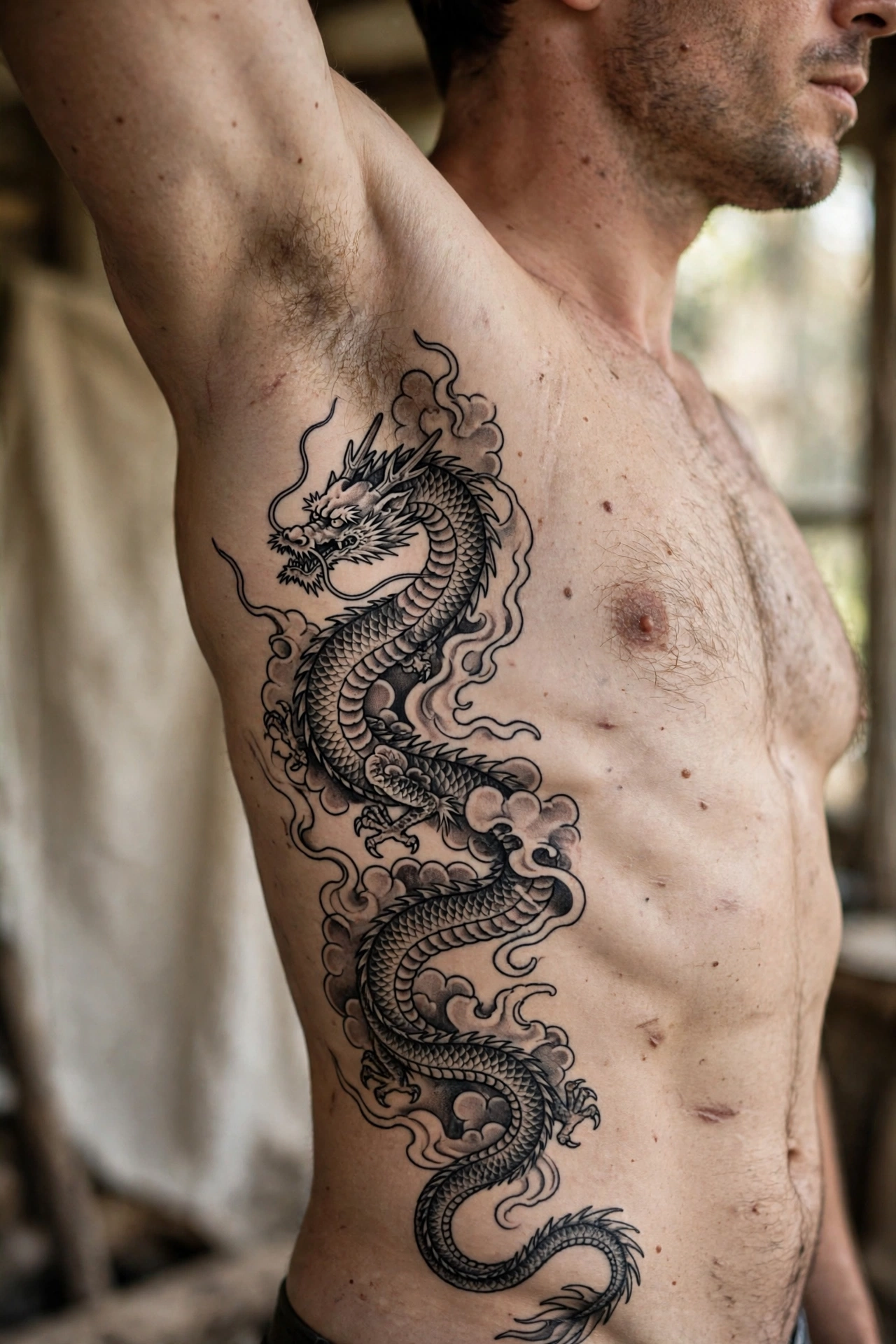
Ribs are where dragons look most alive, because the body’s curve gives the serpentine body a natural flow. They are also where dragons hurt most, honestly — ribs are a 7–8/10 for most people, with breathing making it trickier because the canvas moves. Short sessions help. So does an artist who works efficiently. Do not plan a rib dragon as your first tattoo unless you already know you handle pain well. It is a second or third tattoo kind of placement.
Forearm and smaller spots
A forearm dragon, medium-sized and simplified, is a great first dragon. Visible, easy to heal, easy to show and easy to cover with a long sleeve. Pain is gentle, about 3/10. Wrists and ankles suit only very simplified dragons — a tiny coil, a silhouette — and even then, expect some softening over time. The wrist is a lovely spot for a small dragon that means something private, but do not ask it to carry a portrait. It cannot, and it will not thank you for trying.
Size, Cost and Pain — Honestly
Dragons are not cheap tattoos, and anyone who tells you otherwise is either planning to rush yours or planning to charge you twice when it needs fixing. The size of the dragon decides almost everything else — the price, the number of sessions, how much it hurts, and how well it ages.
Small (5–8 cm): a simplified dragon, a silhouette, a small coil on the wrist, ankle or behind the ear. Cost: roughly $100–$200 in the US, often around the shop minimum. Fine for a symbol. Not fine for a detailed portrait, and any artist who promises you a fully scaled, fully coloured dragon at this size is selling you a blur that will arrive in about three years.
Medium (15–25 cm): a forearm dragon, a shoulder piece, a thigh dragon with room to breathe. This is the sweet spot for most people — enough space for scales and a face with expression, without committing to a bodysuit. Cost: roughly $300–$800, depending on colour and detail.
Large (full sleeve, chest panel, back piece): this is where dragons belong, if your budget and patience allow it. Cost: roughly $1,000–$4,000+, spread over multiple sessions. A full back piece from a respected Japanese-style artist can go well beyond that, and it is worth every penny if the artist is right, because a bad large dragon is a very large problem to live with.
Pain follows the usual map, with one dragon-specific note: long winding designs cross multiple pain zones in a single session. A back piece will take you from gentle (middle back) to spicy (spine, shoulder blades) and back again. That variety actually helps some people — you never sit in one painful spot for too long — but it also means you cannot judge a dragon session by its first ten minutes. The easy part is not the whole story.
Choosing an Artist for a Dragon
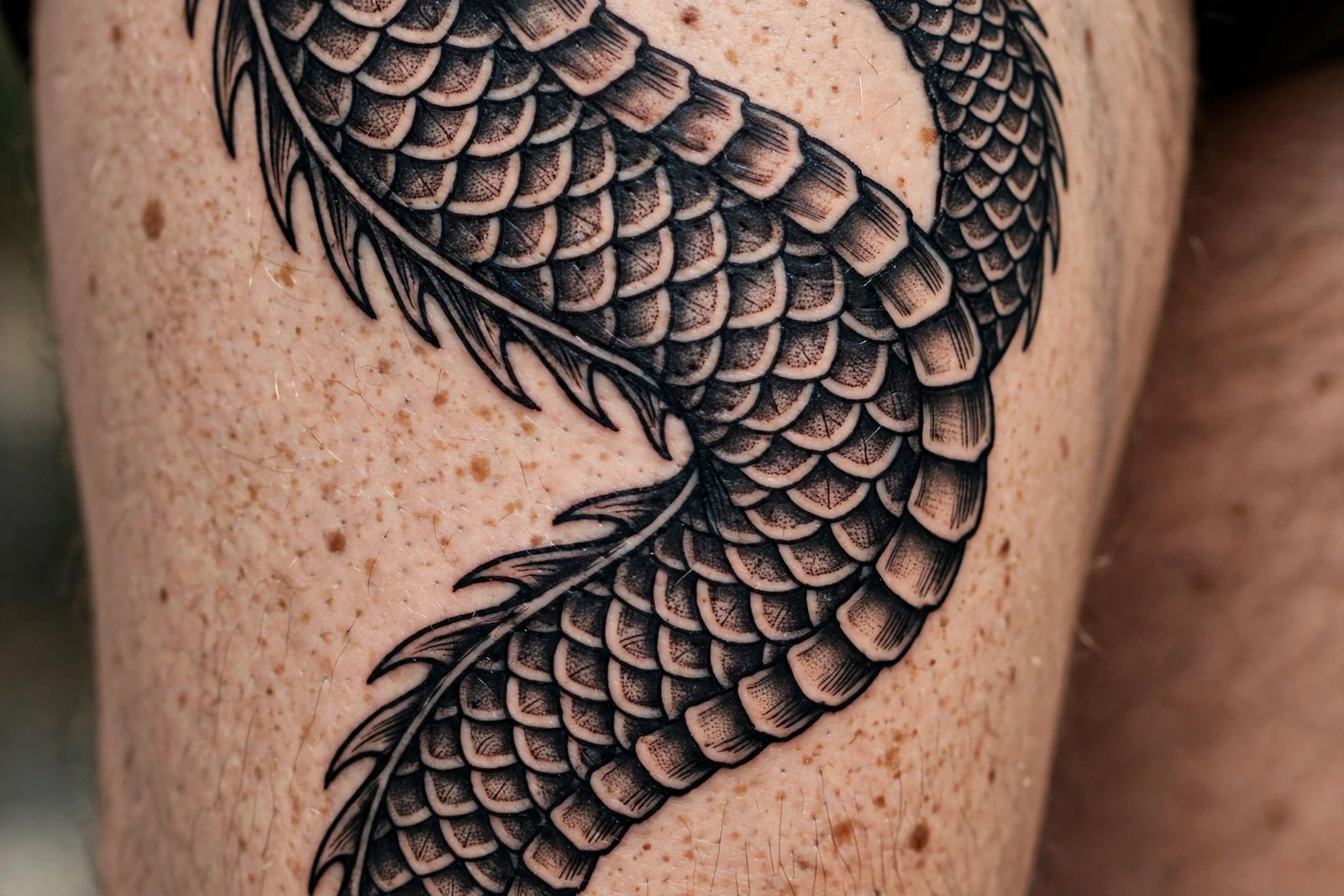
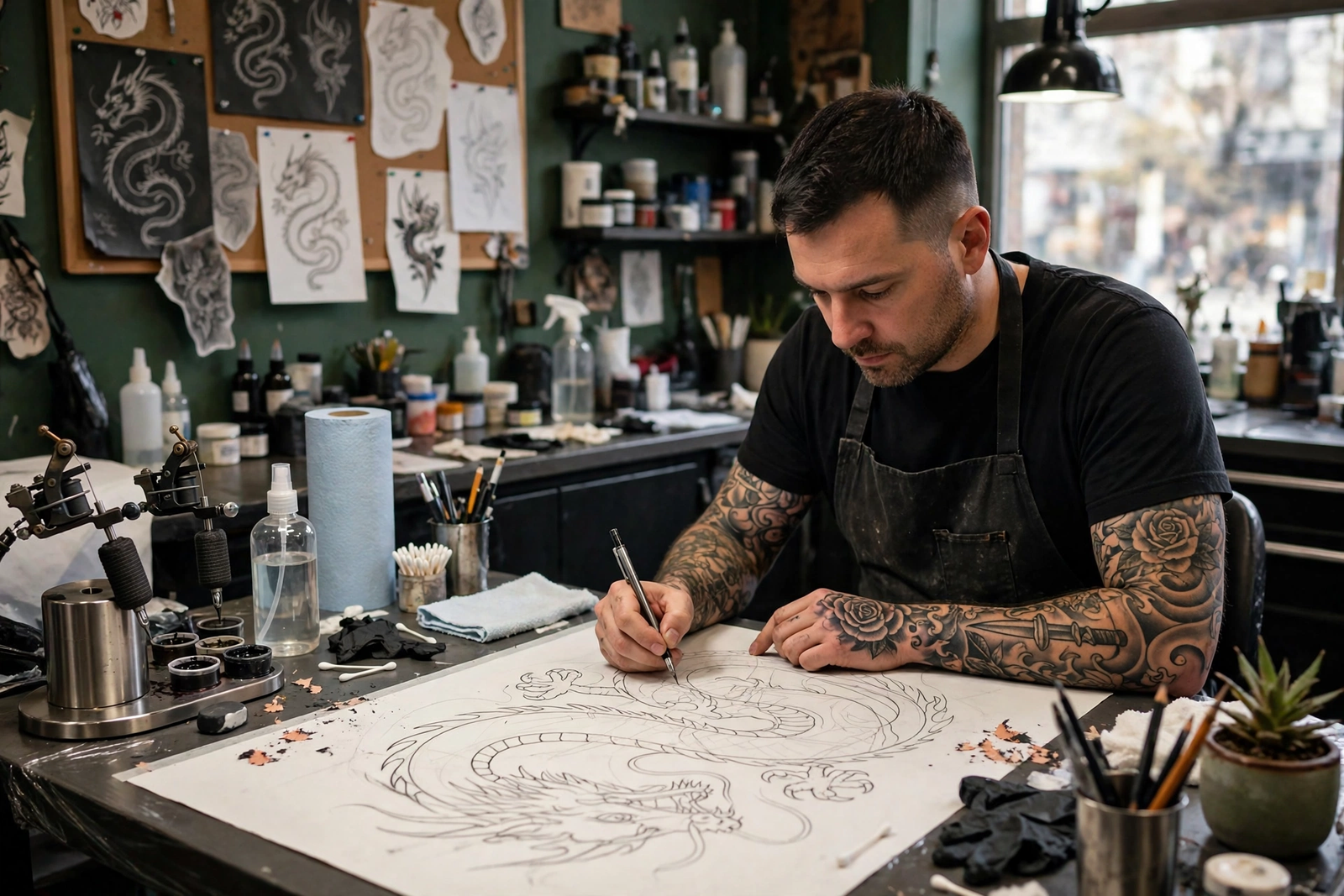
This matters more for dragons than for almost any other subject, because dragons punish generic skill. A rose can survive a mediocre artist. A dragon cannot. Its body has to coil with anatomy, its scales have to stay even as the body twists, its face has to have expression without looking cartoonish, and its claws have to look like they could actually grip something. That is a lot of separate skills in one design.
So look for an artist whose portfolio already has dragons — not one dragon, several, and healed, not just fresh. Fresh dragon tattoos almost always look good. The ink is dark, the skin is tight, the photo is filtered. Healed dragons tell the truth: did the scales stay separate or melt together? Did the red stay red or go pink? Did the whiskers survive or fade to ghosts? Ask to see healed work specifically. A good dragon artist will be proud to show it. An artist who only shows fresh work, for dragons especially, is asking you to take their word for the part that matters most.
Also, bring references from the right tradition. If you want a Japanese dragon, bring Japanese dragon art, not just other people’s tattoos of Japanese dragons. If you want a Chinese dragon, bring Chinese art. The difference between a copy of a copy and a design drawn from the source is visible, even to people who cannot name it. And talk to your artist about the dragon’s personality before you talk about size or colour. Is it calm or fierce? Rising or resting? Guarding or chasing? Those answers shape the pose, and the pose shapes everything else. Our tattoo ideas library and tattoo styles guide can help you narrow the tradition and style before you book, and our placements guide is worth a read if you are torn between a sleeve and a back piece.
Dragon Tattoos and Cultural Respect
Let us talk about this plainly, because dragons sit right on the line between appreciation and appropriation, and it is better to think about it before the needle than after. Getting a Chinese or Japanese dragon tattoo when you are not Chinese or Japanese is not automatically disrespectful. Tattooing has always borrowed across cultures, and Japanese tattooing itself spread around the world precisely because people outside Japan loved it. What matters is how you do it.
Do your reading, which you are doing right now, so that is a good start. Choose the right tradition rather than a mash-up. Avoid sacred or specifically religious imagery you do not understand — some dragon imagery is tied to temples and rituals, not just decoration. And if you can, learn how to say what your dragon means in a sentence, so that if someone from that culture asks you about it, you have an answer that shows respect rather than a shrug. Most people are generous when they can see you cared enough to get it right. The ones who get annoyed are usually annoyed by carelessness, not by love.
Aftercare in Brief
Large dragon pieces need serious aftercare, because a big tattoo is a big wound, even when it does not feel like one. Wash gently twice a day with unscented soap, moisturise thinly — thin, not greasy — do not pick the flakes, and keep it out of pools, baths and direct sun while it peels. For a multi-session piece, each session needs the same care, and the gaps between sessions are when the real healing happens. Do not rush your artist into the next session before the last one has settled. Colour dragons especially need sunscreen after healing. Red and blue fade faster than black, and a dragon whose red has gone patchy loses half its presence. The full day-by-day routine is in our tattoo aftercare guide, and for a piece this size, read it properly rather than skimming it.
Dragon Tattoos for Different Stories
Because dragons are so flexible as symbols, it is worth pausing on who actually gets them, because you might recognise yourself in one of these and realise your dragon was decided a while ago. There is the protector dragon: parents, older siblings, people who guard a family or a team. Their dragons tend to be coiled, watchful, wings slightly raised — not attacking, but clearly capable of it. There is the survivor dragon: the one you get after the hard thing, often a Western dragon slain or a koi becoming a dragon. There is the ambition dragon: rising, climbing, red or gold, got at the start of something rather than the end. And there is the heritage dragon: Welsh, Chinese, Korean, Japanese, got because it is yours by birth or by family story. None of these is better than the others. But knowing which one you are will make every other decision — culture, colour, pose, placement — fall into place much faster.
Frequently Asked Questions
What does a dragon tattoo mean?
Power, good luck, protection and wisdom — but the culture matters enormously. Chinese dragons mean luck and imperial strength, Japanese dragons mean balanced power and water wisdom, Western dragons mean treasure-guarding, fire and the fight against chaos. Pick the culture first, then the design.
What does a Chinese dragon tattoo mean?
Good fortune, strength, wisdom and protection. Chinese dragons control rain and rivers, were claimed by emperors, and are almost entirely positive symbols — the luck-bringing dragon most people picture when they say the word.
What does a Japanese dragon tattoo mean?
Strength balanced by wisdom, tied to water. Japanese dragons are powerful forces kept in discipline, often shown with waves, clouds and blossoms. Paired with a koi, they tell the story of effort becoming power.
Is a dragon tattoo good luck?
In Chinese and Japanese tradition, yes — dragons are bringers of rain, fortune and protection. In Western tradition, dragons are more often a challenge to overcome than a lucky charm. So a dragon tattoo is good luck if it is an Eastern dragon, and a badge of survival if it is a Western one. Both readings are legitimate, and plenty of wearers like holding both at once.
Are dragon tattoos bad luck or evil?
Not in the traditions that tattoo them most. Eastern dragons are benevolent, wise and protective. Western dragons are dangerous, but that danger is the point for many wearers — a guard, a survivor’s mark, or a creature that refuses to be tamed. Nothing about a dragon tattoo is inherently cursed, and the old idea that dragons are demonic comes from one narrow medieval reading, not from the animal’s whole history.
Where is the best placement for a dragon tattoo?
The back for a full traditional piece, the arm for a sleeve, the thigh for a large piece you can hide, and the forearm for a medium dragon you want to see daily. Match the size to the spot: long coiling dragons need long canvases, and wings need room to spread.
How much does a dragon tattoo cost?
Small simplified dragons run about $100–$200 in the US; medium pieces $300–$800; large sleeves and back pieces $1,000–$4,000 or more, spread over multiple sessions. Colour, detail and the artist’s reputation all push the price up, and a well-known Japanese-style specialist will charge more than a generalist — usually for good reason.
Does a dragon tattoo hurt?
It depends on the spot more than the subject. Thighs and outer arms are gentle (2–3/10), backs are moderate (5–6/10), ribs and sternum are the painful ones (7–8/10). Long sessions ache more from duration than from any single moment, so plan breaks, food and a good artist who works efficiently.
What colour dragon should I get?
Red for luck and fierce passion, black for wisdom and longevity, gold for prosperity, green for growth and nature, blue for calm and compassion. Choose the meaning first, then check how that ink ages on your skin tone with your artist, because the same red looks different on different skin, and a good artist will be honest about that.
Can a small dragon tattoo work?
Yes, if it stays simple — a bold silhouette, a single coil, minimal detail. Highly detailed dragons at small sizes blur within a few years. If you love detail, go bigger or accept a simpler version. There is no shame in a small dragon. There is only shame in a small dragon that was drawn like a big one and then melted.
Dragons in Myth, in Brief
It helps to know a few of the stories, because they are the reason dragons feel so deep as symbols, and because your artist may reference them without realising you have not heard them. The Chinese dragon Shenlong brings rain. The Japanese Ryujin rules the sea from a palace under the waves and controls the tides with jewels. The Welsh red dragon fought a white dragon for a kingdom and won, which is why it is still on the flag. The Norse dragon Fafnir was a man turned dragon by greed for gold, which is where the treasure-hoarding image partly comes from. Quetzalcoatl, the feathered serpent of Mesoamerica, was a creator god tied to wind, learning and the morning star — about as far from a cave monster as a dragon can get.
Before You Book: A Short Checklist
We end every meanings guide with a checklist, because enthusiasm is a wonderful thing and a terrible planning tool. Run through this before you put down a deposit. First, can you say in one sentence what your dragon means and which culture it comes from? If not, you are not ready yet, and another week of looking will save you a lifetime of explaining. Second, have you seen healed dragons from your artist, not just fresh ones? Third, does the size match the detail — is there actually room for the scales, the face and the claws you want? Fourth, does the placement suit your life: your job, your pain tolerance, how much you want to show it? And fifth, have you budgeted for the whole piece, not just the first session? A half-finished dragon, abandoned after two sessions because the money ran out, is worse than no dragon at all.
Carry It Like You Mean It
A dragon is not a quiet tattoo, even a small one. It carries thousands of years of stories, and people will read those stories onto you whether you invite them to or not. That is not a warning. It is the appeal. To wear a dragon is to say you are not afraid of power — your own, or the world’s — and that you have thought about what to do with it.
So choose slowly. Choose the culture that fits your story, the colour that fits your meaning, the artist who can actually draw the creature, and the placement that gives it room to breathe. Then wear it the way dragons are meant to be worn: not as decoration, but as a statement you can stand behind. If you do that, the dragon will not just look powerful. It will be honest. And honest tattoos are the ones that still feel right when the trend has moved on and the ink has settled into your life.
Browse our tattoo meanings library for more symbols with stories behind them, or read our tattoo styles guide if you are still deciding between Japanese, traditional and blackwork for your dragon. If a rebirth story is closer to your heart than a power story, our phoenix guide is the natural next read.