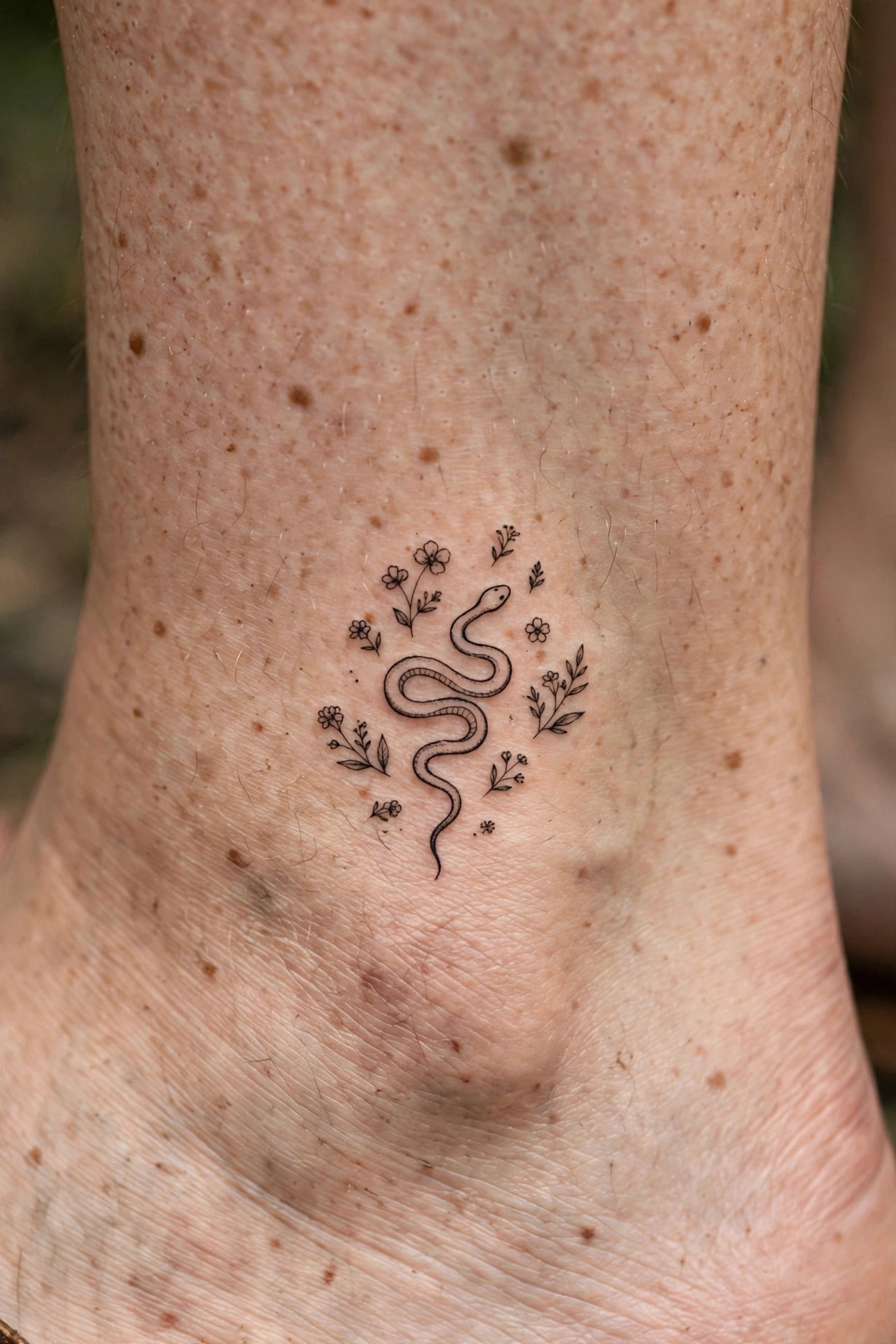
Quick answer: A snake tattoo means transformation, protection, and rebirth. Snakes shed their skin and walk away from it, whole and new, which is why they have become the tattoo for people who have outgrown a version of themselves. It can also mean wisdom, danger, healing, and fertility, depending on the culture and the design — but at its core, a snake tattoo says: I changed, I survived it, and I am not the person I was before.
I will be honest with you: snakes used to make me nervous. Not in a dramatic way, just in the ordinary way most people flinch at a photo of a coiled viper before they have even registered what they are looking at. Then I spent a summer around a tattoo studio where, I swear, every second client seemed to be getting a snake, and my whole opinion flipped. There was the nurse who got a tiny snake curled around her wrist after leaving a job that had hollowed her out. There was the older man, quiet as anything, who had a huge blackwork python winding up his whole forearm for his fiftieth birthday — his gift to himself, he said, because he had finally stopped drinking. And there was a young woman who brought in a photo of a cobra, not because she thought cobras were cool, although she did, but because her grandmother had told her snakes guard the home. Three people, three completely different snakes, and not one of them was about being dangerous for the sake of it. That is the thing nobody tells you about snake tattoos until you start listening to the stories behind them. They are rarely about menace. They are almost always about getting through something.
So this is the full guide, the way we would talk you through it if you walked into the studio with a screenshot saved on your phone and a half-formed idea. What a snake tattoo means, why the species matters more than people think, what different cultures have said about snakes for thousands of years, the designs that actually work on skin, where to put one, what it costs, what it feels like, and how to choose a version that still feels like yours in twenty years. If you only take one idea away from this page, let it be this: a snake is not one meaning. It is a whole family of meanings, and the design you pick decides which one you are wearing.
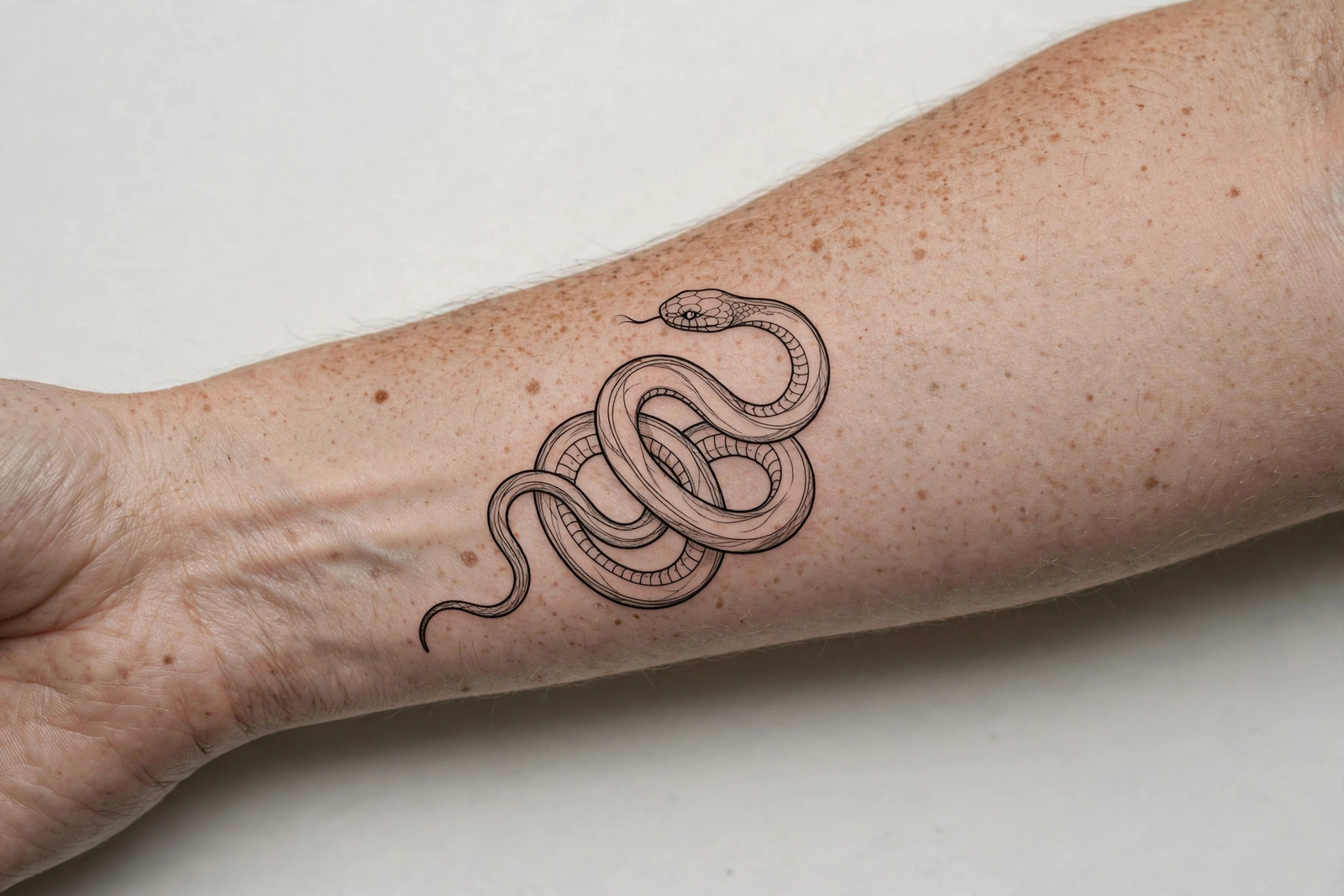
What Does a Snake Tattoo Mean?
Strip away the folklore for a second and look at the animal itself, because almost every meaning of a snake tattoo grows out of something a real snake actually does. Snakes shed their skin. They move without legs, close to the ground, silent and deliberate. They can be still for an absurdly long time and then move in a blink. They are both feared and respected in just about every culture on earth. Put all of that together and you get a symbol that refuses to be simple, which is probably why it has lasted so long.
1. Transformation: shedding the old skin
This is the big one, and it is the reason most people end up here. A snake does not patch up its old skin or pretend it still fits. It rubs against something rough, splits the old layer open, and crawls out of it, leaving the whole thing behind like a ghost of itself. I have heard that image described by people going through divorces, career changes, recoveries, moves to new countries — all the unglamorous, unphotogenic kinds of change that do not come with a celebration. One woman told her artist she did not want a phoenix, because a phoenix is too loud, too much fire and applause. She wanted a snake, she said, because her change had been private and slow and nobody had clapped for it. I think about that a lot. If your transformation was quiet, a snake might be more honest than a bird bursting into flame.
2. Rebirth and healing
Snakes have been tied to healing for thousands of years, and this is not just poetic licence. The Rod of Asclepius — a single snake wrapped around a staff — is still the symbol of medicine in much of the world, and it goes back to the Greek god of healing. Snakes were kept in healing temples in the ancient world, and their venom, in careful doses, has been used as medicine for centuries. So a snake tattoo can be a quiet nod to recovery: from illness, from addiction, from a period of life that genuinely hurt. I know someone who got a small snake on her ribs after a year of treatment, and she told me she picked it because she wanted something that meant “I got better” without literally spelling it out. A snake does that. It carries the healing story without turning your body into a medical chart.
3. Protection and power
Here is where the snake’s reputation for danger actually becomes a virtue. A coiled snake, head raised, is a warning, and warnings protect. In many traditions snakes guard thresholds, treasures, homes and sacred places. In Egypt, the cobra on the pharaoh’s crown — the uraeus — was literally a protector, spitting fire at the king’s enemies. In Hindu tradition, snakes guard temples and treasure. So a snake tattoo, especially a cobra with its hood flared or a snake wrapped defensively around something, can mean: I look after my own, and I am not as soft a target as I look. It is a protective symbol that does not need to shout. Actually, that is the whole point. A snake does not posture the way a lion does. It just sits there, coiled, and lets you draw your own conclusions.
4. Wisdom, instinct and hidden knowledge
Snakes see the world differently — quite literally. Some sense heat, some taste the air with their tongues, all of them navigate a world we can only partly perceive. That has made them symbols of wisdom, intuition and secret knowledge in culture after culture. The Greek Oracle at Delphi was associated with a serpent. In Norse myth, the world serpent Jörmungandr encircles the whole earth and knows things the gods do not. A snake tattoo can mean trusting your gut, or valuing knowledge that is not taught in classrooms, or simply being the person in the room who notices things before anyone else does. My own take? If you have ever made a decision everyone told you was wrong, on a feeling you could not defend in a meeting, and been proved right — you already know why this meaning sticks.
5. Danger, temptation and duality
We have to be honest about the darker side, because a snake tattoo would not be interesting if it were only wholesome. In the Biblical story, the serpent in Eden is temptation and the fall. In some folk traditions, snakes are deceit and betrayal. Some people choose a snake precisely because of that edge — they want a tattoo that admits they have a darker side, or that they have been tempted, or that they are not entirely the good person in every story. And honestly, that duality is part of the appeal. A snake is not a dove. It does not pretend to be innocent. It is beautiful and dangerous at the same time, and a lot of people find that more truthful than a purely sweet symbol. The trick is knowing which side of that line your design falls on, because a snake and an apple reads very differently from a snake and a rose.
Snake Meanings Around the World
One of the reasons snake tattoos travel so well is that almost every culture has a snake story, and they do not all agree. That is a feature, not a bug — it means you can find a tradition that matches the meaning you actually want, rather than settling for a generic one. But it also means you should know what you are borrowing. A quick tour:
Ancient Egypt: royalty, protection and eternity
To the Egyptians, the cobra was Wadjet, goddess and protector of kings. The uraeus on the pharaoh’s crown was not decoration; it was a weapon, a divine snake that would strike at enemies. Snakes also appeared in funerary art as guardians of the afterlife. An Egyptian-style snake tattoo — think clean lines, gold and lapis colours, a cobra with its hood spread — carries that royal, protective weight. It says guardian, not villain.
Ancient Greece and Rome: healing and the underworld
Hinduism and Buddhism: energy, guardians and rebirth
In Hindu tradition, snakes — nagas — are powerful, semi-divine beings who guard water, treasure and sacred places. Shiva wears a cobra, Vasuki, around his neck, calm and completely under control, which is a beautiful image if you think about it: power, worn lightly, not flaunted. Kundalini, the coiled serpent energy at the base of the spine, represents spiritual awakening rising through the body. That makes the coiled snake a natural tattoo for the spine itself, by the way — the symbolism and the placement line up perfectly. In Buddhism, the serpent king Mucalinda sheltered the Buddha from a storm with his hoods spread, so the snake becomes a protector of wisdom and calm. If any of this is your own tradition, by the way, wear it with the respect it deserves and talk to your artist about getting the details right. If it is not your tradition, it is worth asking yourself whether you are drawn to the meaning or just the look — both are fine, but the meaning lasts longer.
China and Japan: good fortune, wisdom and longevity
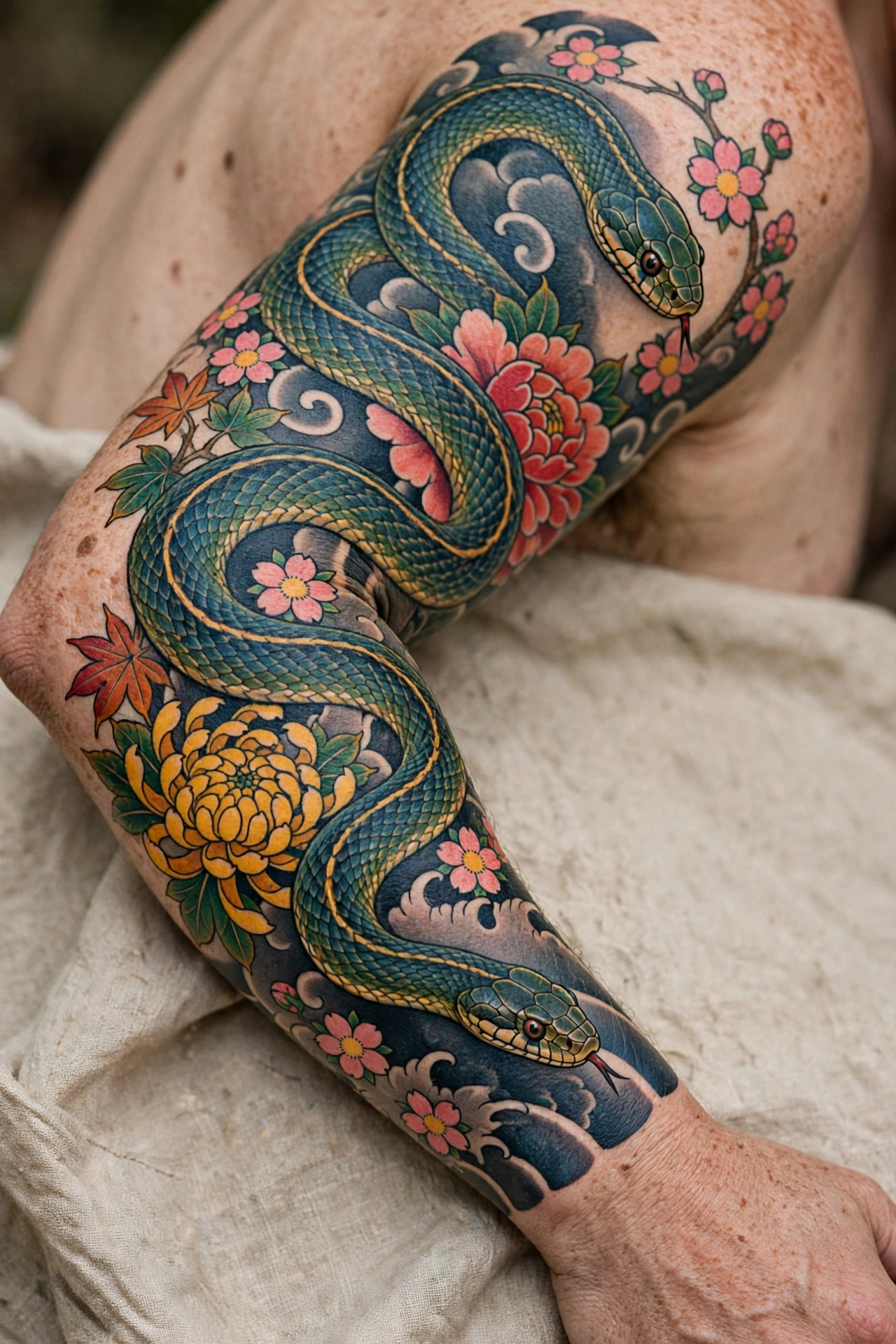
Chinese tradition treats the snake as one of the zodiac animals — intelligent, intuitive, graceful, a little mysterious, and famously good with money and strategy. A snake year baby, people say, thinks before they act. In Japan, snakes are associated with water, good fortune and rebirth, and the white snake in particular is a messenger of the goddess Benzaiten, bringing luck and prosperity. Japanese-style snake tattoos — bold, flowing, often part of a larger bodysuit with flowers and waves — lean into that auspicious, powerful reading. They are not the shy, fine-line snakes of the wrist; they are statements.
Norse myth: the world serpent
Jörmungandr, the Midgard serpent, is so enormous it wraps around the entire world and bites its own tail. Thor will fight it at Ragnarök, and both will fall. A Jörmungandr tattoo — often an ouroboros, the snake eating its own tail — means cycles, eternity, the idea that endings feed beginnings. It is a popular choice for people who think in long arcs: historians, writers, anyone who has watched a family story repeat itself across generations and decided to wear that awareness rather than run from it.
The Americas: creation and duality
Quetzalcoatl, the feathered serpent of Aztec and Maya tradition, is a creator god, a bringer of knowledge, wind and learning — about as far from the Eden serpent as you can get. The rattlesnake, meanwhile, became an American symbol of vigilance and readiness: “don’t tread on me” is a snake saying, “I warned you.” A rattlesnake tattoo can carry that self-reliant, leave-me-alone energy, especially in traditional American tattoo style. As with other traditions, if you are borrowing from a living culture that is not yours, do it with care and get the details right.
Snake Tattoo vs Other Animal Tattoos
People often arrive at a snake after considering something else, and the comparison is useful because it clarifies what you actually want. A lion tattoo says power out loud. A wolf tattoo says loyalty and pack. A snake says something quieter and more complicated: power that does not need to announce itself, change that happened under the surface, wisdom that is not on display. If you want a tattoo that strangers instantly read as “strong,” a snake might frustrate you — people will ask what it means, and you will have to decide how much of the story to tell. If you like that, if you prefer a symbol that keeps a little back, a snake is perfect. It is a tattoo for people who are comfortable being slightly unreadable.
Snake Tattoo Designs That Work
Here is where the fun starts, because “a snake tattoo” could mean a dozen completely different pieces. The species and the companion elements do most of the talking, so choose them deliberately. A snake on its own says one thing; a snake wrapped around a dagger says another; a snake eating its own tail says a third. None of these is wrong. They are just different sentences.
Cobra: protection, royalty, readiness
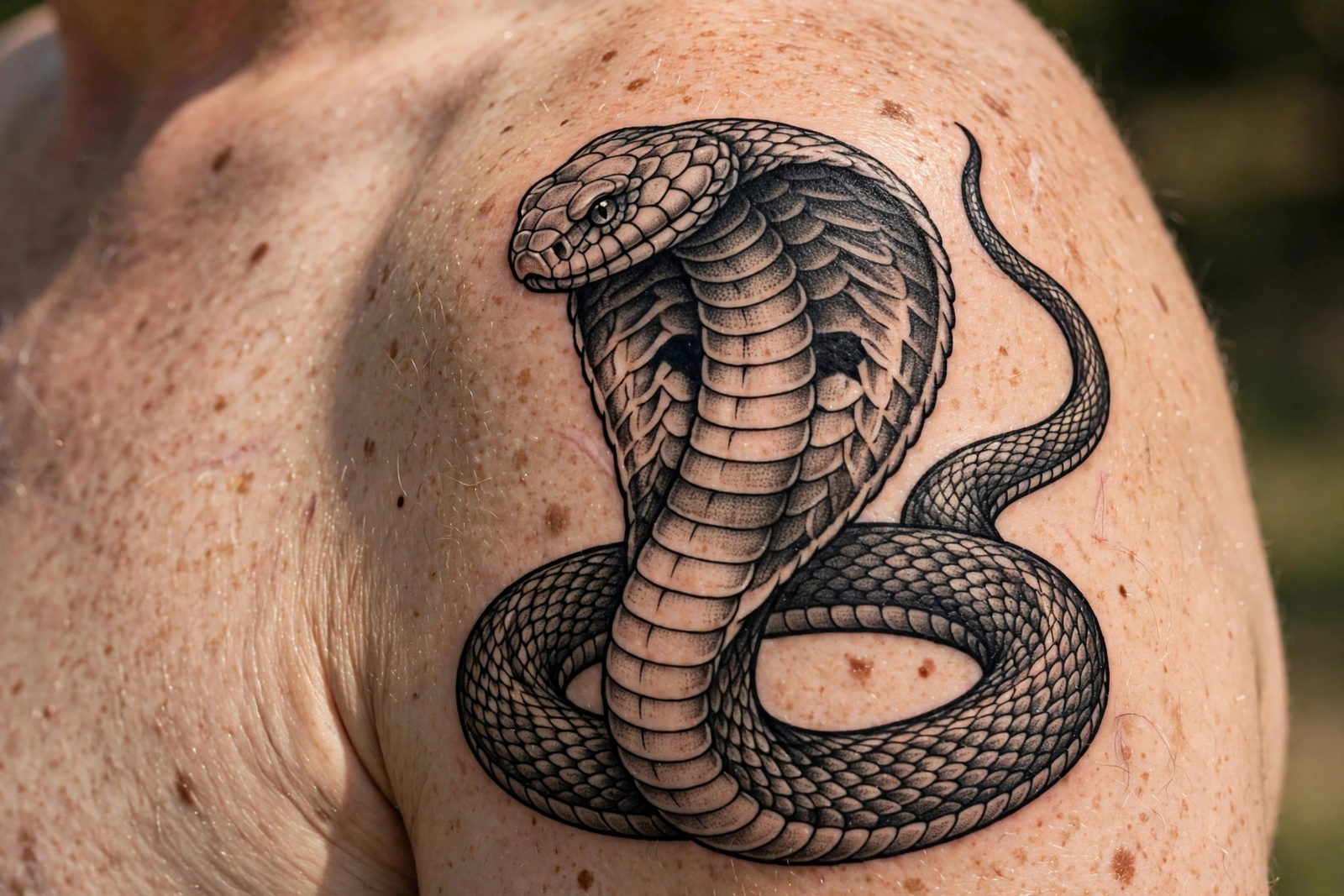
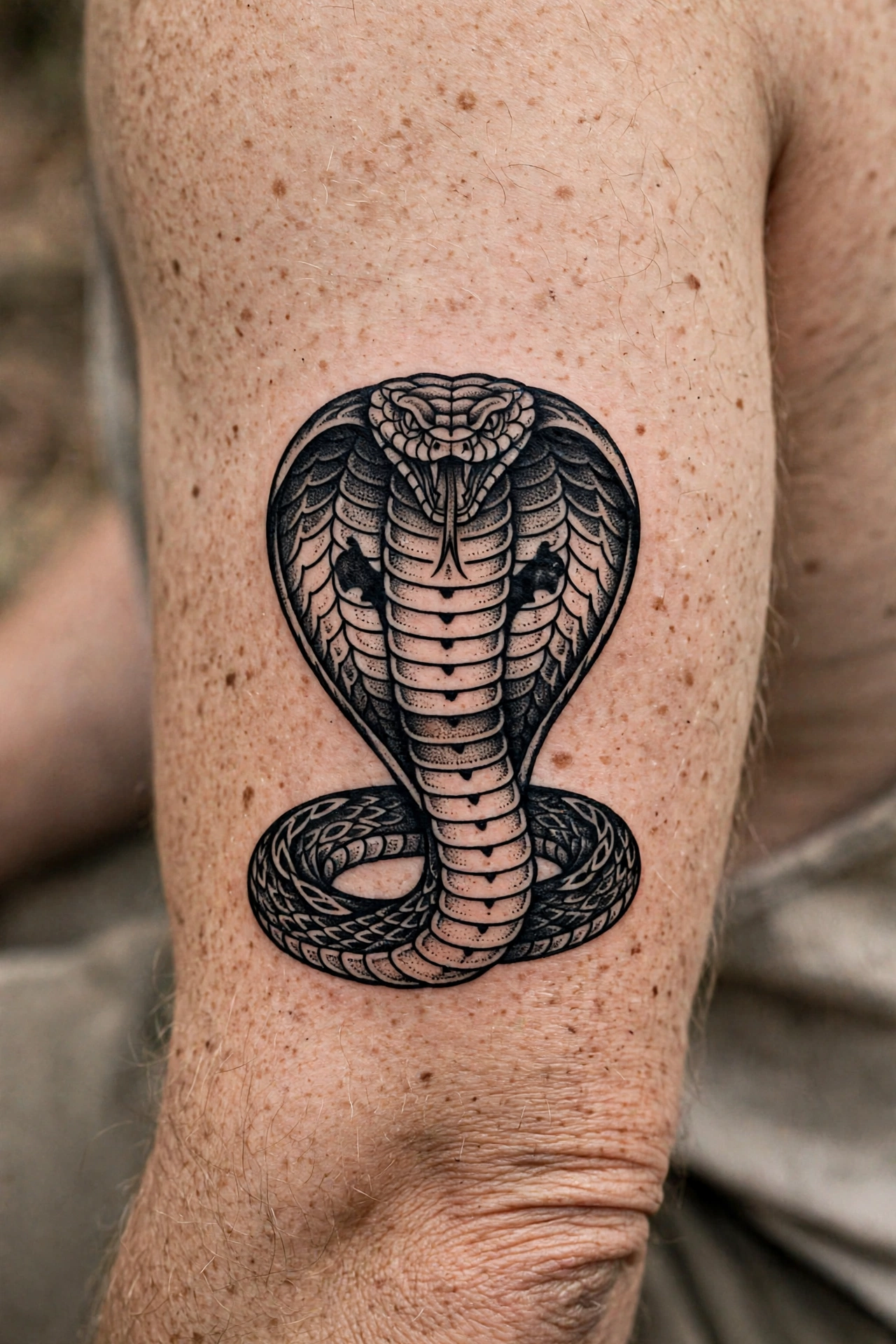
The cobra is the most recognisable snake in tattooing, and for good reason. Hood flared, head raised, it is instantly readable even at a small size, which is rarer than you think. A cobra tattoo usually leans into protection and power — the snake as guardian, the snake that warns before it strikes. It suits the chest, the upper arm, or the back, where the hood can spread properly. One practical note from artists: a cobra squeezed too small loses the hood, and a cobra without its hood is just a snake with a headache. Give it room, or pick a different species for a tiny piece.
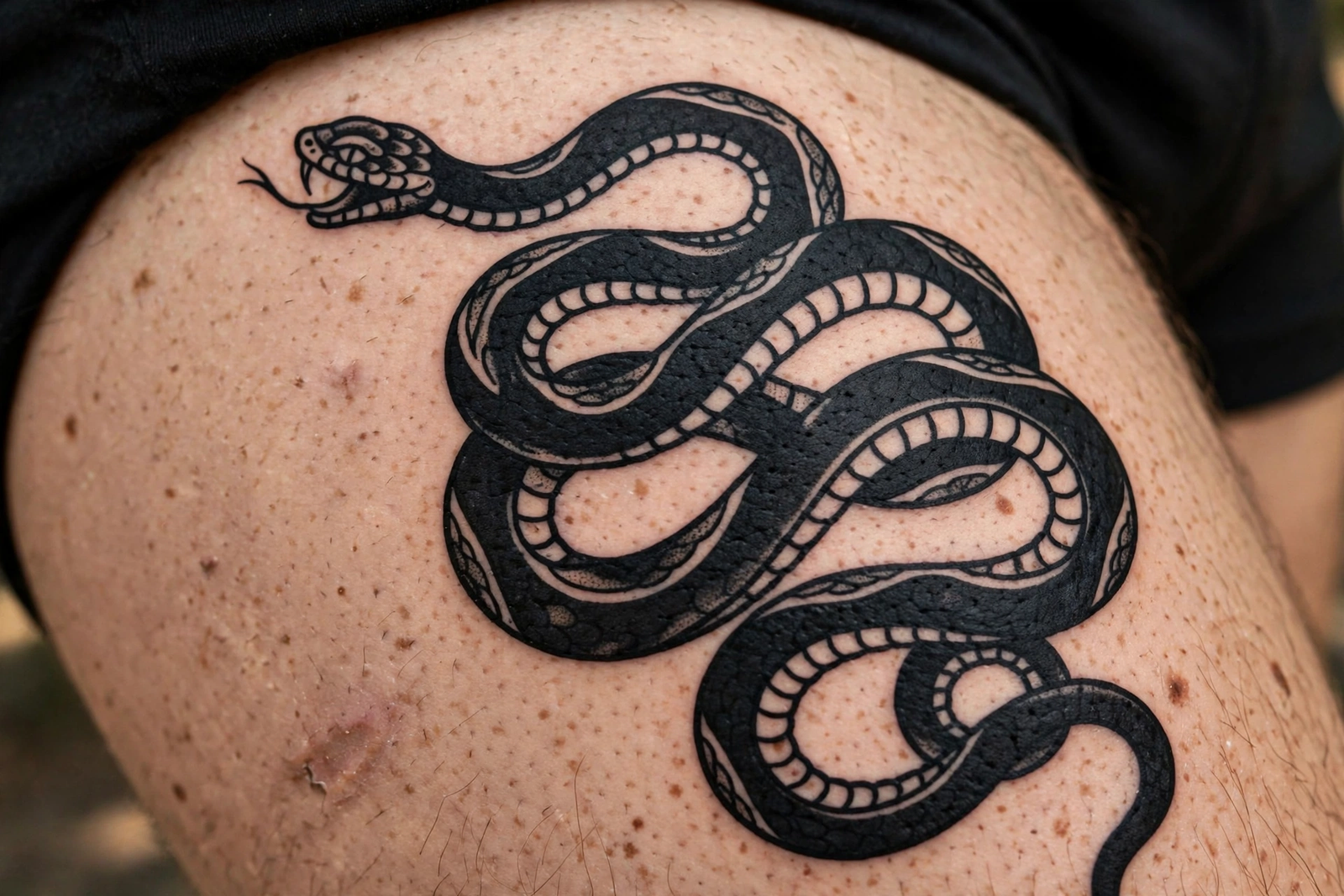
Viper and rattlesnake: warning, self-reliance, edge
Vipers, with their triangular heads and patterned scales, and rattlesnakes, with their unmistakable tails, are the snakes of the American traditional flash sheet and the blackwork world. They read as danger, vigilance and independence. A rattlesnake coiled and rattling is a classic “I warned you” tattoo, and in traditional style — bold outlines, limited palette, reds and yellows — it has a vintage punch that never really goes out of fashion. These are also the snakes people choose when they want the tattoo to have a bit of bite, literally and figuratively. If your story has a chapter where you learned to set boundaries the hard way, a rattlesnake might be your animal.
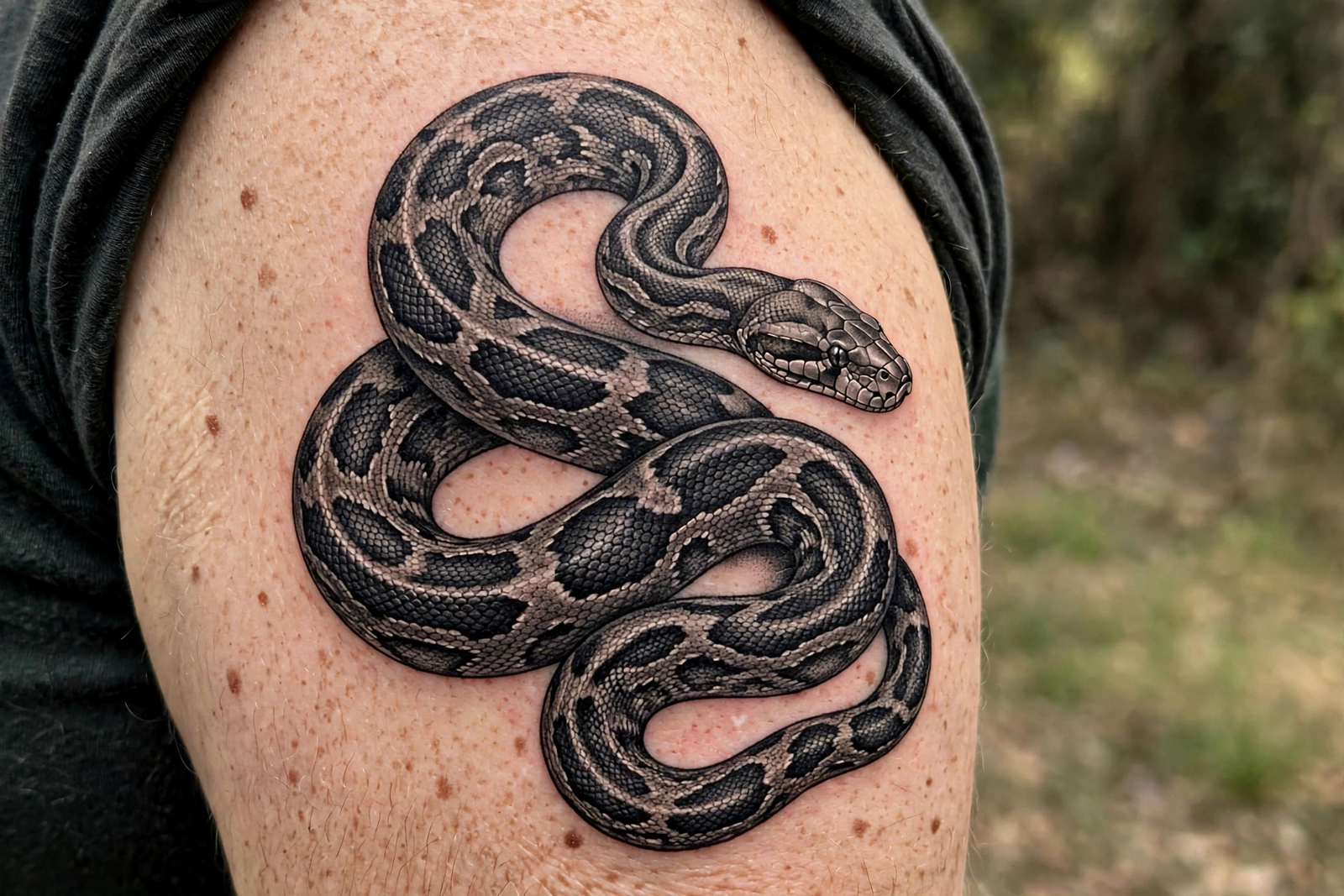
Python and boa: strength, patience, calm power
Constrictors are a different energy entirely. They do not strike fast; they wait, they wrap, they hold. A python tattoo — long, muscular, often beautifully patterned — tends to mean strength, patience and endurance. It is a good choice for a wrap-around piece, because the animal itself wraps: around a forearm, around a thigh, around a calf. I once watched an artist design a python that started at a client’s ankle and ended at their knee, following the leg’s curve so naturally that it looked like it belonged there more than the leg did. That is the constrictor’s gift. It turns the body’s shape into part of the design.
Ouroboros: eternity, cycles, wholeness
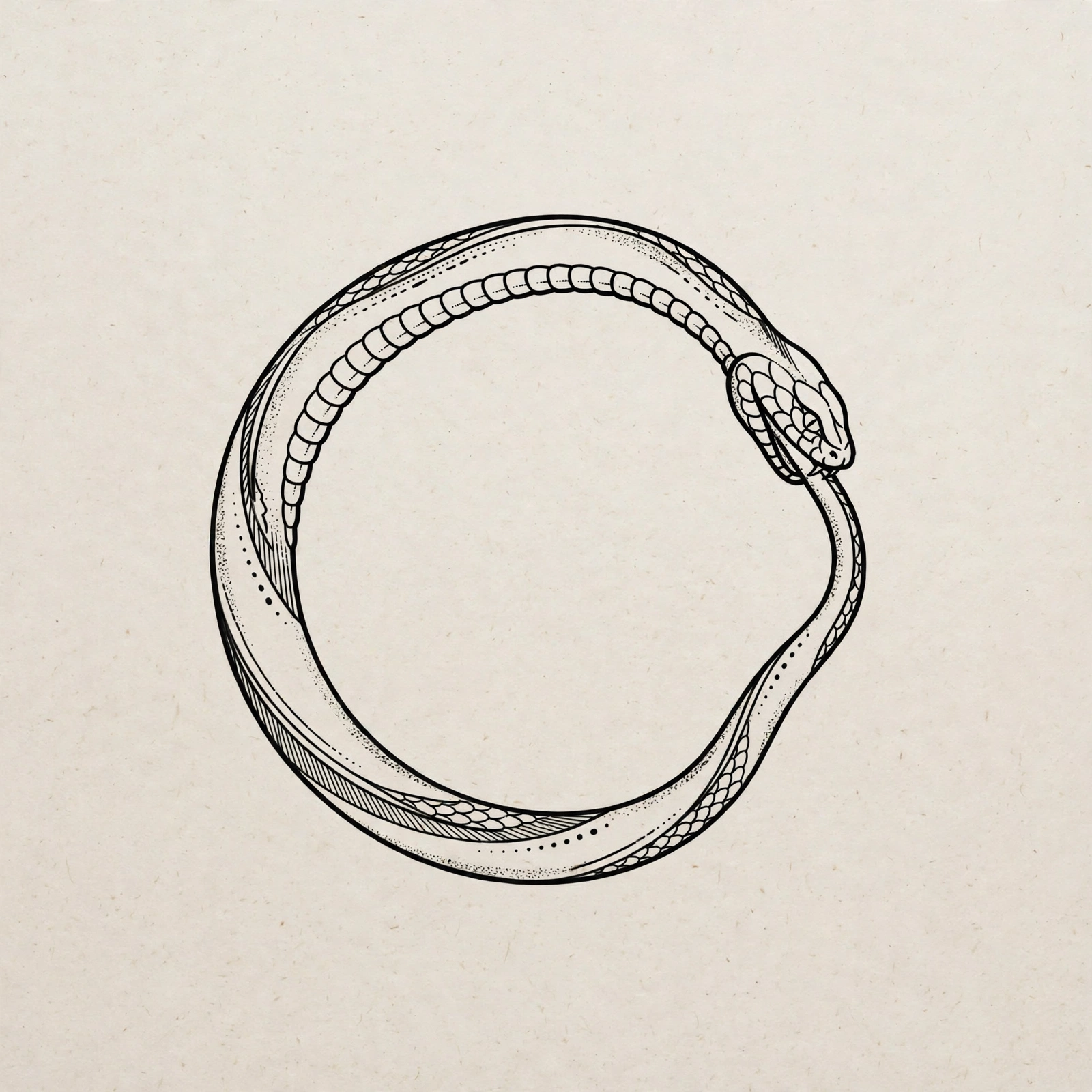
The snake eating its own tail is one of the oldest symbols in the world, and it still stops people in their tracks. It means the cycle — life, death, rebirth, repeat — and the idea that endings are not really endings, just the start of the next loop. Ouroboros tattoos work beautifully as circles: on a shoulder, the back of the neck, the centre of the back, or as a ring around an arm. They also pair well with small additions — a sun and moon inside the circle, stars, a flower — without losing the core image. If you are the kind of person who thinks in cycles rather than straight lines, if you have watched your own life rhyme with itself, this is probably the snake for you.
Snake and rose: love, danger, beauty with teeth
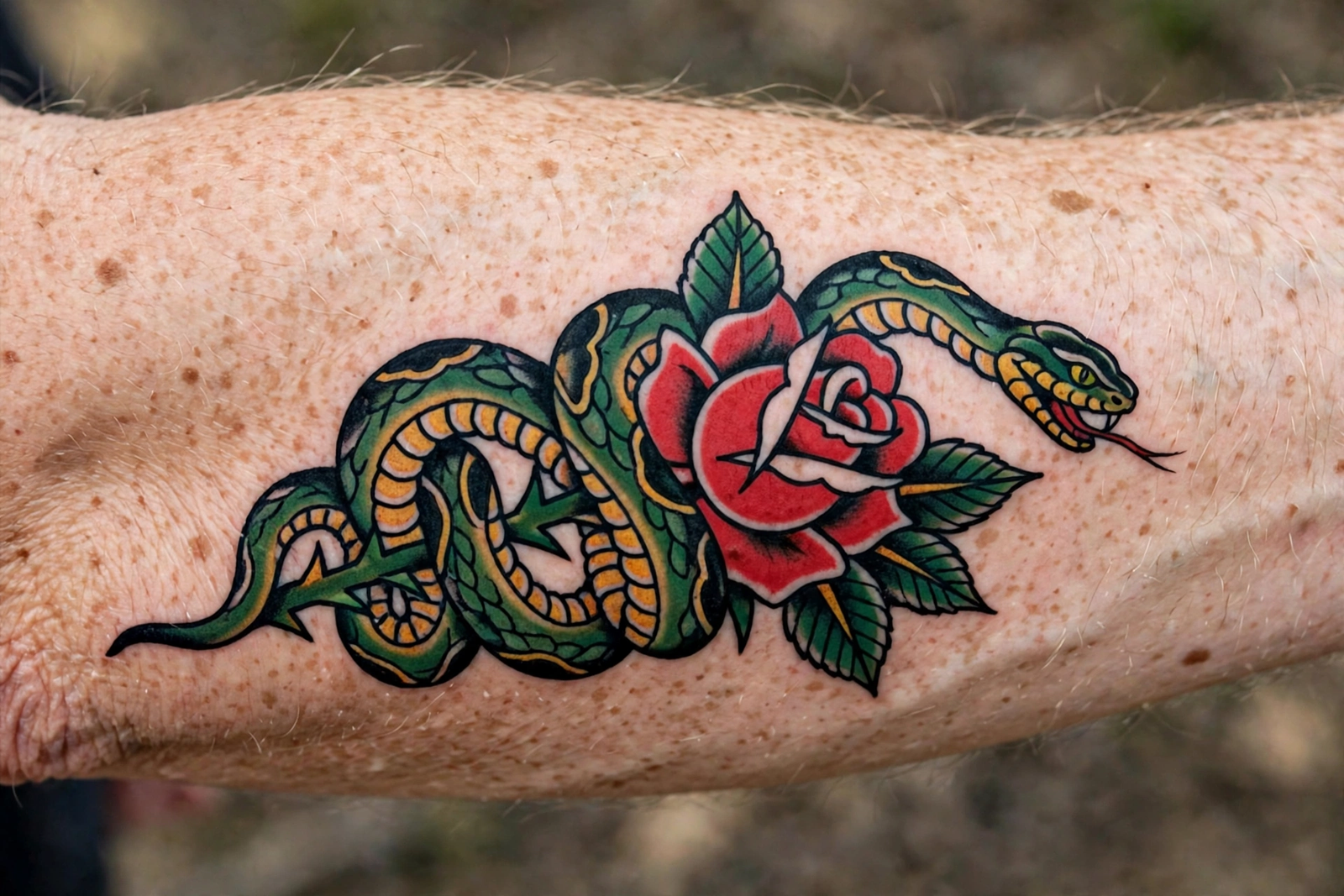
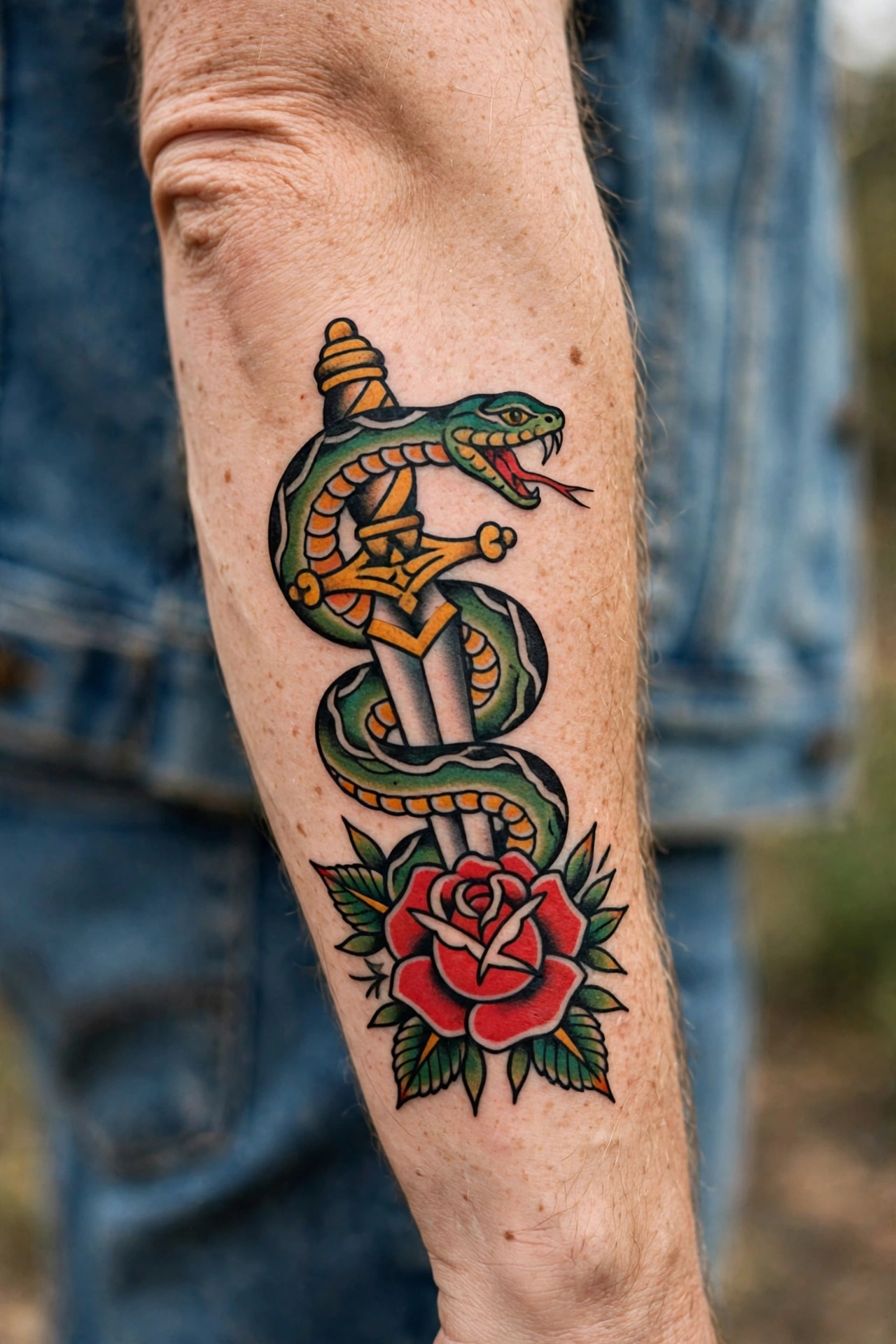
Possibly the most popular snake pairing in existence, and it earns that popularity. The rose brings love, beauty and passion; the snake brings danger, temptation and transformation. Together they say something most love tattoos cannot: this love is real, and it is not naive. It is the tattoo people get after a relationship that survived a hard patch, or for a love that has a complicated history. Colour matters here — a red rose leans romantic, a black rose leans grief or loss, a rose with thorns and a snake together leans “I know exactly what this cost.” Talk to your artist about the rose’s state, too: a blooming rose and a wilting rose are telling different stories.
Snake and dagger: protection, betrayal, readiness
The dagger adds a sharp edge, literally. A snake wrapped around a dagger, or pierced by one, can mean protection and readiness — the soft thing that can defend itself — or it can mean betrayal, a wound that taught a lesson. Context is everything, and artists will ask you which way you mean it, because the composition changes: a snake coiled protectively around a dagger’s handle reads as guardian; a dagger through a snake reads as a fight that already happened. If you are not sure which you mean, sit with it for a week. Daggers are hard to un-mean once they are on your skin.
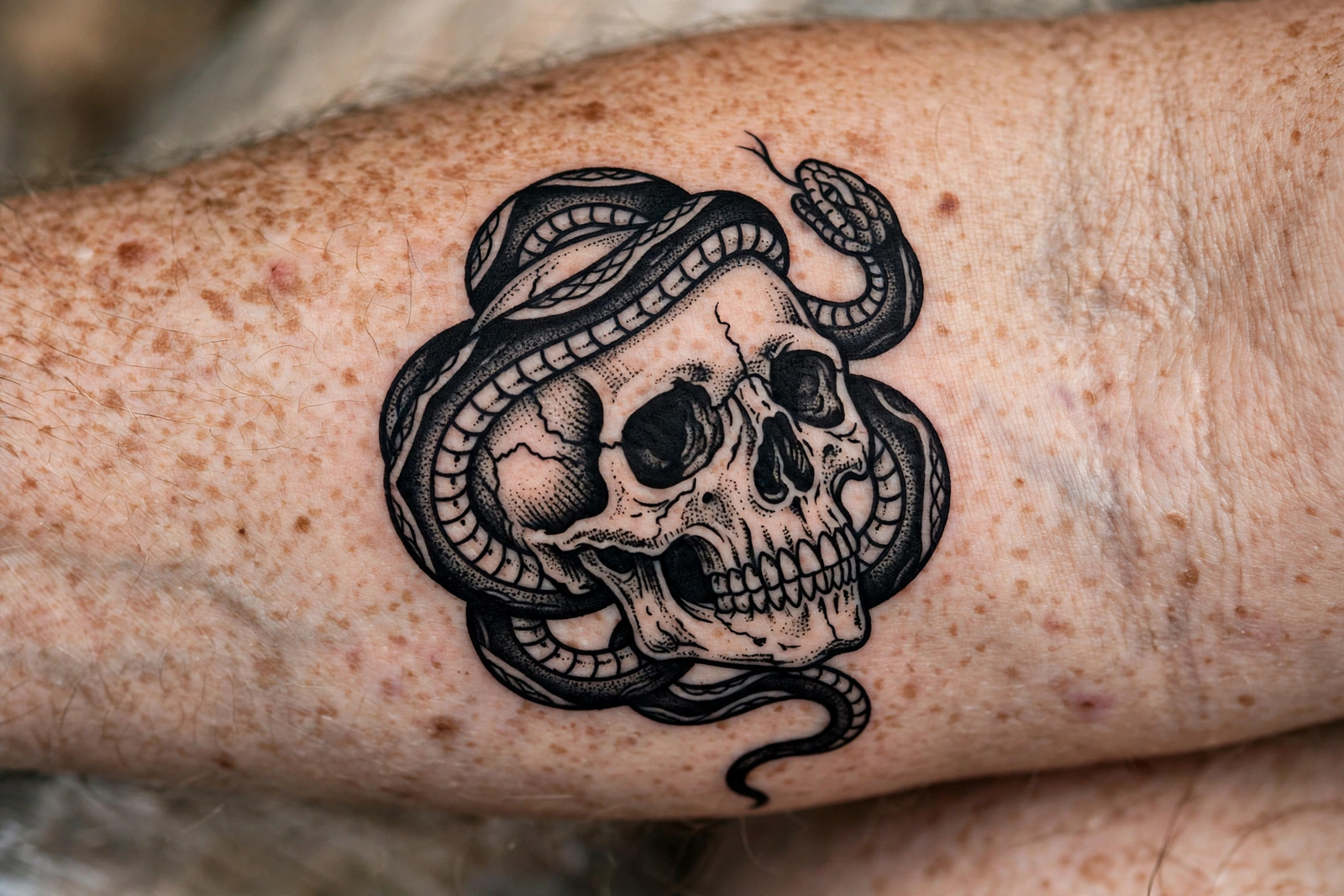
Snake and skull: mortality, rebirth, memento mori
Snakes and skulls are a natural gothic pairing, and the meaning is richer than it first looks. The skull says death; the snake says rebirth. Together they say: death is real, and so is what comes after it. It is a memento mori with a hopeful second half. These pieces look best in blackwork or traditional style, with the snake as the living, moving element against the skull’s stillness. Give it size — a skull and a snake both need detail to read, and a tiny version of this pairing turns into a muddle within a few years.
Snake and moon, snake and stars: intuition and mystery
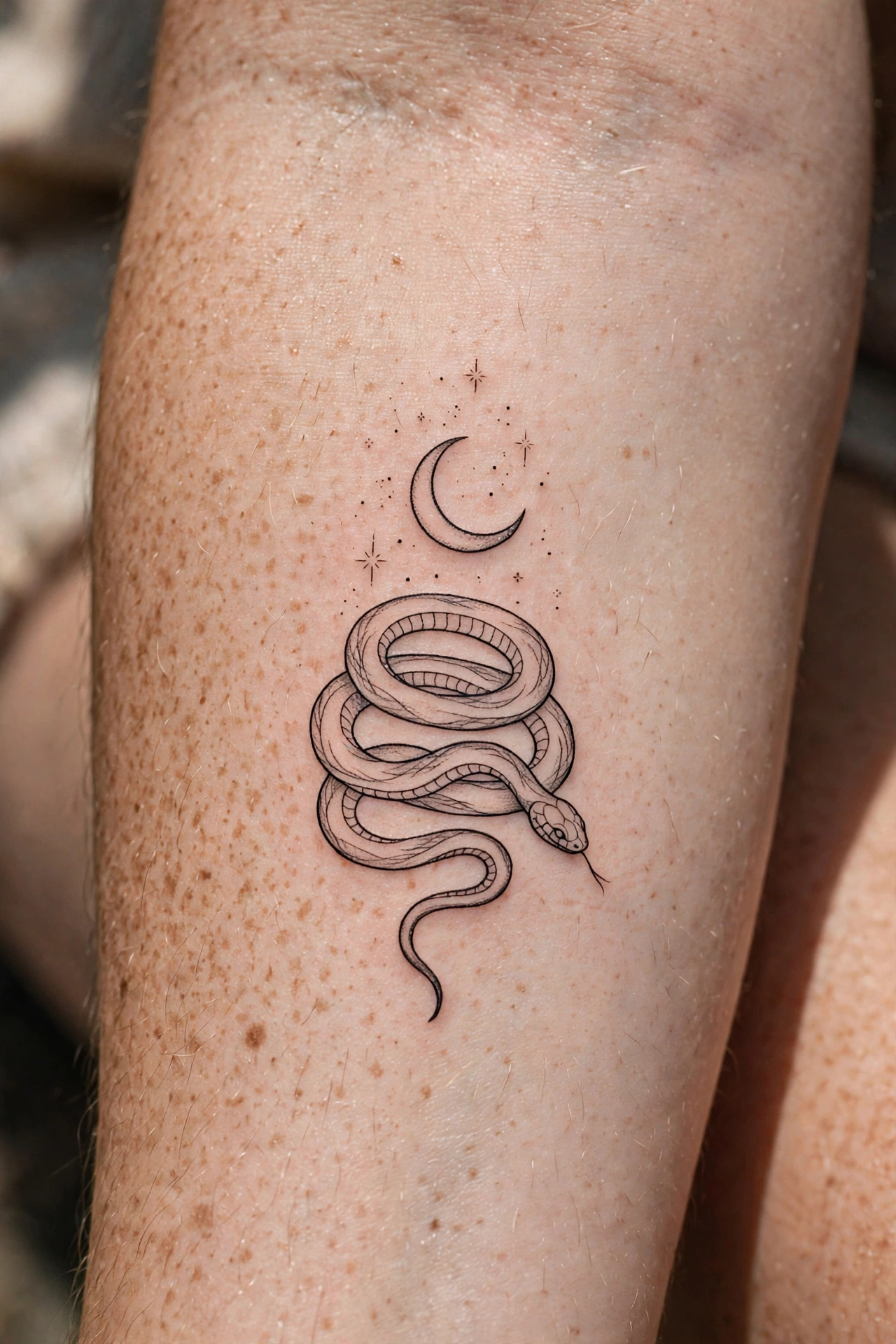
The moon brings intuition, cycles and the feminine divine, and it pairs with a snake the way it pairs with a moth — naturally. A snake beneath a crescent moon, or winding through stars, leans into mystery, dreams and the parts of yourself you do not show at work. It is a gentler snake tattoo, and it suits fine-line and dotwork styles beautifully. This is also a good pairing if you want a snake but you do not want it to read as aggressive. The moon softens it without weakening it, which is a neat trick.
Snake and flowers: growth, healing, softness
Florals change a snake’s temperature completely. Cherry blossoms bring fleeting beauty and the Japanese tradition; wildflowers bring freedom; lilies bring purity and rebirth; peonies bring prosperity. A snake moving through flowers says growth and healing — the dangerous thing, made gentle by what surrounds it, or the healing thing that still has its defences. This is the version people choose when the story has a happy ending they actually want to celebrate, and it is one of the most forgiving designs for colour, because flowers let an artist use a palette a snake alone might not support.
Styles: Which Look Fits Your Snake?
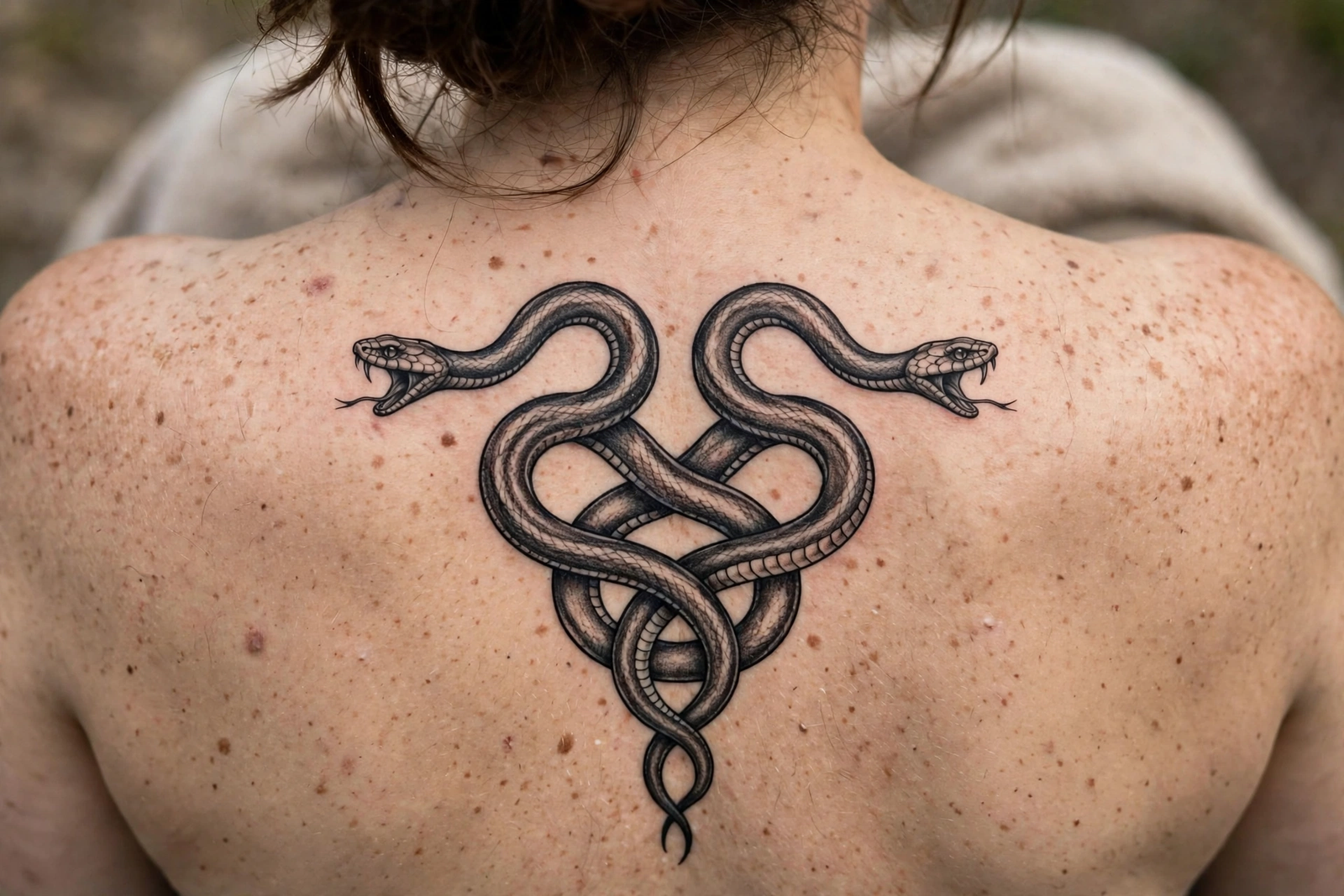
The same snake in five different styles is five different tattoos, and this is where a lot of people get stuck scrolling reference photos at midnight. A quick guide to the main options, with honest trade-offs:
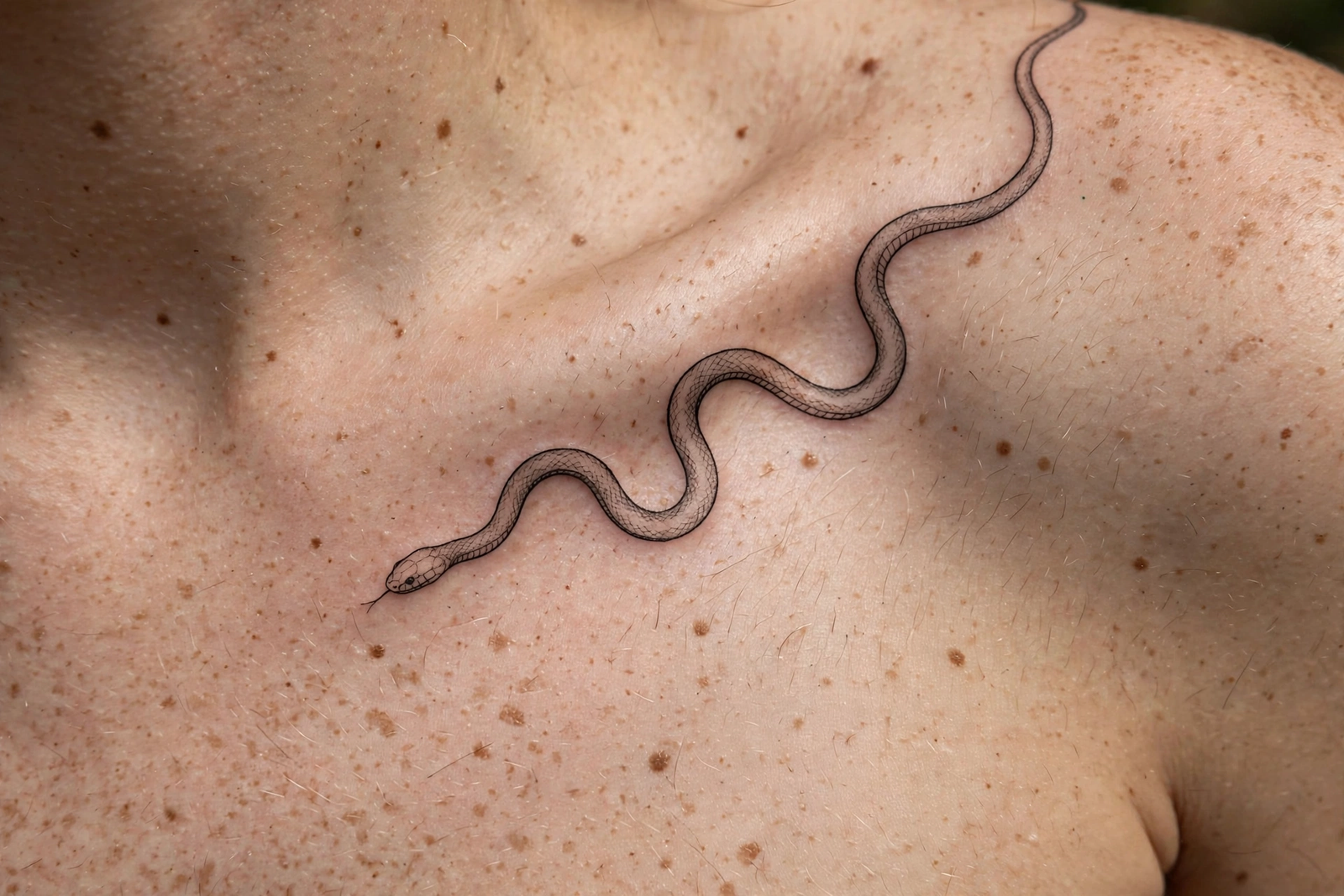
Fine-line: delicate, modern, detailed
Thin lines, minimal shading, often black ink only. Fine-line snakes look elegant and contemporary, and they suit small to medium pieces on the wrist, forearm, collarbone or ribs. The trade-off is ageing: very fine lines spread and soften over time, so a fine-line snake needs to be a little bigger than you think, and you should expect a touch-up in five to ten years. Ask to see the artist’s healed fine-line work, not just the fresh photos that look perfect on day one.
Blackwork: bold, graphic, built to last
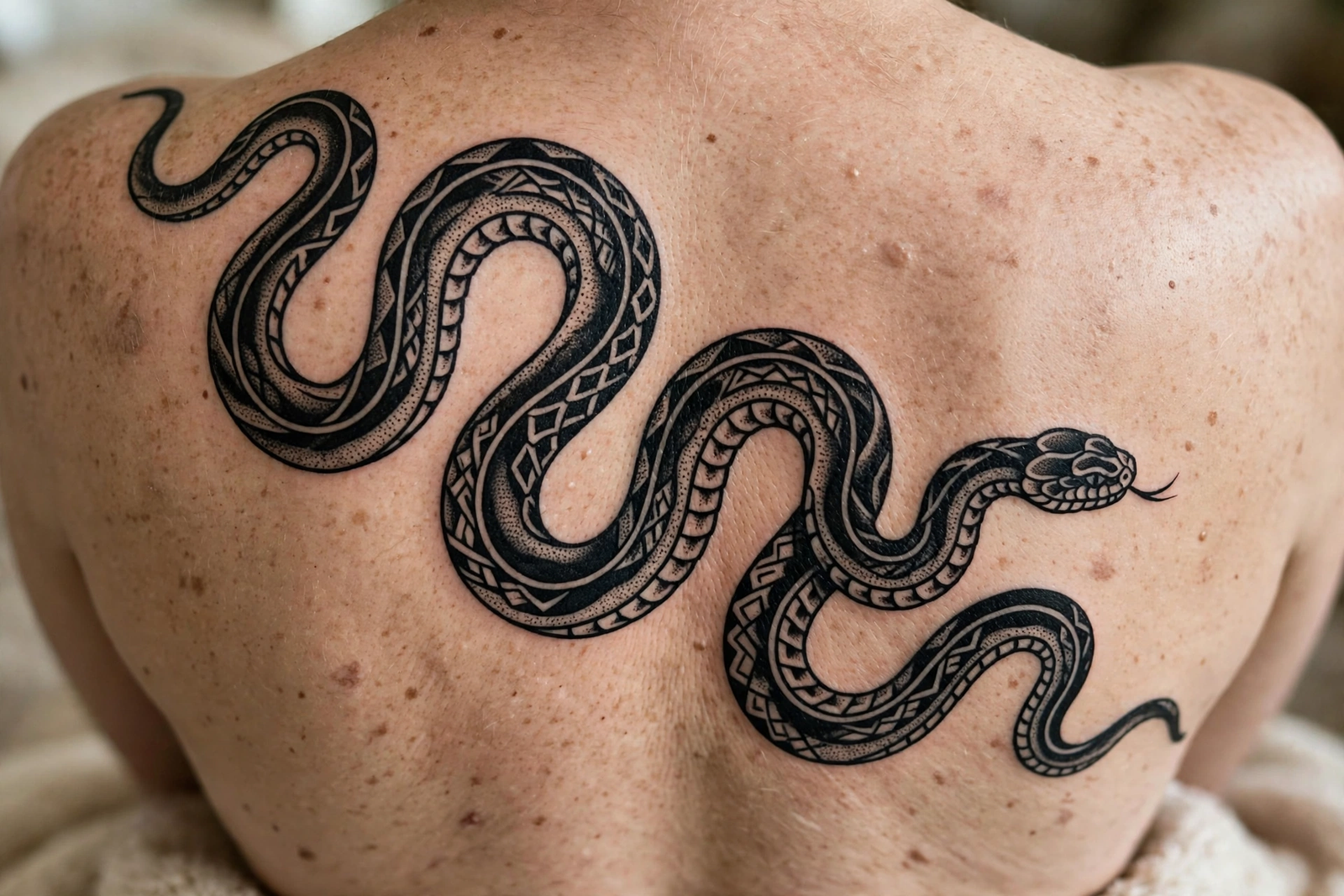
Solid black, strong shapes, sometimes dotwork shading. Blackwork snakes are dramatic, they age well, and they suit larger pieces — forearms, thighs, backs. If you want a snake that will still read clearly from across a room in twenty years, blackwork is your safest bet. The trade-off is that it is less forgiving: there is nowhere to hide a wobbly line in solid black, so the artist matters more, not less.
American traditional: vintage, bold, colourful
Thick outlines, a limited palette, that classic flash-sheet look. Traditional snakes — rattlesnakes, cobras, snakes with roses and daggers — have been done for a century, and they have survived because they work. They age beautifully, they read instantly, and they carry a whole history with them. If you like the old-school tattoo world, this is home.
Realism: lifelike, detailed, demanding
A realistic snake, with individual scales, shading and texture, can be genuinely breathtaking — and it is the hardest style to do well. It needs a specialist, it needs size, and it needs a reference photo of a real snake, not just another tattoo. Do not book a realism snake with an artist whose portfolio is mostly lettering. This is not a criticism; it is a kindness. The wrong artist for realism will give you a snake that looks like a stock photo, and you will know it every time you look at it.
Japanese (irezumi): flowing, large, storied
Japanese snake tattoos flow with the body, often as part of a larger piece with waves, flowers and wind bars. They are bold, colourful and deeply traditional, and they are best done by artists trained in that tradition. A Japanese snake is rarely a small, standalone piece — it wants room, and it rewards it. If you love this style, commit to the scale it needs. A Japanese snake squeezed onto a wrist is like a novel printed on a postage stamp.
Best Placements for a Snake Tattoo
Forearm: the classic showcase
The forearm is the snake’s most popular home, and it is easy to see why. A snake can coil around it, climb it, or stretch along it, and the placement is visible enough to show off and easy enough to cover with a sleeve. Pain is gentle, around 3/10, and healing is straightforward. This is also the best placement if you think you might add to the piece later — a moon above, flowers below, a second snake winding the other way. Forearms grow well.
Spine: symbolism meets anatomy
A snake down the spine is one of those ideas that makes artists smile, because the symbolism and the body line up so perfectly — the kundalini serpent rising, the snake as the backbone of the piece, literally. It suits a vertical, elegant snake, often fine-line or blackwork. Pain is higher, around 6/10, because the spine is bony and the skin is thin, and you will need to lie still for a while. But the result is striking, and it is one of the few placements that looks good from directly behind, which matters more than people think.
Thigh and calf: room to wrap
Thighs and calves give a snake room to be long, which is what snakes want. A python wrapping a calf, a cobra climbing a thigh — these are pieces that would be cramped anywhere smaller. Pain is gentle on the thigh (2–3/10) and moderate on the calf (4/10), and both spots are easy to hide when you need to. Thigh pieces also age well, because the skin there sees less sun and moves less than arms do. If you want a big snake, start here.
Wrist and ankle: small, private, daily
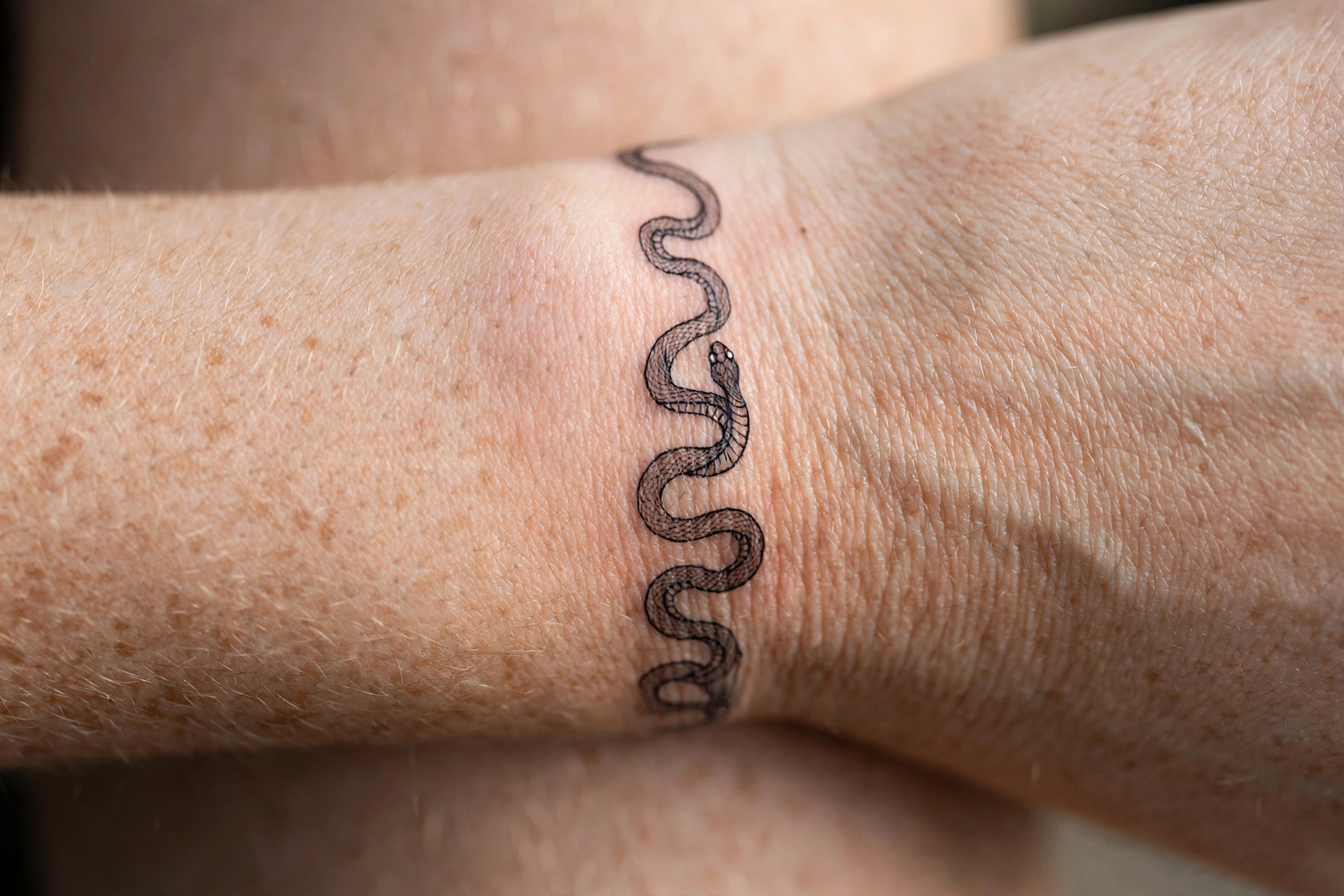
A small snake wrapped around a wrist or ankle is a private tattoo — a daily reminder you can glance at, and cover with a watch or a sock when work demands it. Pain is around 3/10. Keep the design simple at this size: a tiny snake with intricate scale detail will blur into a wavy line within a few years, and no amount of wishing will stop that. Simple, bold, a little larger than you first imagined — that is the formula for a small snake that lasts.
Chest and sternum: bold and symmetrical
A snake across the chest, or coiled symmetrically on the sternum, makes a statement. Cobras suit this spot particularly well, because the hood can spread across the chest’s width. Pain is moderate to high, around 5–6/10, and sternum pieces are hard to hide in summer. But if you want a snake that feels like armour, this is where armour goes.
Back: the big canvas
Size, Cost and Pain — Honestly
Small (5–8 cm): wrist, ankle, behind the ear. Simple snakes only — a small coiled snake or a minimal fine-line piece. Cost: roughly $80–$150 in the US, often the shop minimum.
Medium (10–20 cm): forearm, calf, shoulder. Room for a cobra with its hood, a snake with a rose, or a detailed fine-line piece. Cost: roughly $150–$400.
Large (20 cm+): full forearm wrap, thigh, back. Pythons, Japanese pieces, snakes with full scenes. Cost: roughly $400–$1,200+, depending on the artist, the style and the hours. A full back Japanese snake can run into several thousand dollars over multiple sessions, and it is worth every penny if the artist is right — and a waste if they are not.
Pain follows the usual map: bony spots (spine, sternum, ankle, ribs) sting more; padded spots (thigh, outer arm) are gentler. Snake tattoos have one pain advantage: most of the work is line and shading, not the packed solid black that makes large pieces ache, unless you go full blackwork. Sessions are usually shorter than you would expect for the length, because a snake is mostly outline with patterned fill, not a solid block of colour. That said, a long snake means a long line, and long lines mean staying still. Bring water, eat beforehand, and do not book a session the day before a big event.
Choosing an Artist for a Snake
Snakes punish sloppy linework more than most subjects, because the eye follows the line along the whole body. One wobble in the middle of a long, smooth curve and the whole snake looks wrong, even if you cannot say why. So look at healed work, not just fresh photos. Ask to see a healed snake specifically — how the scales held up, whether the line stayed smooth, whether the pattern is still readable. A good artist will have one to show you. If they only show fresh work, ask why, politely. It is a fair question, and a good artist will not mind it.
Bring reference photos of real snakes, not just other people’s tattoos. A cobra’s hood shape, a python’s pattern, a rattlesnake’s tail — getting the animal right is what separates a snake tattoo from a generic wavy line with a head. Our tattoo ideas library and placements guide can help you narrow the style and spot before you book, and our tattoo styles guide is worth a read if you are torn between fine-line, blackwork and traditional.
Aftercare in Brief
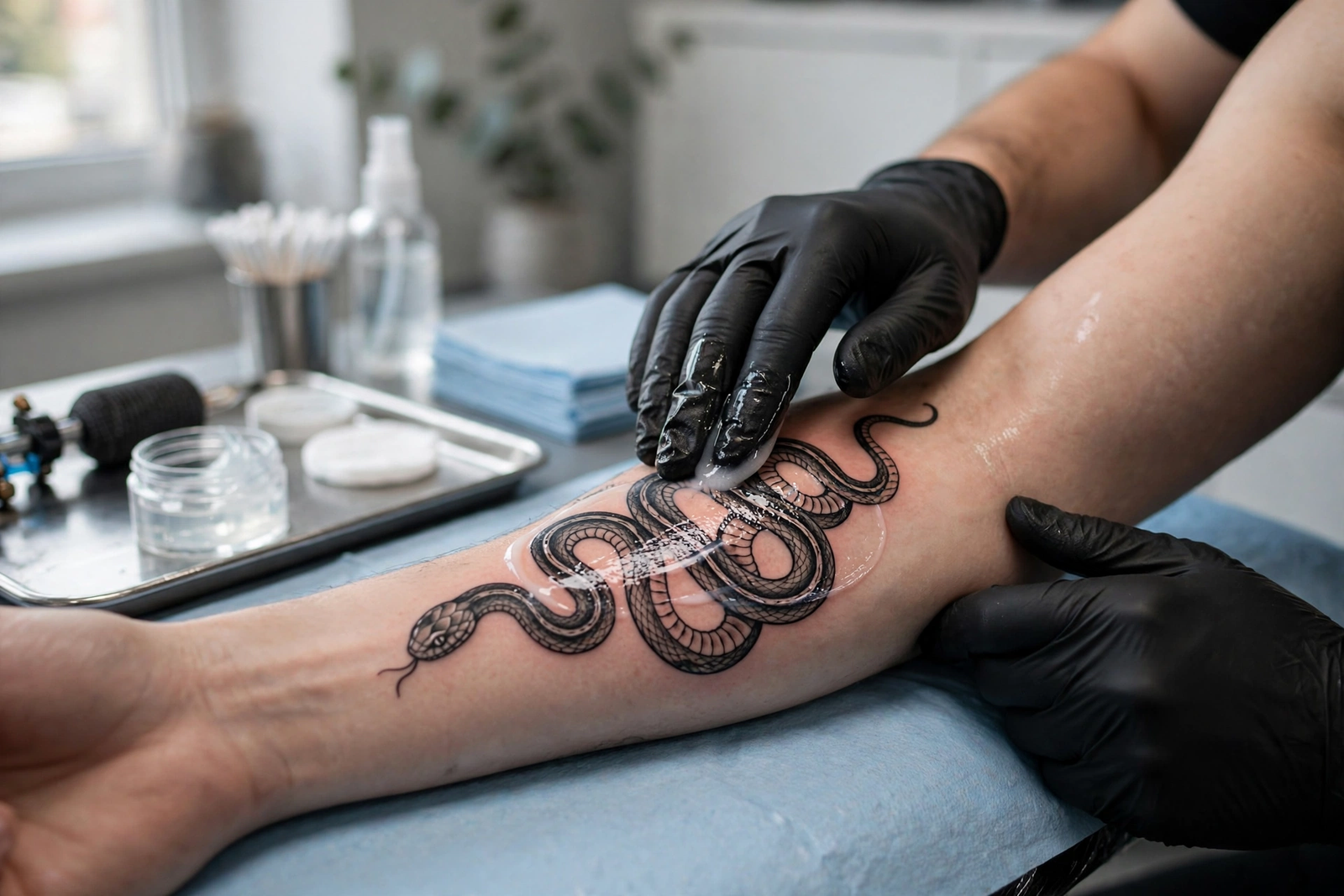
Wash gently twice a day, moisturise thinly (thin — greasy is not better), do not pick the flakes, and keep it out of pools and direct sun while it peels. Snake scales show fading faster than bold traditional work, so sunscreen after healing is not optional — it is the difference between crisp scales and a grey smudge in five years. The full day-by-day routine is in our tattoo aftercare guide. One snake-specific note: long, thin tattoos cross a lot of skin that moves differently — wrist, elbow, knee — so be extra careful about bending and stretching the area in the first two weeks. Your snake will thank you by staying smooth.
Frequently Asked Questions
What does a snake tattoo mean?
Transformation, protection and rebirth above all — shedding an old skin and coming back new. It can also mean wisdom, healing, danger or fertility, depending on the design and the culture behind it.
What does a cobra tattoo mean?
Protection, royalty and readiness. The cobra’s raised hood is a warning, and in Egyptian tradition it guarded kings. A cobra tattoo says: I protect what is mine, and I am not a soft target.
What does an ouroboros tattoo mean?
Eternity and cycles — life, death and rebirth in a continuous loop. The snake eating its own tail says endings are not final, just the start of the next round.
Is a snake tattoo bad luck or evil?
It depends on the tradition you are drawing from. In the Biblical story the serpent is temptation, but in Hindu, Egyptian, Chinese and Japanese traditions snakes are protectors, healers and bringers of good fortune. Most wearers today choose the protective and transformative meanings, and they are not shy about saying so.
Where is the best placement for a snake tattoo?
The forearm for visibility and versatility, the spine for symbolism, the thigh or calf for a long wrap-around piece, and the wrist or ankle for a small private snake. Match the length of the snake to the length of the spot.
How much does a snake tattoo cost?
Small snakes run about $80–$150 in the US; medium pieces $150–$400; large or full-back work $400–$1,200 or more, with large Japanese pieces running higher over multiple sessions.
Does a snake tattoo hurt?
It depends on the spot. Thigh and outer forearm are gentle (2–3/10); spine, sternum and ribs sting more (5–6/10). Most snake work is line and shading rather than packed black, so sessions are usually manageable.
Can I get a snake tattoo if I am afraid of snakes?
Honestly? Some of the best snake tattoos belong to people who were. A tattoo can be a way of facing a fear, or of reclaiming a symbol that used to scare you. If the fear is severe, though, live with the design on paper first — you will be looking at it every day, and it should feel like power, not anxiety.
Shed, and Shed Again
Here is what I keep coming back to, after all those studio afternoons and all those stories. A snake tattoo is not a trophy. It is not proof that you changed once, a long time ago, and now you are done. It is a reminder that change is something you know how to do, because you have done it before, and you will do it again when you need to. The skin you shed is not a failure. It is evidence. It fit you once, it does not fit you now, and leaving it behind is not ungrateful — it is growth.
If that feels true for you, then pick your snake like you mean it. Pick the species that matches your story, not just the one that photographs best. Give it room on your body, find an artist whose healed snakes you would trust with a long, smooth line, and live with the design for two weeks before you book. Then wear it the way a snake wears its new skin: quietly, completely, and without apology.
Browse our tattoo meanings library for more symbols with stories behind them, or start with our tattoo ideas if you are still deciding which snake is yours.