
Quick answer: A moth tattoo means transformation, intuition, and the search for light in dark times. Moths change completely — egg, caterpillar, cocoon, winged adult — but they do it in the dark, without an audience. So where a butterfly tattoo tends to say “look how I’ve changed,” a moth tattoo says something quieter: I changed when nobody was watching, and I’m still finding my way toward the light.
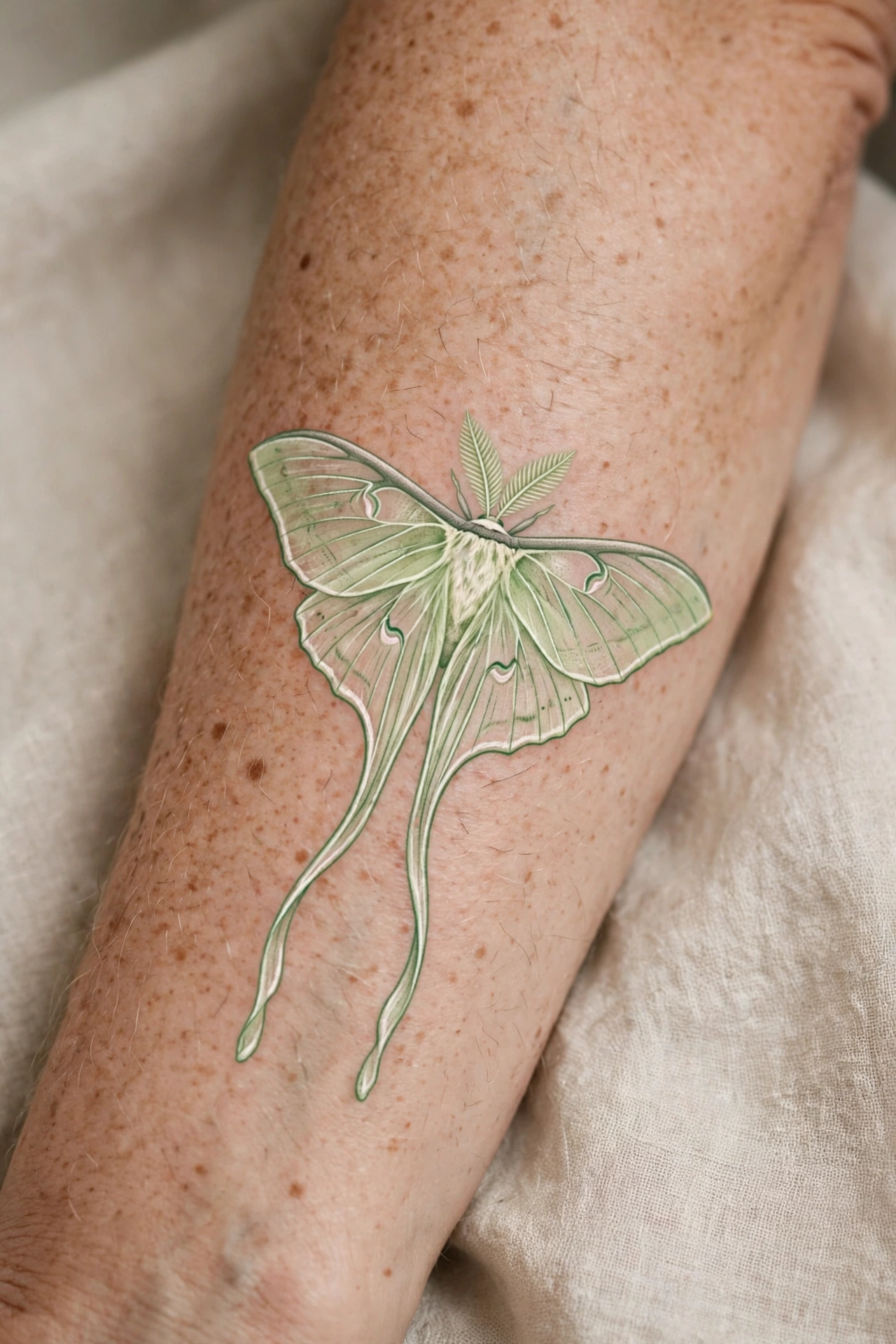
Butterflies get all the attention. They’re daytime creatures, bright, easy to photograph, easy to love. Moths are the night shift. And honestly? That’s exactly why people pick them. I first properly noticed the difference in a studio waiting room, of all places. A woman ahead of me was showing her artist a photo of a luna moth — pale green, feathery antennae, those long trailing tails — and she said, almost apologetically, “I know everyone gets butterflies, but mine happened at night.” The artist didn’t miss a beat. “Then get the night one,” he said. She did. And I’ve thought about that sentence ever since, because it sums up the whole appeal: a moth tattoo isn’t the prettier version of a butterfly tattoo. It’s the truer version, for a certain kind of person.
So here’s the full story, the way we’d tell it across a studio counter: what a moth tattoo means, why the species matters (a luna moth and a death’s-head hawkmoth are not saying the same thing at all), the designs people actually get, where they put them, what they cost, and how to choose one that still means something in twenty years.
What Does a Moth Tattoo Mean?
Strip it back and the moth’s symbolism rests on three facts about the animal itself. Everything else — the poetry, the folklore, the late-night meaning — grows out of these.
1. Transformation, done in private
Yes, moths metamorphose like butterflies do. The difference is the setting. A butterfly’s transformation is a daytime spectacle; a moth’s happens in a cocoon in the dark. That’s why moth tattoos so often mark changes nobody applauded: getting sober, leaving a marriage, rebuilding after a burnout that never made it onto social media. The change was real. It just wasn’t performed.
2. Attraction to light
This is the image everyone knows — a moth circling a lamp, a flame, the moon. Read kindly, it’s hope and determination: refusing to give up on the thing that draws you, even when the path is dark. Read honestly, it carries a warning too: chasing light can burn you. Plenty of wearers like that tension. They didn’t pick a symbol that pretends the journey was safe. They picked one that admits it wasn’t.
3. Intuition and the unseen
Moths navigate by moonlight and by senses we barely understand. Across folklore they get linked to dreams, the subconscious, and trusting your gut when you can’t see the whole road. If you’ve ever made a huge decision on a feeling you couldn’t explain to anyone — and been right — you know exactly why someone would ink that.
Put those three together and you get the moth’s core sentence: quiet growth, guided by instinct, toward the light. Some wearers add a fourth layer — vulnerability with courage. Moths are fragile things. They fly toward what draws them anyway. Softness and boldness in the same small body. That’s a combination a lot of people recognise in themselves.
Luna Moth vs Death’s-Head Moth: Not the Same Tattoo
This is where moth tattoos get interesting, because the species you choose changes the message completely. Pick wrong and you’ll spend years explaining a tattoo you didn’t mean.
The luna moth: gentle transformation
Pale green wings, eyespots like little moons, long tails trailing behind. The luna moth lives only about a week as an adult — it doesn’t even have a mouth — and somehow that brevity makes it more poignant, not less. A luna moth tattoo usually means gentle change, new beginnings, and making a short, beautiful chapter count. It’s the moth people choose after healing, after a fresh start they want to protect rather than shout about. Soft colours, fine lines, and placements like the wrist, shoulder blade or collarbone suit it best.
The death’s-head hawkmoth: darkness, faced head-on
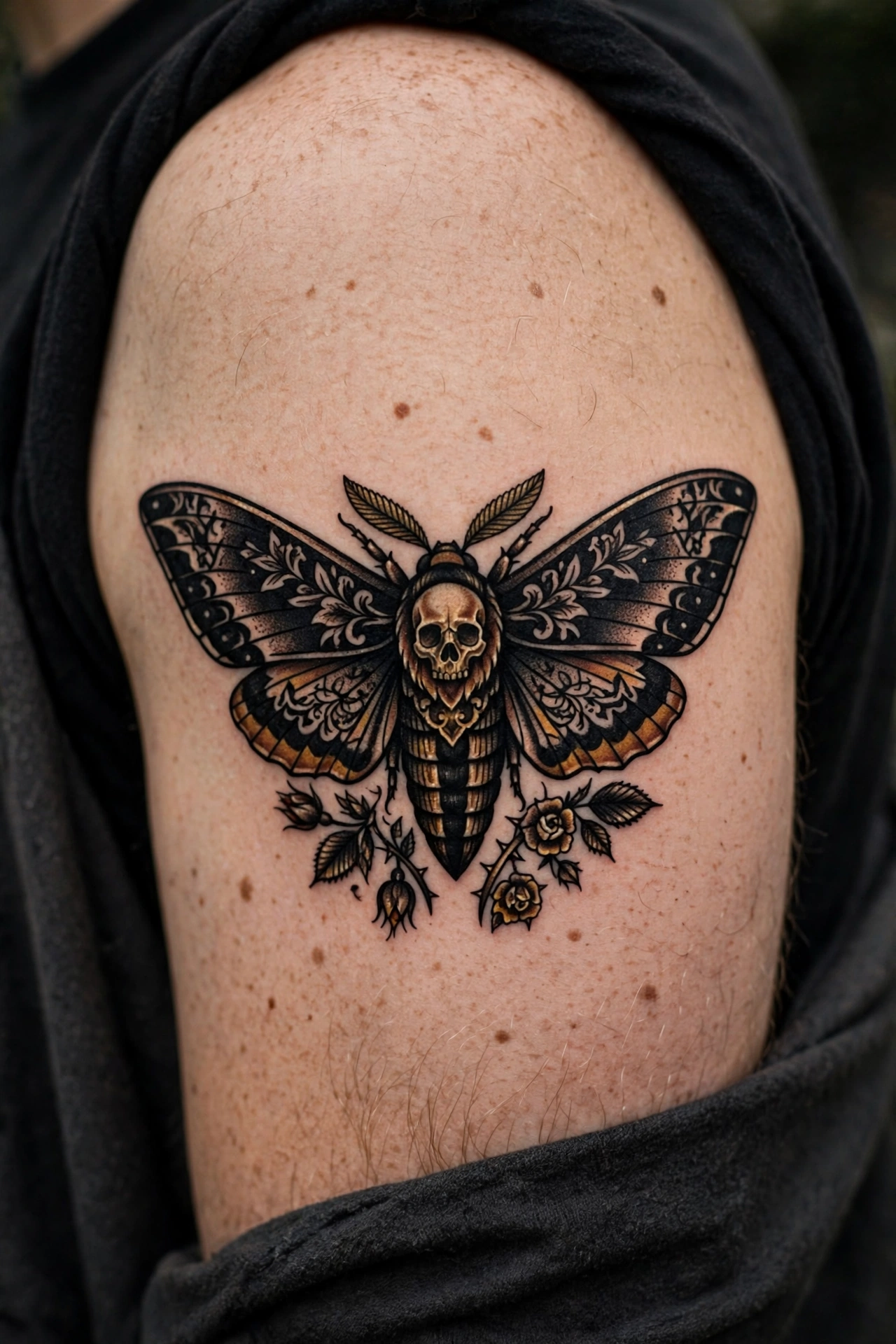
Big, brown and gold, with a marking on its back that looks uncannily like a human skull. The death’s-head hawkmoth is the moth of gothic tattoos, horror lovers, and people who have stared at mortality and decided to wear the answer. Its meaning runs toward death and rebirth, mystery, and the acceptance that endings are part of the story. It also carries a pop-culture shadow — yes, the Silence of the Lambs poster — which some wearers love and others spend forever explaining. If the skull marking isn’t your thing, say so early; plenty of artists will soften it or leave it out.
Other moths worth knowing
The atlas moth — huge, with snake-head wingtips — reads as awe and scale; the rosy maple moth, pink and yellow like candy, flips the dark-moth script entirely. You don’t need the famous species, though. The moth that means something to you beats the one that photographs best.
Moth Tattoo vs Butterfly Tattoo: Which One Is Yours?
People ask us this constantly, and it’s a fair question — they look similar on a flash sheet and they share the metamorphosis story. But the feeling is different, and the feeling is the point.
A butterfly tattoo usually celebrates a transformation that’s complete and visible: freedom, beauty, a new chapter you’re proud to show. A moth tattoo usually honours one that was harder, quieter, or still in progress — growth in the dark, intuition over applause, light sought rather than found. If you read that and felt a small jolt of recognition at the second half, congratulations: you’re a moth person.
Moth Tattoo Designs That Work
Luna moth, fine-line
The classic. Delicate green shading (or pure black fine-line if colour isn’t your thing), feathery antennae, long tails. It works small on a wrist or ankle and large across a shoulder blade. One warning from artists: those tails are the first thing to blur if the piece is too small. Give them room, or accept a simplified tail.
Moth and moon
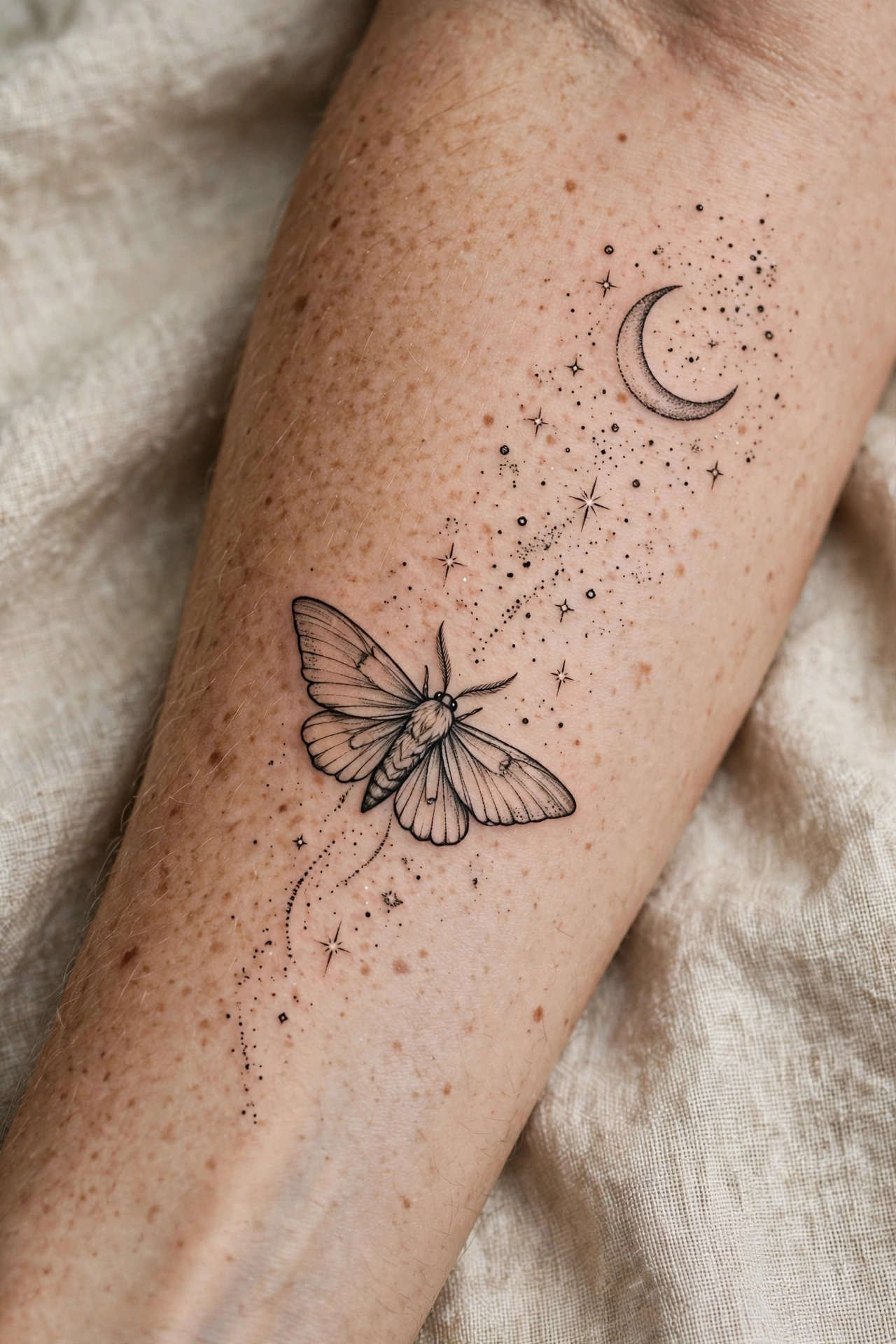
The most natural pairing in tattooing. The moth flies toward the crescent moon, sometimes with a scatter of stars, and the meaning doubles down on intuition and guidance. It also just looks right — the curved wings against the curved moon is one of those compositions that basically designs itself. Crescent moons sit beautifully on the sternum, the forearm, or the back of the shoulder.
Moth with flowers
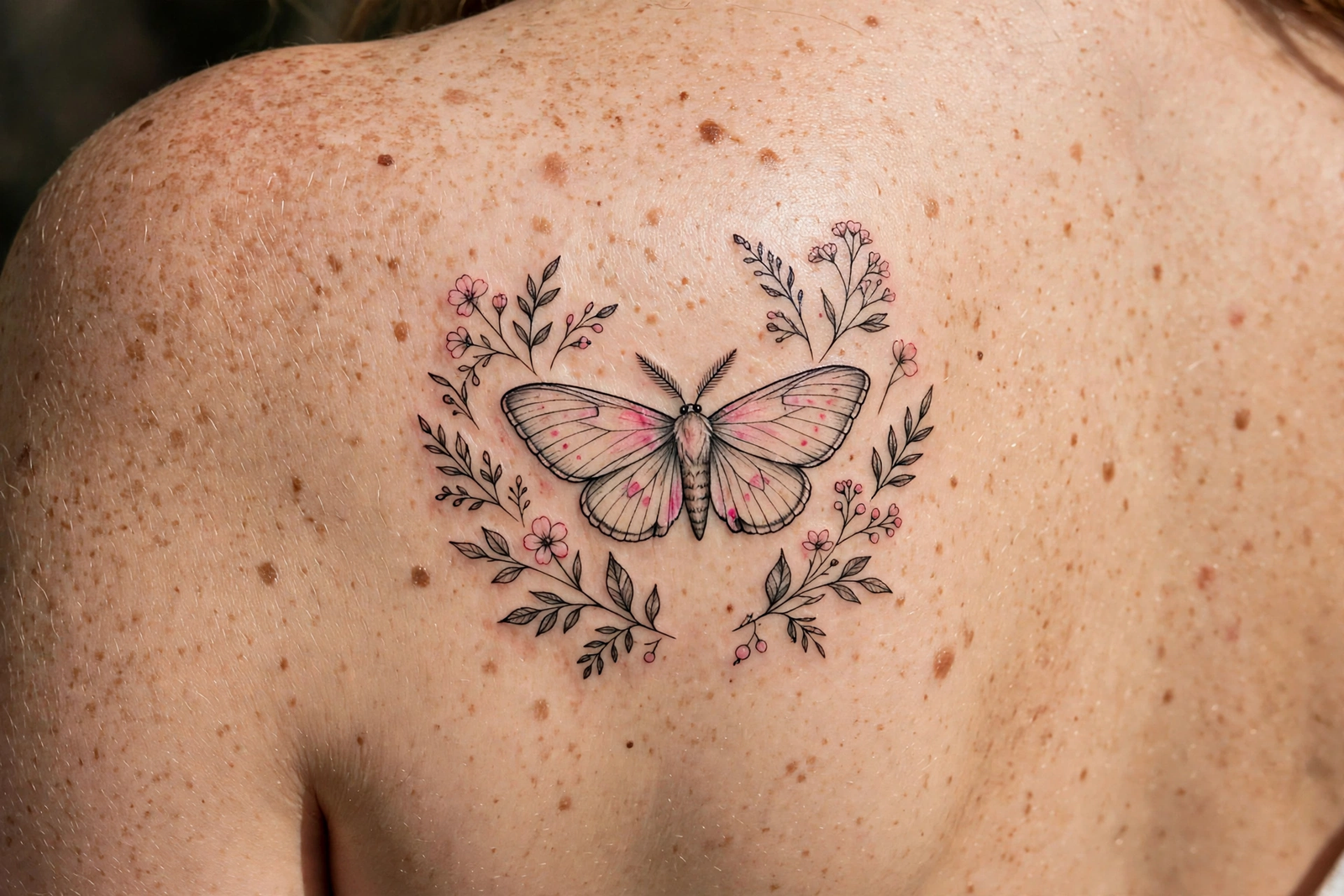
Florals woven around a moth soften the whole piece and add renewal: life blooming on top of a dark chapter. Lavender for calm, roses for love that survived something, wildflowers for freedom. This is the version people choose when the story has a happy ending they actually want to show.
Death’s-head, blackwork or traditional
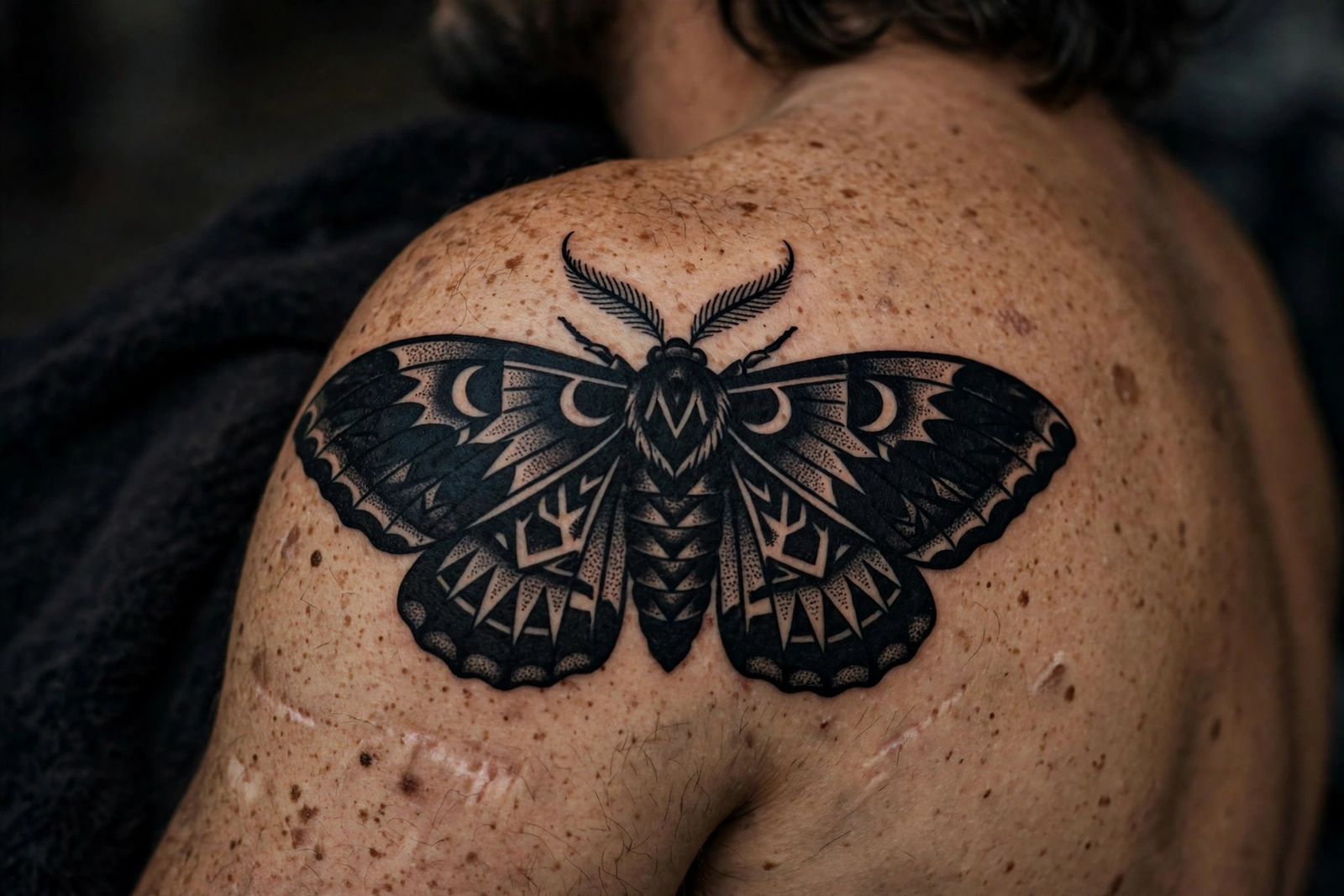
Bold outlines, heavy shading, the skull marking front and centre. Traditional-style death’s-heads with gold and brown colouring look almost like old natural-history illustrations — beautiful in a slightly unsettling way, which is precisely the appeal. These need size: a death’s-head squeezed into two centimetres becomes an unidentifiable blob within a few years.
Moth and dagger, moth and skull
The dagger adds protection and readiness — softness that can defend itself. A skull underneath or behind the moth leans into the death-and-rebirth reading. Both pairings are popular in gothic and traditional collections, and both look best when the moth stays the hero and the second element stays supporting cast.
Best Placements for a Moth Tattoo
Sternum / chest
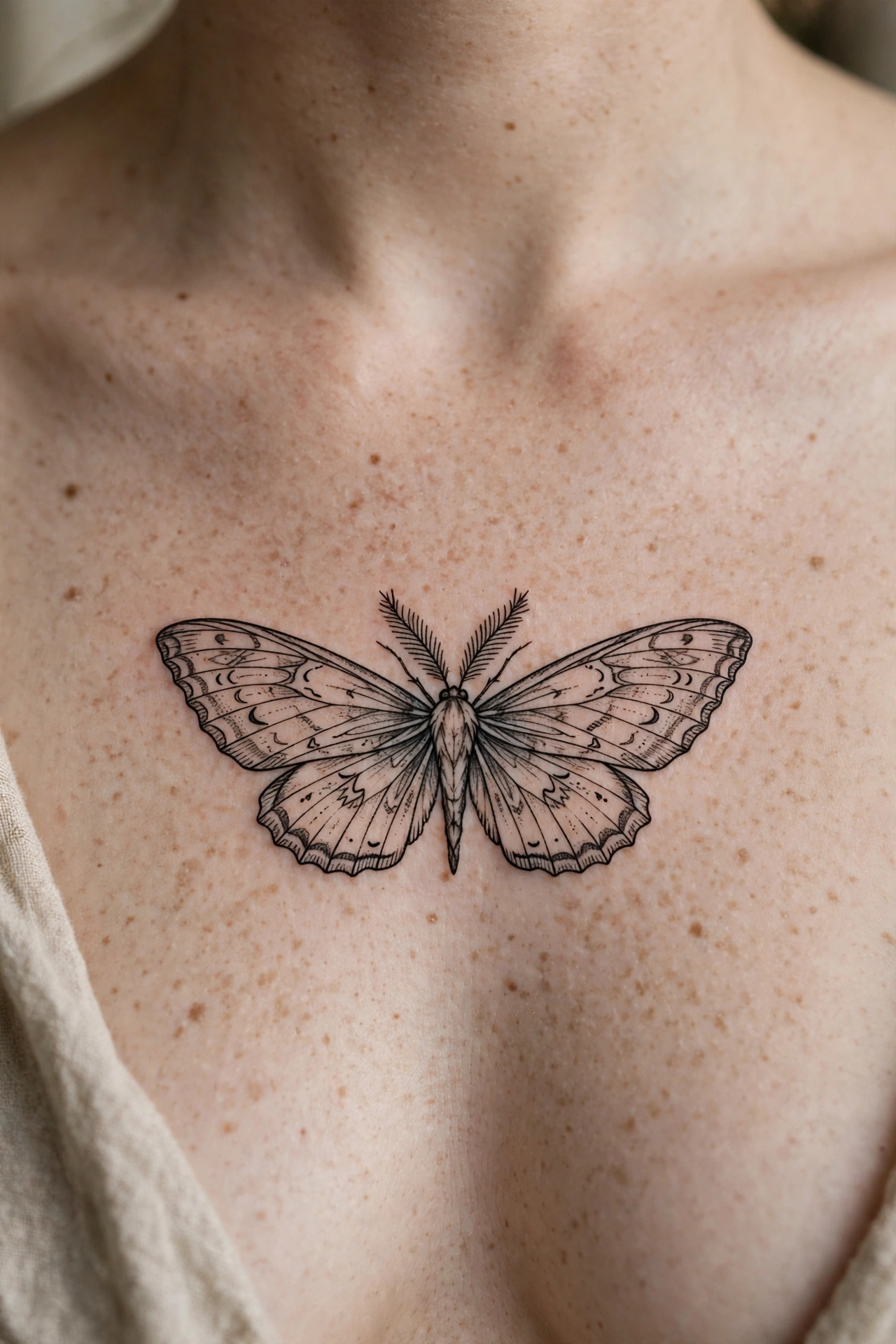
The sternum is the moth’s natural home. The body’s centre line mirrors the moth’s symmetry, so a centred moth here looks like it was designed for the spot — because, in a sense, it was. Pain: about 6/10 — the bone is close to the surface and the skin is thin. Worth it, wearers say, every time. Just know that sternum pieces are hard to hide in summer.
Shoulder blade / upper back
The big-canvas option. A large luna or atlas moth spread across one shoulder blade — or a pair of wings stretching across both — gives the design room to breathe. Pain: 3–4/10, one of the gentler large placements. This is where the most detailed moth work lives.
Forearm
Visible, easy to show, easy to cover with a sleeve. A medium moth on the inner or outer forearm reads clearly and heals well. Pain: 3/10. The forearm is also the best spot if you want to add to the piece later — a moon above, flowers below, a whole night sky over time.
Wrist
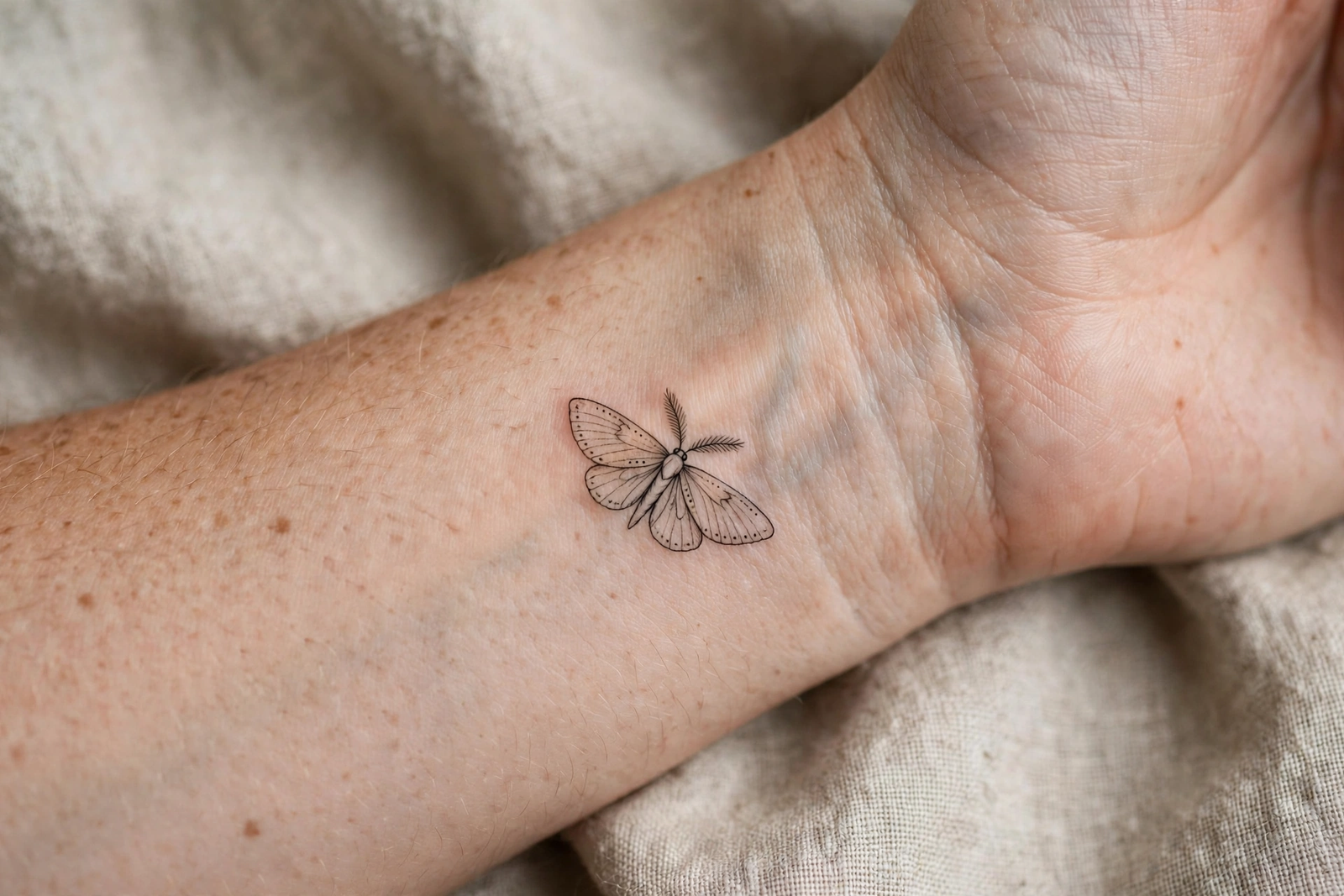
The private version. A small moth on the inner wrist is a daily reminder you can glance at — and cover with a watch when work demands it. Pain: 3/10. Keep it simple at this size; fine antennae and wing veins blur fastest here.
Thigh
Room for the biggest, most detailed moths, with the gentlest pain of any large placement (2–3/10) and easy concealment. Thigh moths also age well — the skin there moves less and sees less sun than arms do. If you want a death’s-head with full shading, start here.
Size, Cost and Pain — Honestly
Small (3–5 cm): wrist, ankle, behind the ear. Simple fine-line moths only — detail at this size is a promise your skin can’t keep. Cost: roughly $80–$150 in the US, often the shop minimum.
Medium (8–15 cm): forearm, shoulder blade, sternum. Room for a luna with shading, or a moth with a moon and stars. Cost: roughly $150–$400.
Large (15 cm+): full back, thigh, chest piece. Death’s-heads with heavy blackwork and full detail live here. Cost: roughly $400–$1,000+, depending on the artist and the hours.
Pain follows the usual map: bony spots (sternum, ankle, spine) sting more; padded spots (thigh, outer arm) are gentler. Moth tattoos have one pain advantage — most of the work is line and soft shading, not the packed solid black that makes large pieces ache. Sessions are usually shorter than you’d expect for the size.
Choosing an Artist for a Moth
Moths punish sloppy linework. The wings are symmetrical, the antennae are thin, and the whole design depends on balance — one wing heavier than the other and the eye notices instantly, even if it can’t say why. So look at healed work, not just fresh photos: fine lines spread over time, and a moth that looked crisp on day one can look tired by year three if the lines were too tight. Ask to see a healed moth specifically. A good artist will have one. If they only show fresh work, ask why.
Also: bring reference photos of the actual species, not just other people’s tattoos. A luna moth’s wing shape, a death’s-head’s markings — getting the animal right is what separates a moth tattoo from a generic butterfly-with-attitude. Our tattoo ideas library and placements guide can help you narrow the style and spot before you book.
Aftercare in Brief
Wash gently twice a day, moisturise thinly (thin — greasy is not better), don’t pick the flakes, and keep it out of pools and direct sun while it peels. Moth wings show fading faster than bold traditional work, so sunscreen after healing isn’t optional — it’s the difference between crisp wings and a grey smudge in five years. The full day-by-day routine is in our tattoo aftercare guide.
Frequently Asked Questions
What does a moth tattoo mean?
Transformation in private, intuition, and finding light in dark times — quiet growth guided by instinct, rather than a loud, finished reinvention.
What does a luna moth tattoo mean?
Gentle transformation, new beginnings, and making a short chapter count. The luna moth’s brief adult life — about a week — gives it a bittersweet, “make it matter” feeling.
What does a death’s-head moth tattoo mean?
Death and rebirth, mystery, and facing mortality without flinching. The skull-like marking on its back makes the darker reading literal.
Is a moth tattoo the same as a butterfly tattoo?
No. They share metamorphosis, but butterflies symbolise visible, celebrated transformation and freedom, while moths symbolise quieter growth in the dark, intuition, and seeking light. The feeling is different, and that’s the point.
Are moth tattoos unlucky?
In some folklore, moths are linked to death or omens — the old superstition that a moth in the house foretells a death. Most wearers either don’t mind or actively reclaim it: the moth as a guide through dark passages, not a warning about them.
Where is the best placement for a moth tattoo?
The sternum for symmetry, the shoulder blade or thigh for large detailed work, and the wrist or forearm for a small, private reminder. Match the size to the spot — detailed moths need room.
How much does a moth tattoo cost?
Small fine-line moths run about $80–$150 in the US; medium pieces $150–$400; large detailed work $400–$1,000 or more, depending on the artist.
The Night Shift, Worn Proudly
Here’s the thing about moth tattoos: they don’t ask for attention. They don’t sparkle in daylight or demand an explanation. They sit there — on a sternum, a wrist, a shoulder blade — and mean something to exactly one person, fully, and to everyone else only if that person decides to tell them.
If your change happened at night, if your guidance came from a gut feeling rather than a plan, if you’re still flying toward a light you can’t quite see yet — a moth might be the most honest tattoo you’ll ever get. Choose the species like you mean it, give the wings room, and find an artist whose healed work you’d trust with something this symmetrical.
Browse our tattoo meanings library for more symbols with stories behind them, or read our tattoo styles guide if you’re still deciding between fine-line, blackwork and traditional for your moth.