
Quick answer: A lion tattoo means courage, strength, pride, and leadership — but not the loud, chest-beating kind. The lion’s version of strength is quieter: the animal that doesn’t need to prove anything, that protects its own, and that stays calm until calm stops working. A lioness adds another layer — fierce motherhood, loyalty, and the strength that holds a family together. A roaring lion says power unleashed; a calm, watchful lion says power under control. Both are true. They just belong to different people, or to the same person at different times in their life.
Lions are everywhere in tattooing, and I mean everywhere. Chest pieces, forearms, thighs, full backs — if a studio has a wall of flash, there’s a lion on it somewhere, usually staring straight at you like it owns the place. Which, in fairness, it kind of does. But here’s the thing people miss when they pick a lion off that wall: this isn’t a generic “strong animal” tattoo. A wolf means loyalty to the pack. An eagle means freedom. A lion means something more specific, and a bit more personal — authority you didn’t ask for but accepted, courage you found when you needed it, or a family you’d do anything for.
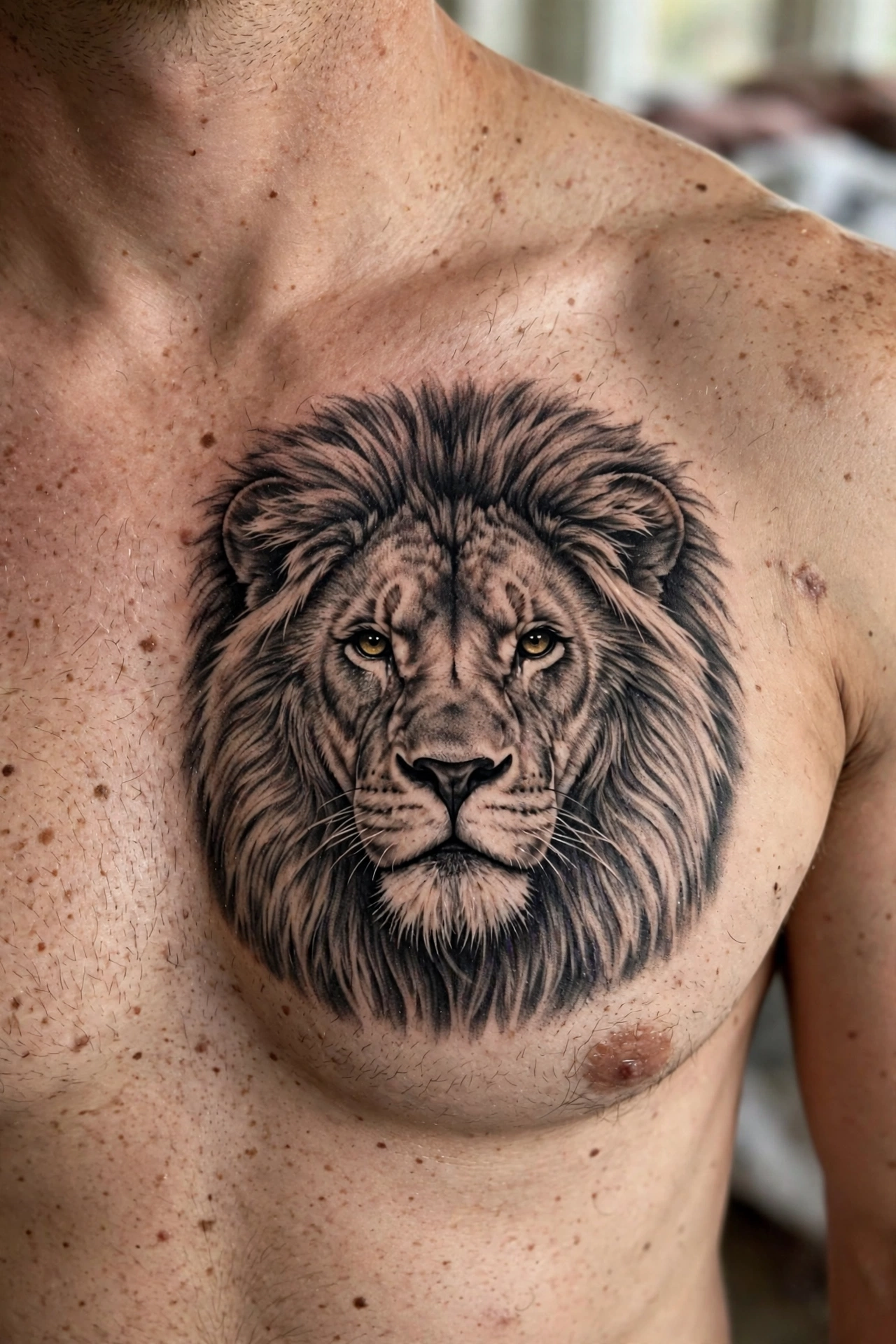
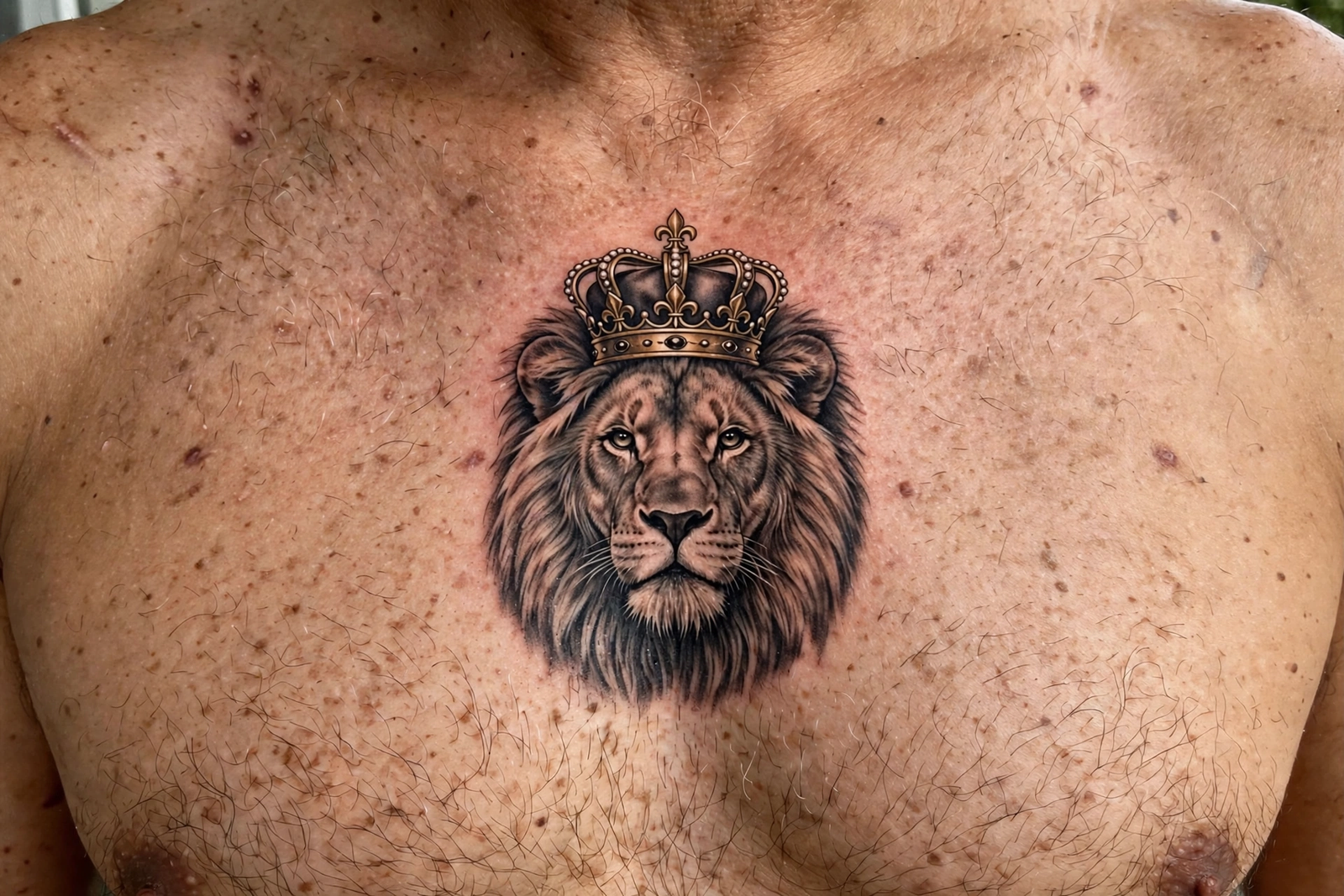
I’ll never forget the first lion tattoo I watched being done properly. It was a big chest piece, a lion’s face right over the guy’s heart, and halfway through the shading he told the artist — quietly, like he didn’t want the whole shop to hear — that he’d gotten it the year his dad died. Not because his dad was loud or fearsome, but because, as he put it, “he was the calm one, and when he wasn’t calm anymore, everybody listened.” That’s a lion tattoo in one sentence, isn’t it? Not the roar. The calm before it, and the reason for it.
So here’s the full guide, the way we’d talk you through it at the counter: what a lion tattoo means, how a lion and a lioness say different things, roaring versus calm, the styles that suit a lion’s face, where to put one, what it costs, what it hurts like, and how to choose a lion that still feels like leadership — not just a cool animal — twenty years from now.
What Does a Lion Tattoo Mean?
Strip away the Disney associations and the sports logos for a minute, and the lion’s symbolism comes from how lions actually live. They’re not the fastest animal, or the biggest, or the most aggressive. What they are is steady. They hold territory. They protect their pride. They rest a lot, and when they move, they mean it. Tattoo meanings grow out of that behavior, not out of a cartoon.
Courage — the kind you use, not the kind you show
Ask a dozen people with lion tattoos what theirs means and courage comes up more than anything else, but listen closely and it’s rarely the movie kind. It’s not “I’m fearless.” It’s “I was scared and I did it anyway.” A job interview after a layoff. Leaving a bad relationship. Speaking up when staying quiet would have been easier. Getting sober, getting help, starting over at forty. The lion fits because lions aren’t fearless either — they’re just willing. That’s a much more useful kind of courage, and it’s the one worth inking.
Strength that protects
This is the distinction that matters. A lion tattoo doesn’t usually mean “I can beat you up.” It means “I can protect what’s mine.” Parents get lions for their kids. Older siblings get lions for younger ones. People who’ve become the steady person in their family — the one everyone calls in a crisis — get lions because, finally, someone named the role out loud. If your strength is mostly used for other people, a lion probably fits you better than a skull or a dagger would. It’s power pointed outward in defense, not inward in anger.
Pride, in both senses of the word
Yes, a group of lions is called a pride, and yes, tattoo artists hear that joke about twice a day. But the double meaning is actually useful. A lion tattoo can mean pride in yourself — what you’ve built, what you’ve survived, who you’ve become — and pride in your people: your family, your team, your community. Some wearers lean into one, some into both. A lion with cubs, for example, is almost always family pride: my pride, literally, on my skin. A lone lion, head high, is more often personal pride: I earned this, and I’m not apologizing for it.
Leadership and authority
Lions are called the king of beasts, not because they’re the strongest animal in every fight — they’re not — but because of how they carry themselves. Other animals move out of the way. That’s presence, not aggression, and it’s why lion tattoos are so popular with people in leadership roles: managers, coaches, military folks, business owners, and plenty of people who lead a family without a title for it. A lion with a crown leans into this hard (we’ll get to crowns in a minute, and the warning that comes with them). A plain lion’s face says it quieter: I lead, and I don’t need a crown to prove it. Which version you pick says a lot about how you lead.
Faith, royalty and heritage
Lions carry deep cultural weight that goes way beyond tattoos. The Lion of Judah in faith and Ethiopian heritage, the lion in British and Scottish heraldry, Leo in astrology, lions guarding temples and palaces across Asia. For a lot of wearers, the tattoo connects to one of those roots — a faith, a family crest, a star sign, a country. If your lion has a heritage meaning, say so to your artist early. The details change: a heraldic lion looks nothing like a realism lion, and getting the tradition right matters more than getting the shading perfect. Respect the source, and the tattoo respects you back.
Lion vs Lioness: Not the Same Tattoo
This is the choice people get wrong most often, usually because they pick the flash that looks coolest without thinking about which animal’s story matches theirs. Lions and lionesses live different lives, and their tattoos say different things. Both are powerful. They’re just powerful in different directions.
The male lion: authority, presence and protection
The mane does a lot of the work here, visually and symbolically. A male lion tattoo, mane in full glory, reads as authority, majesty, and the protector role — the one who stands at the front. It’s the version most people picture when they say “lion tattoo,” and it suits people who’ve stepped into a protector or provider role, or who want to mark a moment they stood their ground. The mane also gives artists a gift: all that flowing hair is perfect for shading, for movement, for making a big piece feel alive rather than flat. If you want a large, dramatic lion, the male’s mane is your best friend.
The lioness: fierce motherhood, loyalty and quiet power
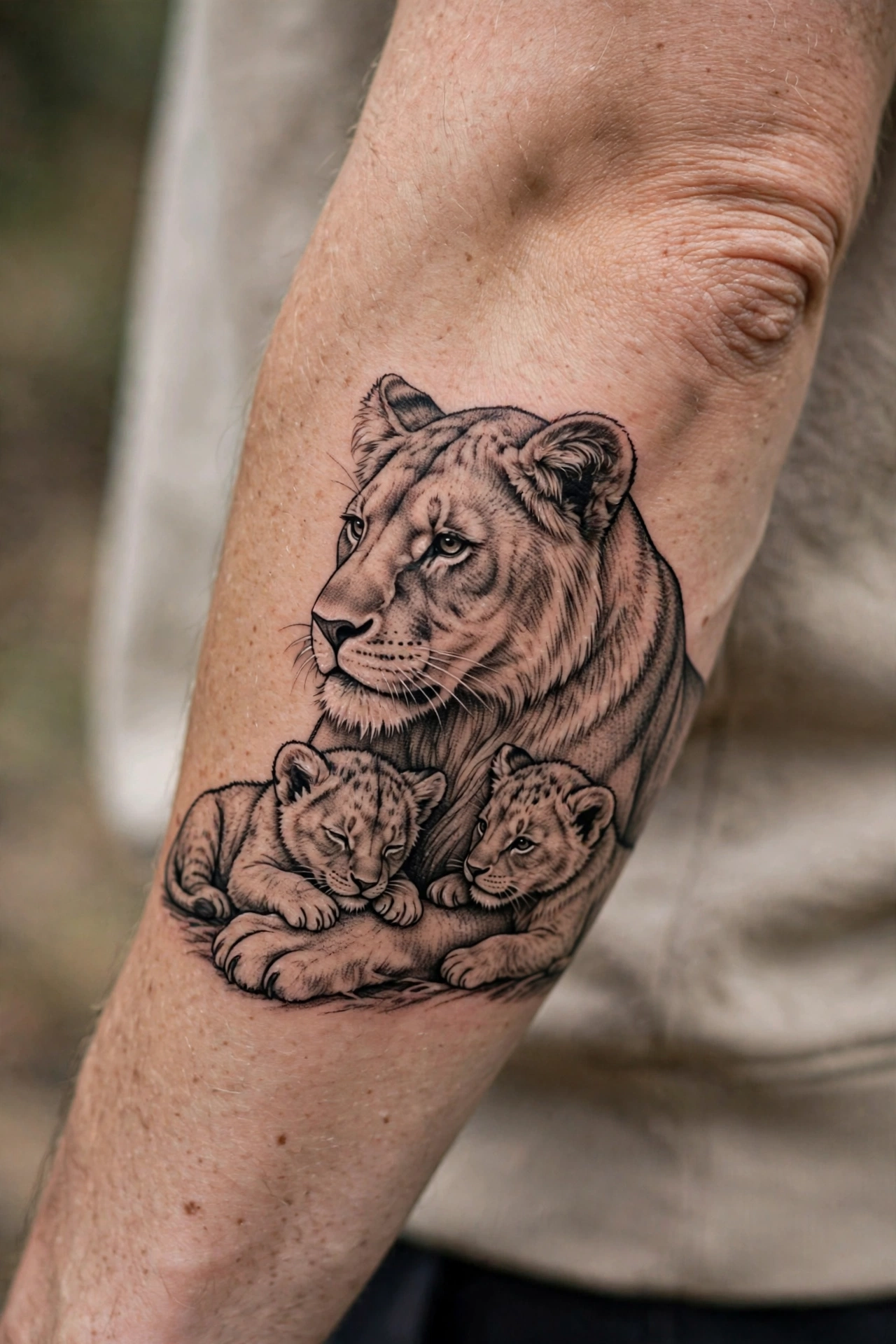
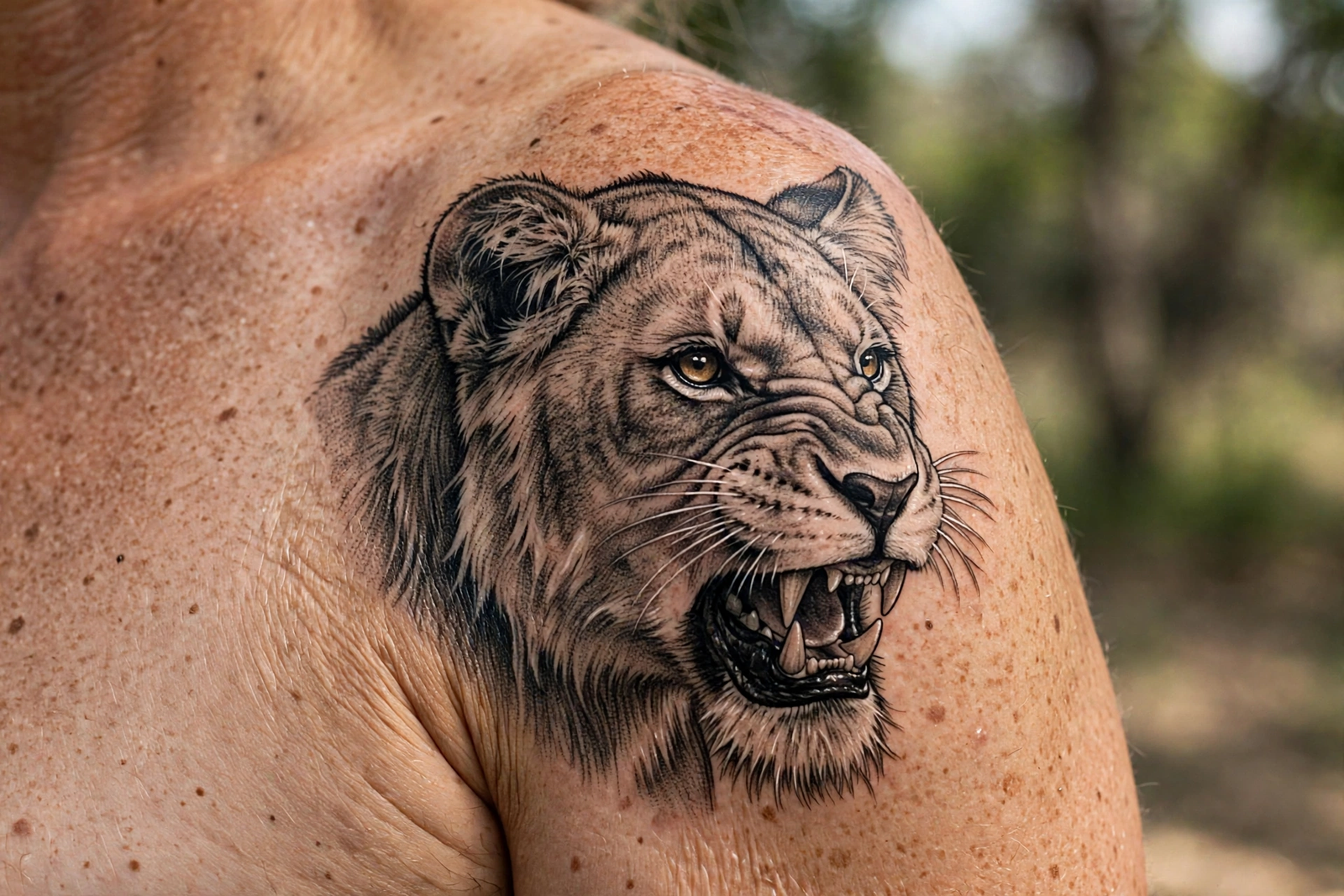
Here’s a fact that surprises people: lionesses do most of the hunting, and they hold the pride together socially. A lioness tattoo means fierce protection of family, loyalty, independence, and strength that doesn’t need to roar to be real. It’s enormously popular with mothers — a lioness with cubs is one of the most requested family tattoos in any studio — but it’s not only for mothers. Anyone who holds things together, who hunts for their people in the metaphorical sense, who leads without needing the title, might be a lioness person. And honestly? Some of the toughest people we know wear lionesses, not lions. The quiet hunters are the ones to watch.
Lion cubs: new life and what you’re raising
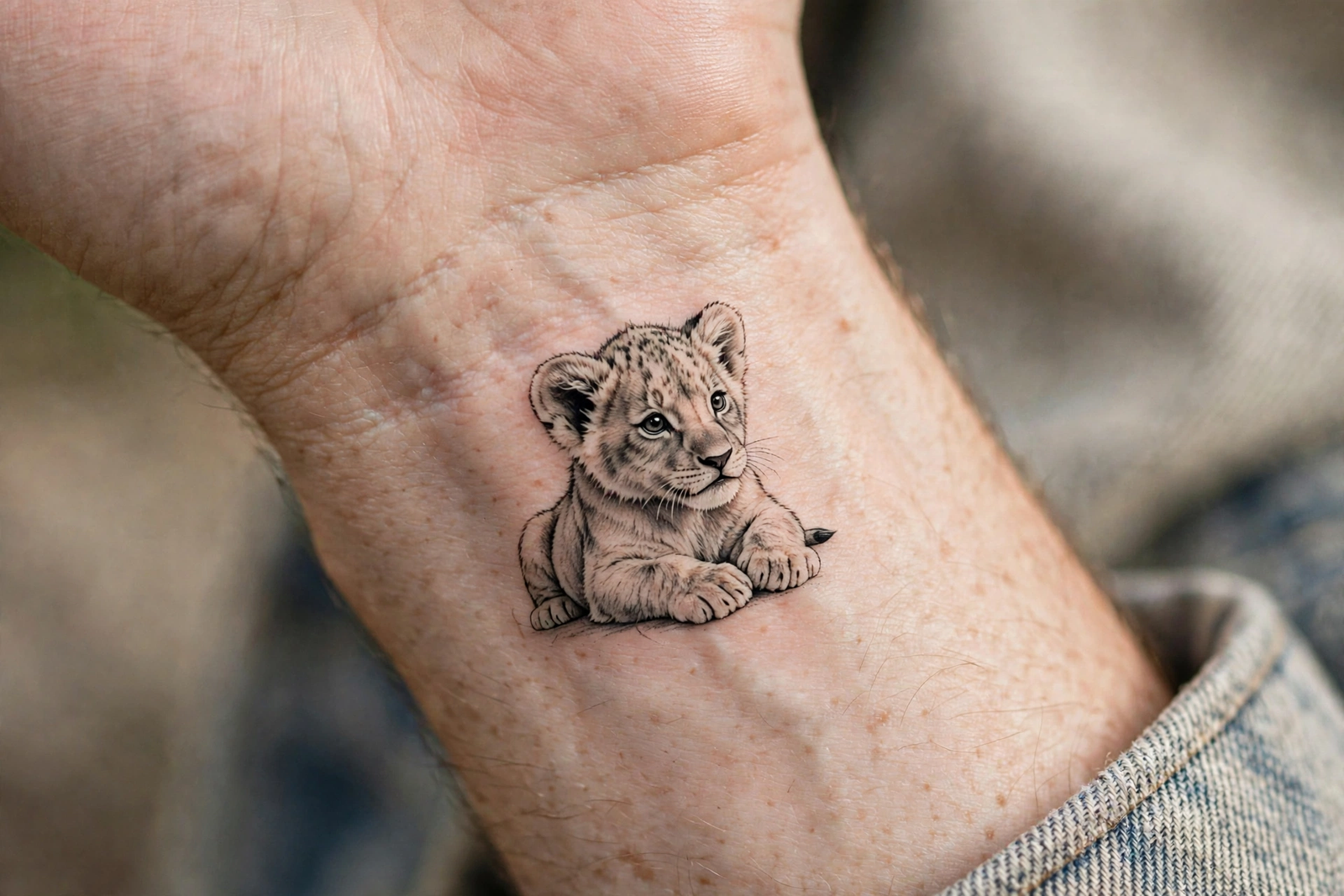
Cubs change everything about a lion tattoo. A lone lion says “me.” A lion with cubs says “us, and what comes next.” Cubs usually stand for children, new beginnings, innocence worth protecting, or a younger version of yourself you’re looking after better now. Parents often add one cub per child, which is lovely until the family grows — so talk to your artist about leaving room, or choose a composition that can grow with you. A cub on its own, without an adult lion, means potential and new life: the start of something, not the finished product.
Roaring Lion vs Calm Lion: Which One Are You?
This might be the single most important design decision, and it’s one people rush. The expression on your lion’s face is the whole message, and roaring versus calm are almost opposite statements.
Roaring lion: power unleashed, warning given
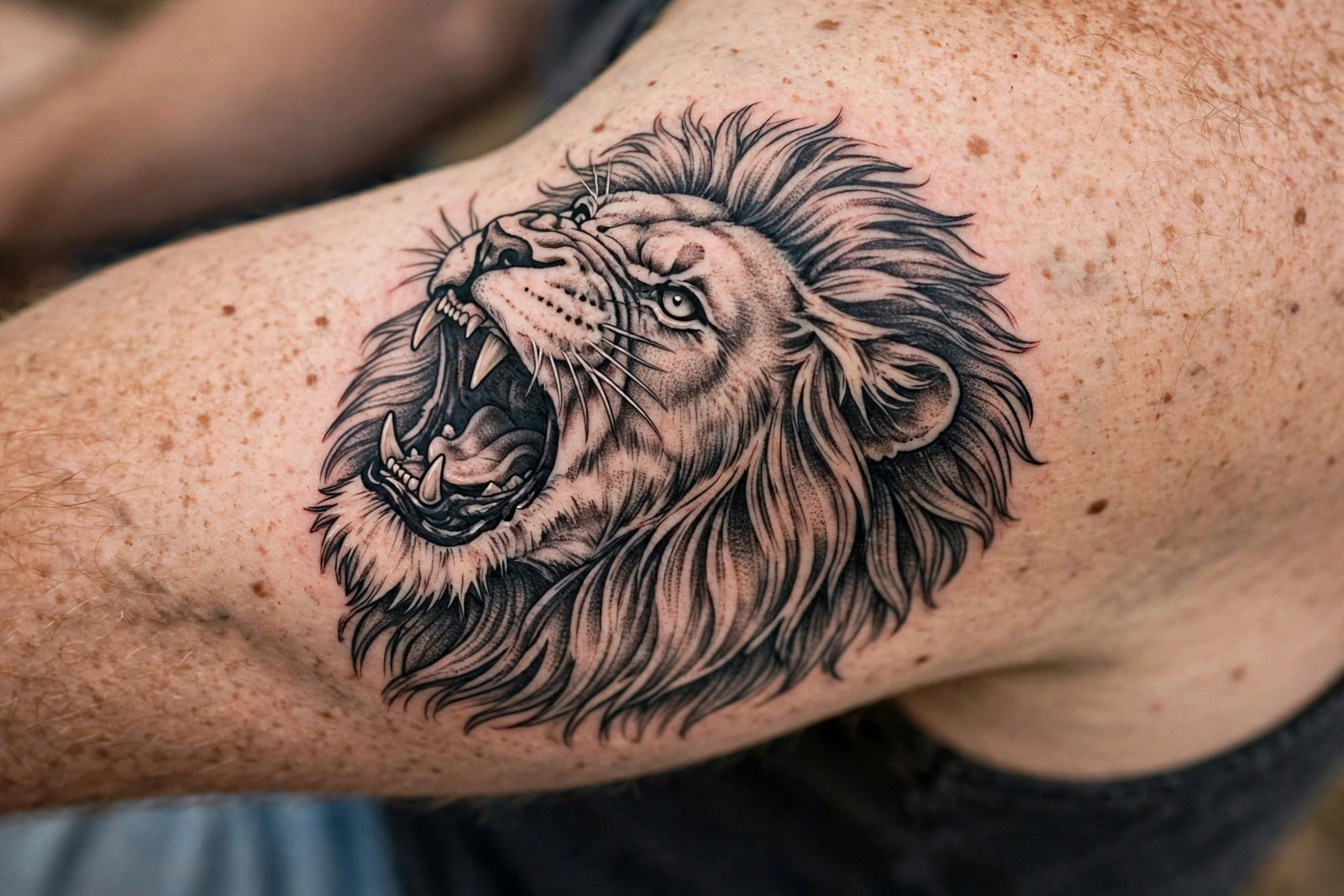
A roaring lion says: don’t mistake my calm for weakness, I have a voice and I will use it, this is me at full power. It’s bold, it’s loud, it’s the tattoo equivalent of standing up in a meeting and saying “enough.” Roaring lions suit people marking a moment they found their voice — after years of staying quiet, after a fight they finally won, after deciding they won’t be pushed around anymore. Visually, roaring lions need size and skill: an open mouth, teeth, tongue, and a mane in motion are hard to get right small. Give it room, or the roar turns into a grimace, and nobody wants a grimacing lion on their chest for life.
Calm, watchful lion: power under control
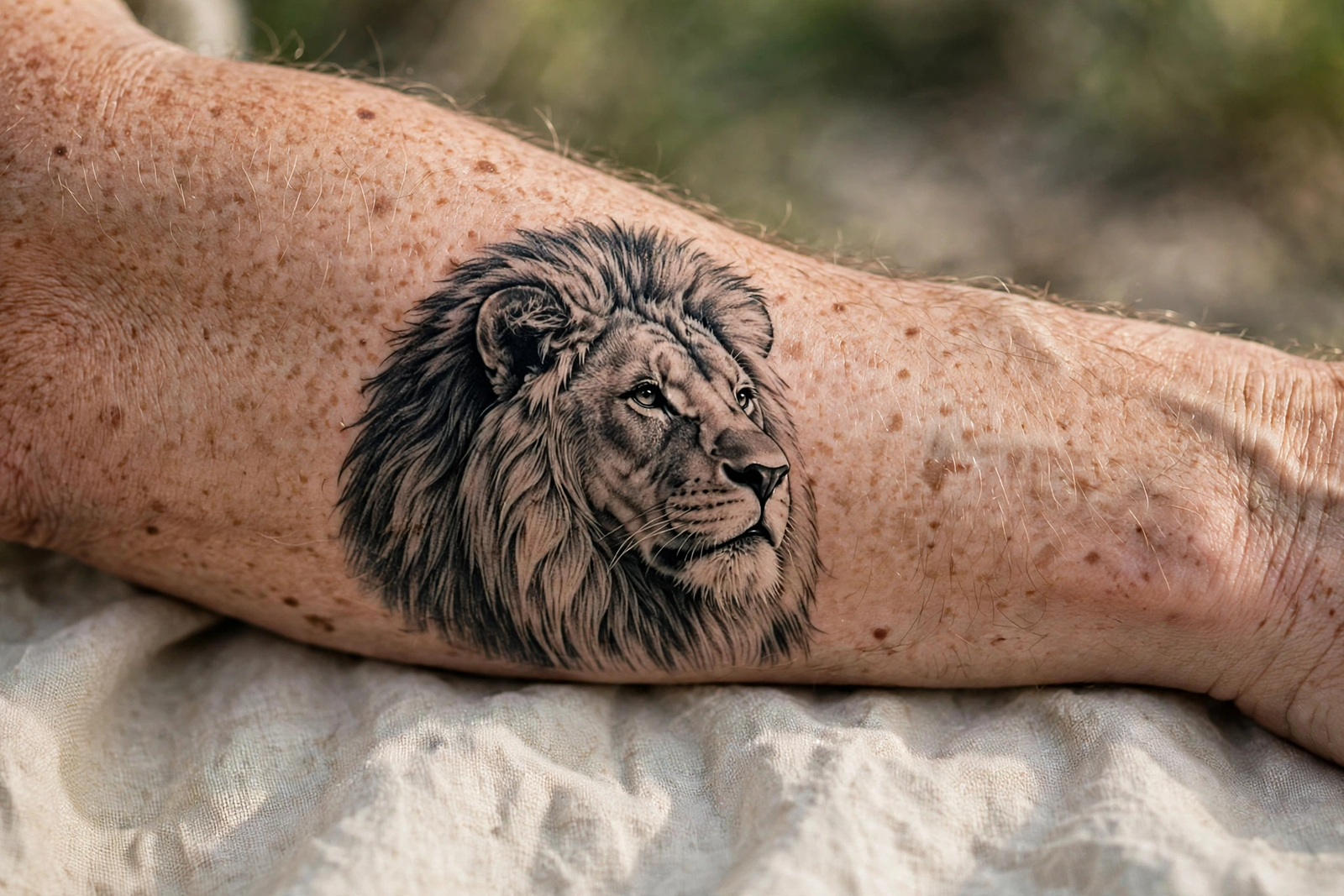
A calm lion — eyes forward, mouth closed, head steady — says something rarer and, in our opinion, harder: I am strong and I don’t need to prove it right now. It’s confidence without performance. This version suits leaders, protectors, and people whose strength is mostly patience. It’s also the version that ages best visually, because a calm face has fewer fine details to blur than an open roaring mouth. If you’re torn, ask yourself a simple question: do you want people to know you’re powerful when they look at you, or do you want to know it yourself? Roaring is for them. Calm is for you.
Lion with a crown: royalty — handle with care
The crown is the most popular lion add-on and the one to think twice about. A crowned lion means royalty, authority, king or queen energy, self-made success. It looks fantastic, especially in realism and black-and-grey. The caution is simpler: crowns read as a big claim. If you’ve earned that feeling — built something, survived something, raised someone — wear it proudly. If you’re eighteen and you just like how it looks, that’s fine too, but know that people will read it as a statement about you, not just a decoration. Crowns invite opinions. Make sure you’re comfortable with that before the needle starts.
Lion eyes: the detail that makes or breaks it
Ask any portrait artist and they’ll tell you: the eyes are everything. A lion’s eyes carry the whole expression — calm, fierce, sad, watchful — and getting them slightly wrong changes the tattoo’s meaning completely. A lion with soft eyes reads as a protector. The same lion with hard, narrowed eyes reads as a threat. When you look at an artist’s portfolio, look at the eyes first. If the lions in there all look a bit blank or a bit angry regardless of the design, that’s a warning sign. The right artist can make a lion look at you like it knows you, and that connection is what makes people keep staring at their own tattoo years later.
Lion Tattoo Designs That Work
A lion’s face is one of the hardest subjects in tattooing and one of the most rewarding when it’s done right. The symmetry, the mane, the eyes — there’s nowhere to hide a mistake. That said, some styles suit lions better than others, and picking the right one is half the battle.
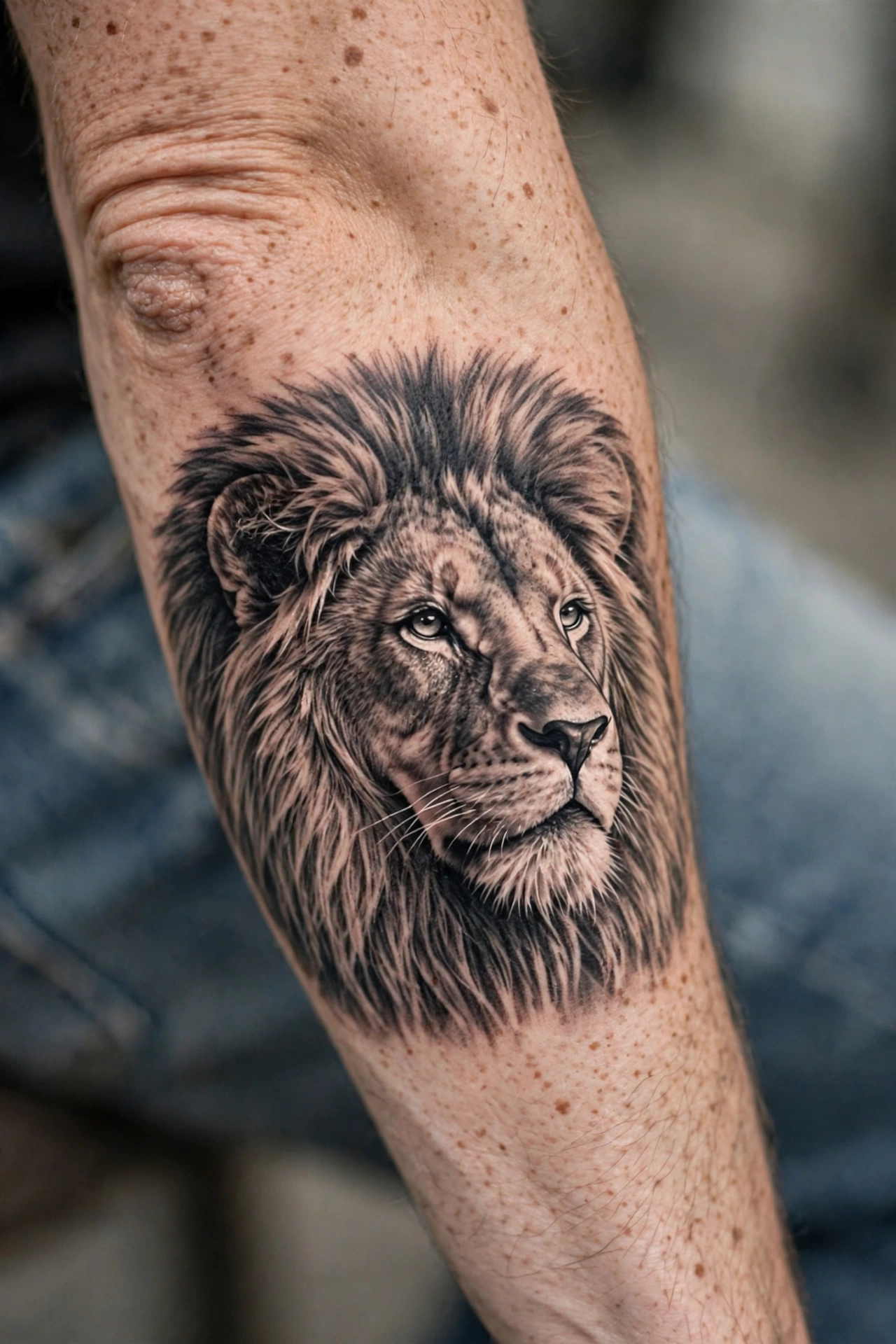
Realism lion
A lion that looks like a wildlife photograph: every hair in the mane, every whisker, light in the eyes. Realism lions are breathtaking and they’re the most demanding style on this list, for you and the artist. They need size — a realism lion smaller than your palm loses the detail that makes it realism — and they need an artist who actually does realism animals, not just realism portraits of people. Animal fur and human skin shade differently, and an artist who hasn’t learned that will give you a lion that looks like a man in a fur coat. Check their animal portfolio specifically. If it’s all roses and script, keep looking, however nice those roses are.
Geometric lion
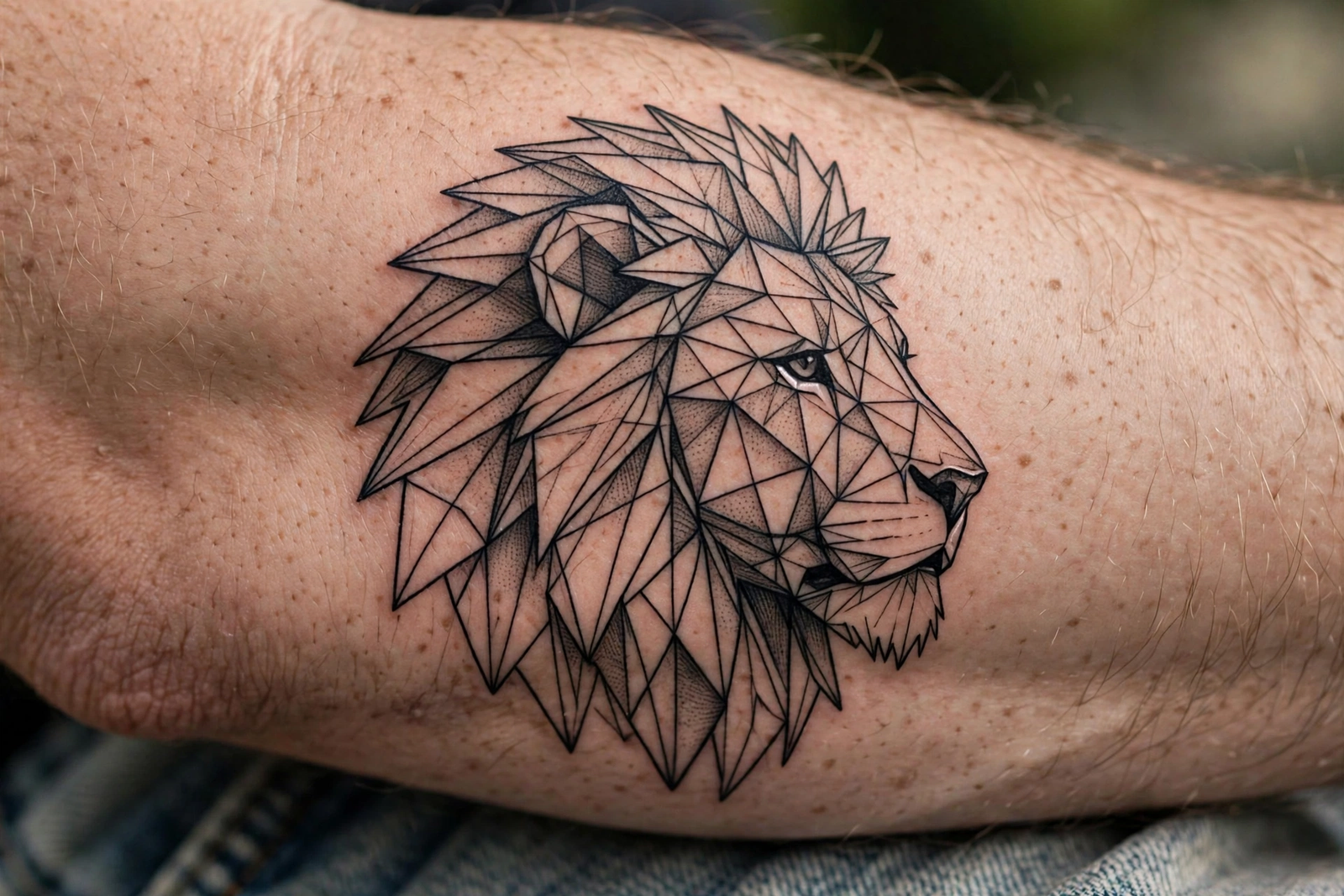
Clean lines, triangles, and polygons forming a lion’s face — sometimes half geometric, half realism, split right down the middle. Geometric lions are modern, striking, and popular with people who want a lion without the traditional wildlife look. The half-and-half version is especially clever: the realistic side says nature and instinct, the geometric side says order and control. Together they say a person who contains both. Geometric work needs precision — a wonky triangle in a geometric lion is visible from across the room — so choose an artist whose lines are actually straight. Look at their healed geometric work, not just the fresh photos where everything looks sharp.
Traditional and neo-traditional lion
Bold outlines, strong color, a lion that looks like it walked off a vintage poster. Traditional lions are less about photographic accuracy and more about presence: big shapes, clear expression, colors that hold. Neo-traditional adds more shading and a wider palette while keeping the bold structure. Both styles age better than realism and fine-line, because thick lines and packed color survive years of sun and skin movement. If you want a lion that looks as strong at sixty as it does at twenty-five, traditional is a serious contender. It also carries a working-class, old-school authority that suits the subject — lions and traditional tattooing grew up together.
Blackwork and black-and-grey lion
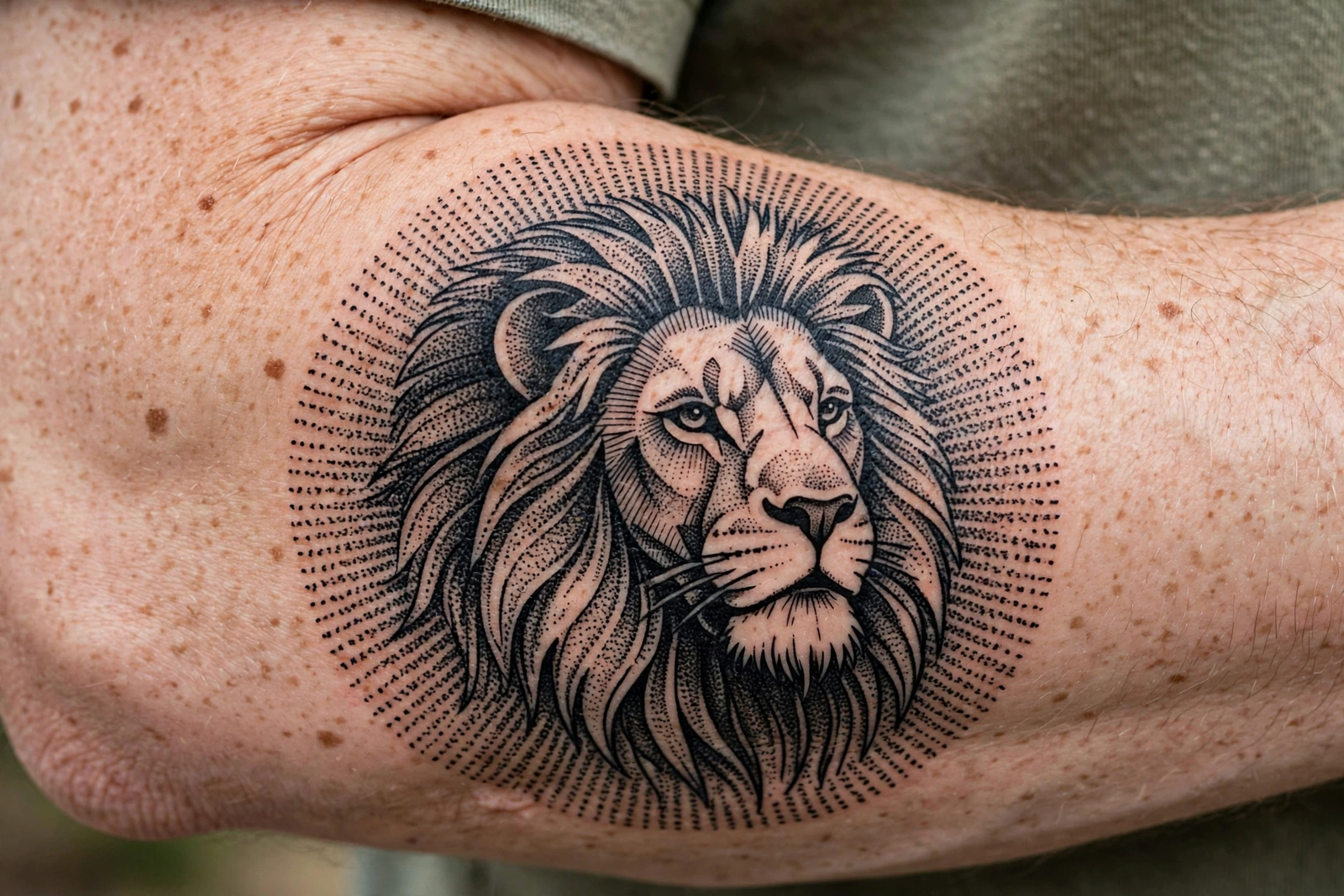
No color, just black ink and shading, sometimes with dotwork in the mane for texture. Blackwork lions look dramatic, timeless, and a bit gothic — power without decoration. Black-and-grey gives you the depth of realism without color upkeep, and it suits every skin tone because it doesn’t rely on color contrast. This is also the best choice if you’re planning a larger blackwork collection, since a color lion in the middle of black pieces can look like it wandered in from another tattoo. Consistency matters in a collection, even if nobody says so out loud.
Fine-line lion
Delicate, minimal, often just the outline of a lion’s face or a small lion on the wrist or ankle. Fine-line lions look elegant and modern, and they suit people who want the meaning without a huge statement piece. The trade-off is the usual fine-line one: thin lines spread and soften over time, and a lion’s face has a lot of small features — eyes, nose, whiskers — that can blur together if the piece is too small. Keep it simple, keep it bigger than you think you need, and budget for a touch-up down the road. A fine-line lion that stays simple stays beautiful. One that tries to be a tiny realism portrait will disappoint you in three years.
Watercolor and abstract lion
Splashes of color behind or through a lion’s face, or a lion dissolving into paint strokes. Watercolor lions are gorgeous and expressive — they suit the “wild, free, untamed” reading of the lion, and they look like art rather than illustration. The honest catch, as with all watercolor, is fading: without strong outlines, colors soften and blend over time. A good artist anchors watercolor with a light black outline you barely notice at first. If you love the look, go for it with that anchor in place, and accept that the lion will change as it ages — which, for a symbol of a life lived, feels kind of appropriate.
Lion Combinations and What They Add
Lions pair well with other symbols, and the pairing usually sharpens the meaning rather than muddying it — as long as the lion stays the hero. Here’s the pairing guide we give people at the counter.
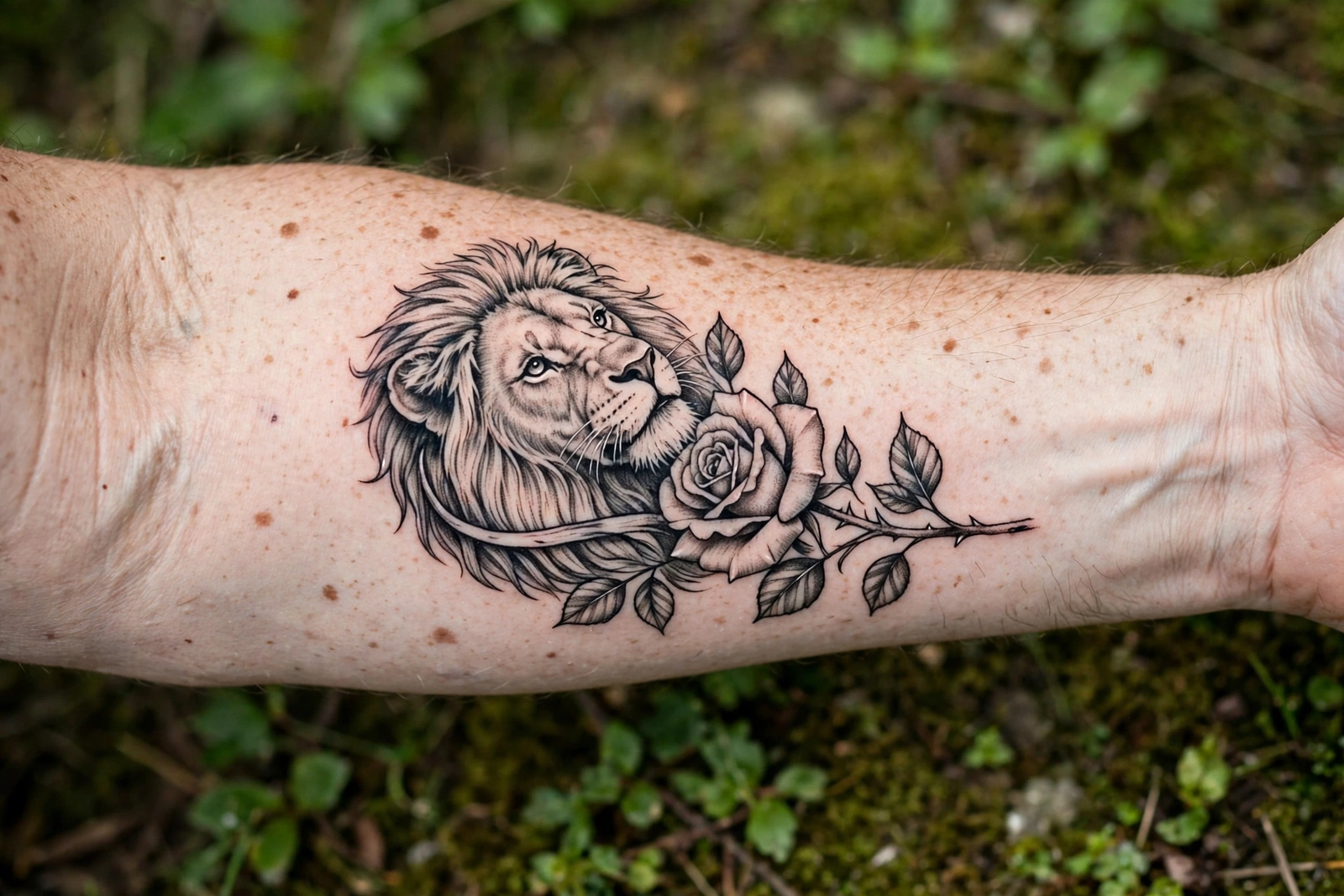
Lion and rose
Strength and love, power and beauty, the protector and the thing worth protecting. A lion with a rose is one of the most balanced pairings in tattooing: it says I’m strong and I’m tender, and neither cancels the other. It’s popular as a couple’s tattoo, a family tattoo, and a personal statement from people who are tired of being told they have to pick one. Our tattoo meanings library covers roses in full if you want to pick the right color for the pairing.
Lion and clock
Time, legacy, and the moments that made you who you are. A lion with a clock often marks a specific time — a birth, a loss, a turning point — or the broader idea that your time matters and you intend to use it like a leader would. Clocks suit larger pieces, and they look best when the lion’s face dominates and the clock sits as a supporting element, not a competitor. Two heroes in one tattoo usually means neither wins.
Lion and crown, lion and cross
We’ve covered the crown — royalty and authority, with the “big claim” warning attached. A lion with a cross leans into faith: the Lion of Judah, strength through belief, protection under something larger than yourself. Both pairings are deeply personal and both get misread by strangers sometimes, so make sure the meaning is clear to you first. A tattoo that needs a five-minute explanation every time someone asks about it gets tiring fast, unless you enjoy the conversation. Some people do. Know which one you are.
Lion and cub, lion and lioness
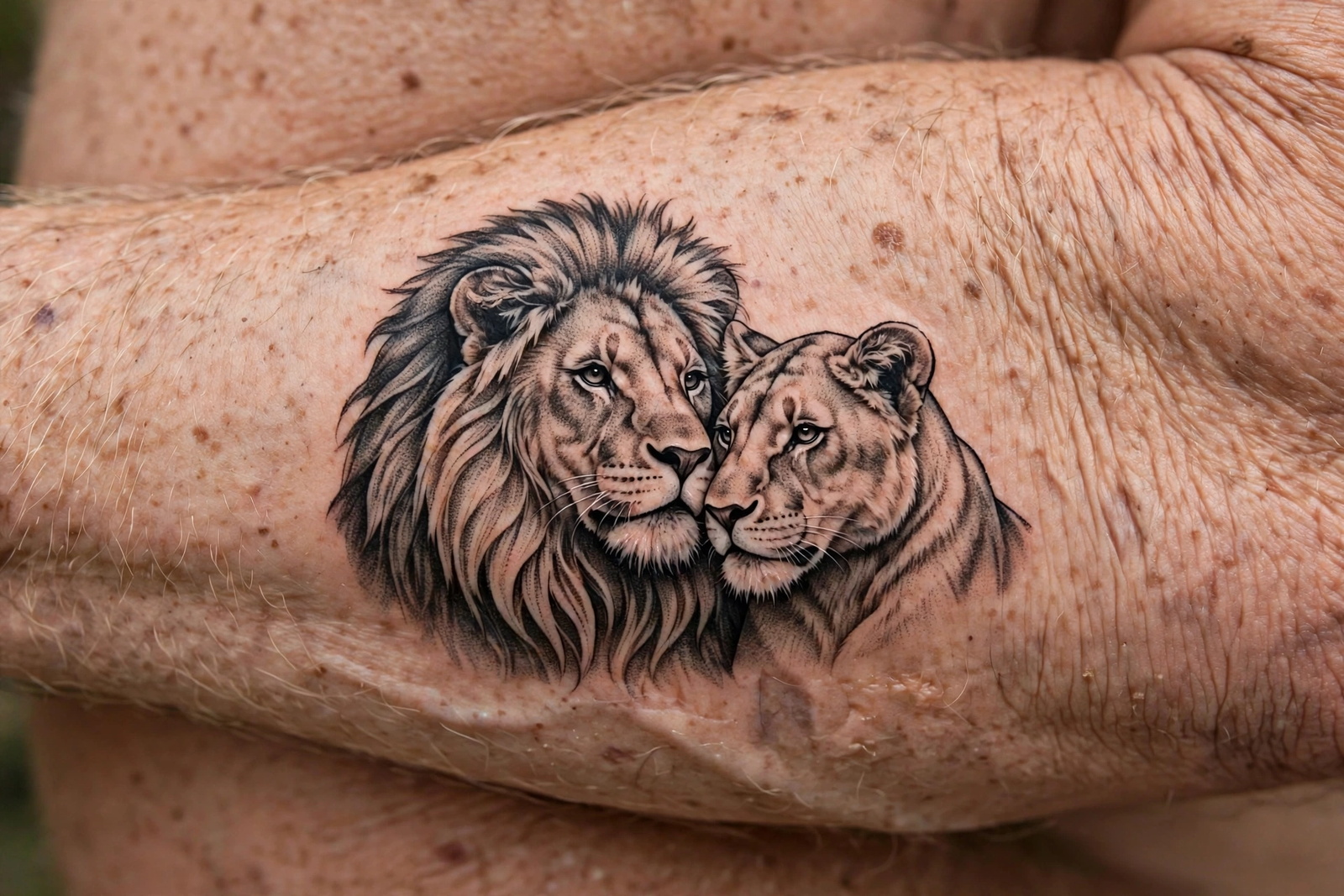
Family, full stop. A lion with a lioness says partnership — two strong animals, different strengths, one pride. A lion with cubs says parenthood and legacy. A full family group — lion, lioness, cubs — is a family portrait in animal form, and it’s one of the most moving tattoos we see, especially on backs and chests where there’s room for the whole group. If you’re planning a family lion piece, think about whether it will grow: leave space for future cubs, or choose a composition that feels complete as it is. Both work. Growing into a tattoo is a lovely problem to have.
Lion and mountains, lion and jungle
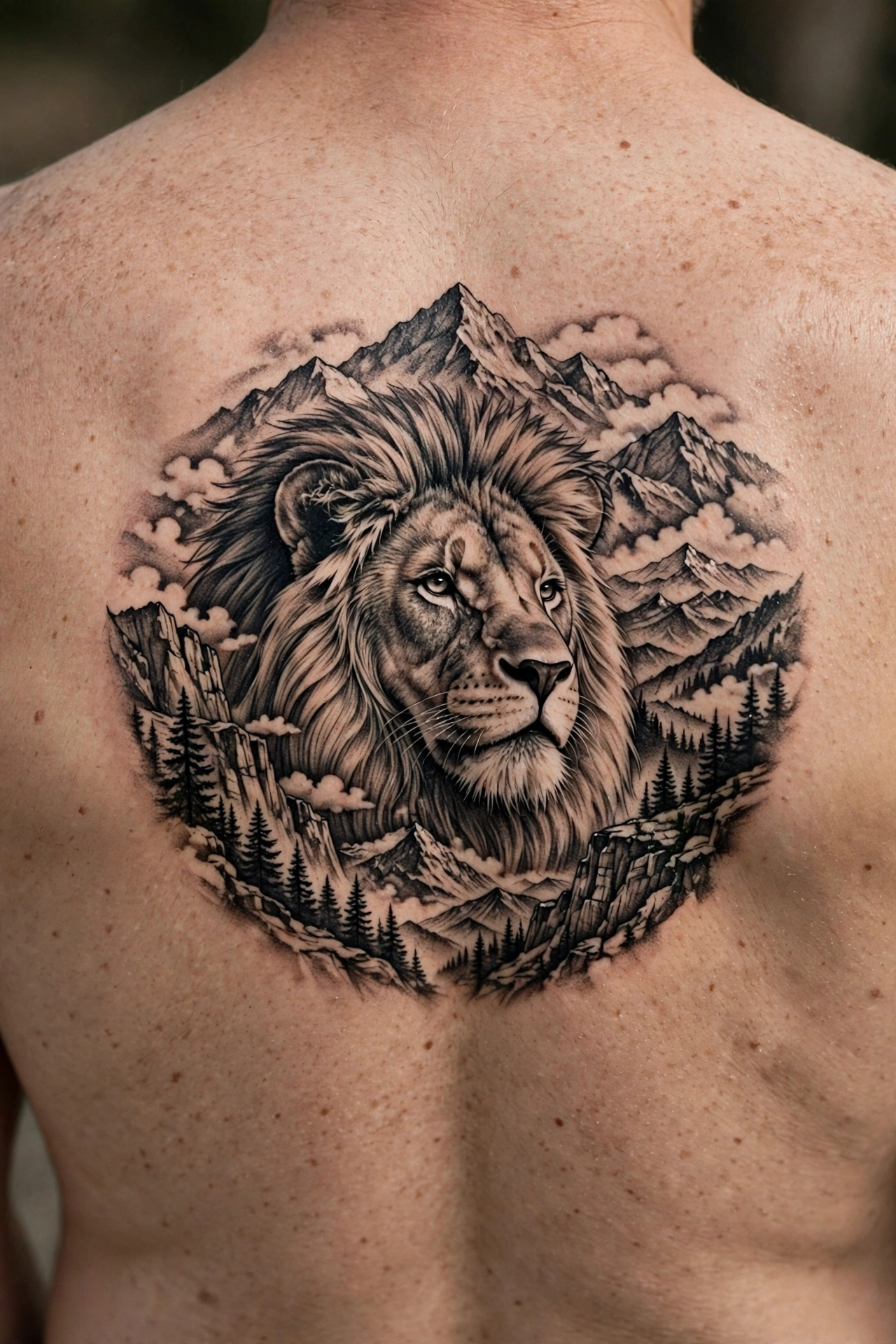
Backgrounds change the story. A lion against mountains says resilience, high ground, the long view. A lion in jungle foliage says wildness, instinct, the untamed part of you. A lion against a sunset or a starry sky says guidance and hope. Backgrounds also give the artist room to make a large piece feel like a scene rather than a sticker, which is why back and thigh lions often have them. Just don’t let the background swallow the face. The lion is the story; the landscape is the setting.
Best Placements for a Lion Tattoo
Chest
The classic lion spot, and the one with the best metaphor: a lion over your heart. Chest lions suit large, face-on designs, and they carry the protector meaning literally — the lion guards what’s inside. Pain is real, around 6/10, especially near the sternum and collarbone, but wearers consistently say it’s worth it. A chest lion is also a commitment to visibility in summer, so think about that before you start. If your lion is for your family, the chest is hard to beat. It’s where you feel them, after all.
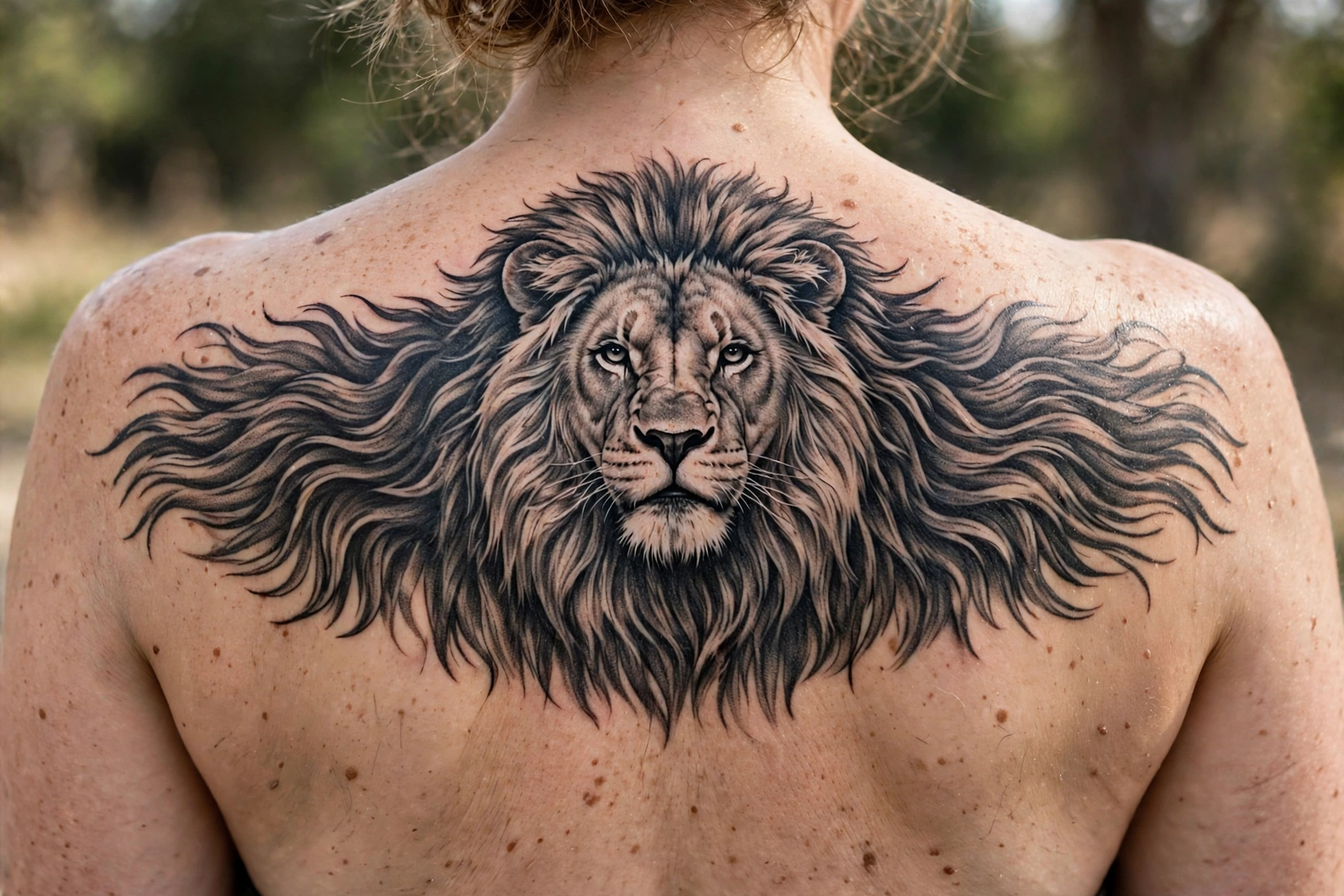
Back and shoulder blade
The big-canvas option. A lion across the upper back or shoulder blades gives you room for a full mane, a family group, or a lion with a landscape behind it. Pain is gentle for such a large spot, around 3–4/10, and back pieces age well because the skin there sees less sun. This is where the most detailed lion work lives, and where artists get to show off. If your lion dream is big, start here and don’t apologize for the size. Lions aren’t small animals. They shouldn’t be small tattoos unless you mean them to be.
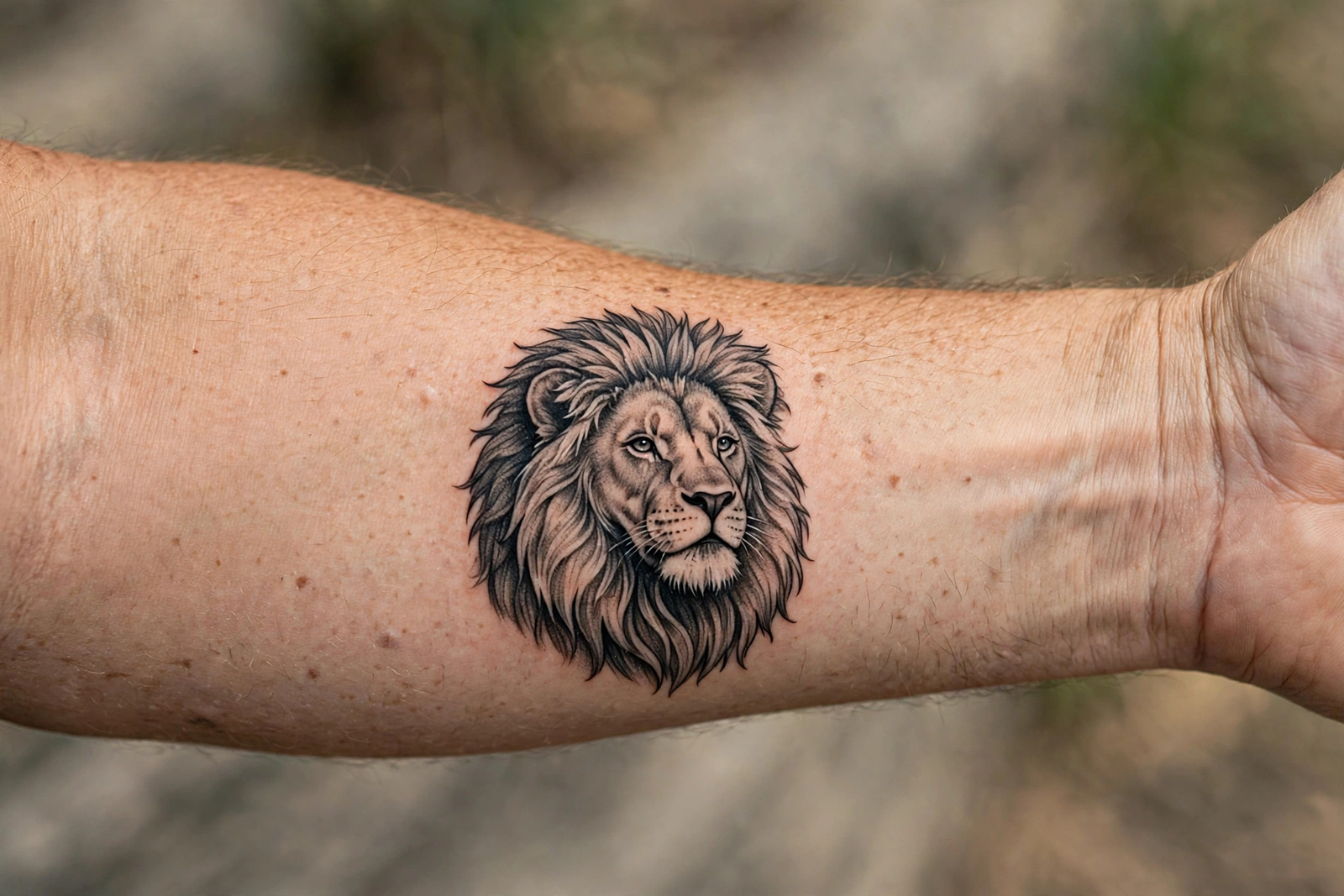
Forearm
Visible, versatile, and the best spot if you want to actually look at your lion every day. Forearm lions suit medium designs — a face, a head with mane, a lioness profile — and pain is gentle, around 3/10. The forearm is also the easiest lion to add to later: a rose below, a clock above, a whole sleeve growing around the lion as the anchor. If you’re not sure you’ll stop at one tattoo, put the lion on the forearm and let the collection grow around it. It was born to be the centerpiece.
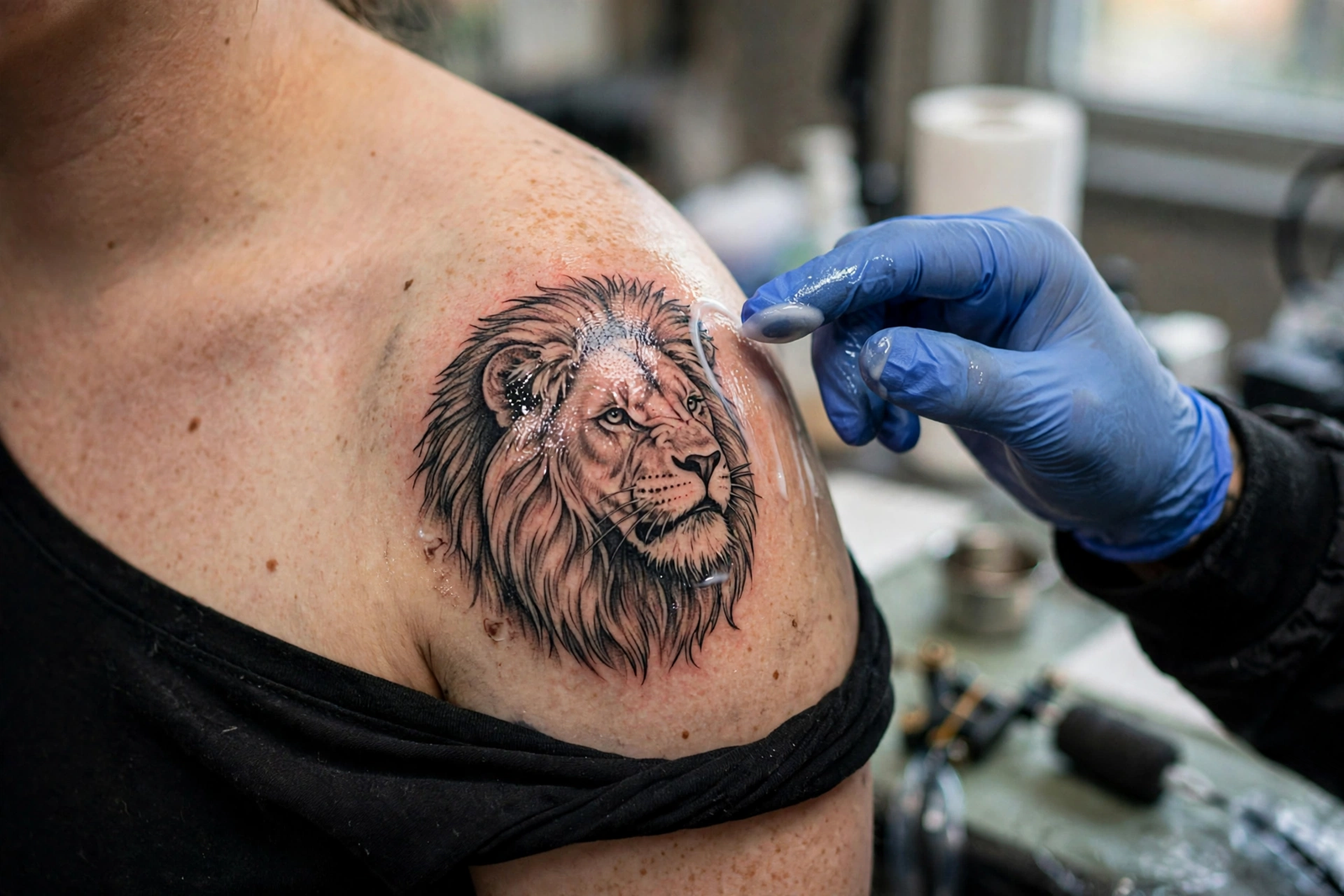
Upper arm and shoulder
Room for a solid lion head, easy to cover, pain around 3–4/10. Shoulder lions follow the muscle nicely, especially a lion’s face curving with the deltoid, and they connect into sleeves naturally. This is the spot for people who want a strong lion but need to cover it for work. A short sleeve hides it; a rolled sleeve shows it. That control is worth more than people realize until they have a tattoo they can’t hide at a job interview.
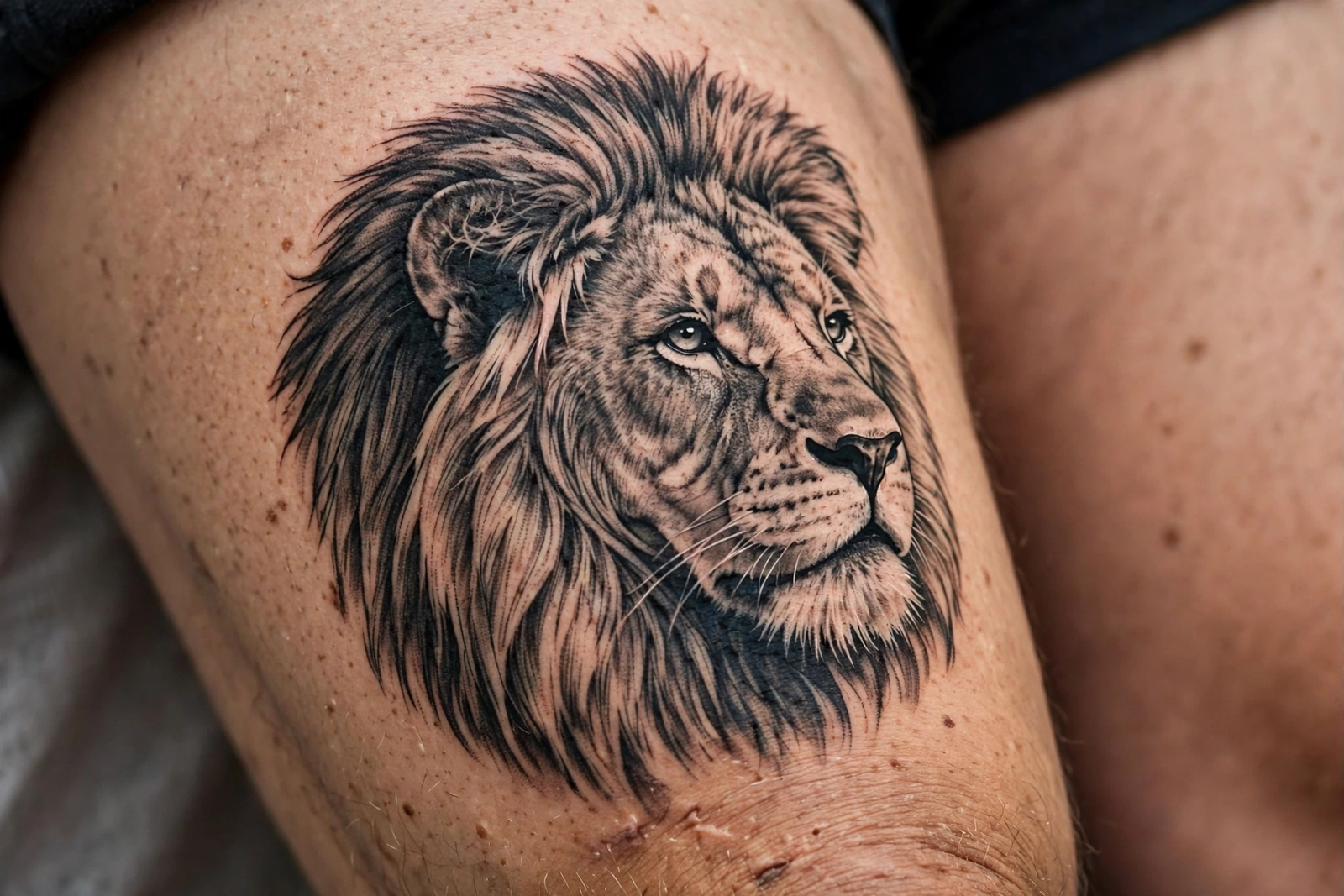
Thigh
Large, low pain (around 2–3/10), easy to hide, and the skin ages well. Thigh lions are a favorite for detailed realism and family groups that need room, and they’re popular with people who want a big piece without the big pain. The only downside is you don’t see it as often yourself — it’s more for other people, or for moments you choose to show it. Some wearers like that: the lion is theirs, not a performance. If that sounds like you, the thigh is your spot.
Hand, wrist and calf
The smaller, more visible options. A small lion on the wrist or hand says commitment — it’s always there, always seen — but small lion faces lose detail fast, and hand tattoos fade faster than anywhere else. Pain on the hand is around 5–6/10, wrist around 4/10, calf around 4/10. Calf lions suit vertical compositions, like a lion’s face with a mane flowing down the leg. Hand and wrist lions suit simple, bold designs only. If your lion needs eyes you can actually see, don’t shrink it onto a finger. Give it a fighting chance.
Size, Cost and Pain — Honestly
Small (3–5 cm): wrist, ankle, behind the ear. Simple fine-line or minimal lion outlines only — a detailed face at this size is a promise your skin can’t keep. Cost: roughly $80–$150 in the US, often the shop minimum.
Medium (8–15 cm): forearm, shoulder, calf. Room for a proper lion’s face with a mane, or a lioness profile. Cost: roughly $150–$400. This is where most lion tattoos live, and it’s a good place to be — detailed enough to read, affordable enough to do well.
Large (15 cm+): chest, back, thigh, full sleeve anchor. Realism lions, family groups, lions with landscapes. Cost: roughly $400–$1,200+, and multi-session realism pieces can go well beyond that. Ask for a per-session quote so a three-session lion doesn’t surprise you at session two.
Pain follows the usual map, with a lion-specific note: lion pieces are often shading-heavy, especially the mane, and long shading sessions ache in a dull, tiring way that’s different from the sharp sting of outlines. Bring water, eat before your appointment, and don’t be shy about asking for a break. Artists expect it, and a five-minute pause doesn’t ruin anything. A lion built in a rush, on the other hand, shows. Take the break. The lion will wait.
Choosing an Artist for a Lion
Lions punish sloppy work more than most animals. The face is symmetrical, the eyes are expressive, and the mane is a test of shading skill — too flat and it looks like a wig, too heavy and it looks muddy. So look for an artist with lions in their portfolio, and look at healed lions specifically. Fresh lions always look impressive; the shading is dark, the lines are crisp, the eyes are bright. Healed lions tell you whether the mane stayed textured or collapsed into a blob, whether the eyes kept their expression, whether the face still reads as a lion after a year.
Bring reference photos of real lions, not just other people’s tattoos. The shape of the muzzle, the set of the ears, the way a mane actually falls — getting the animal right is what separates a lion tattoo from a generic big-cat tattoo. And be honest about your budget and your pain tolerance before the design starts, not halfway through a chest piece. A good artist will adjust the design to fit both. Browse our tattoo ideas and tattoo styles guides to narrow the look, and check our placements guide if you’re still torn on the spot.
Aftercare in Brief
Wash gently twice a day, moisturize thinly, don’t pick the flakes, keep it out of pools and direct sun while it peels. Lion manes show fading and blurring faster than bold traditional work, because so much of the detail is soft shading — so sunscreen after healing isn’t optional, it’s the difference between a mane with texture and a mane that’s just a dark shape in five years. The full day-by-day routine is in our tattoo aftercare guide.
Frequently Asked Questions
What does a lion tattoo mean?
Courage, strength, pride, and leadership — strength that protects rather than shows off. A lioness adds fierce motherhood and loyalty; a roaring lion adds power unleashed, while a calm lion adds power under control.
What does a lioness tattoo mean?
Fierce protection of family, loyalty, independence, and strength that doesn’t need to roar. Lionesses do most of the hunting in a pride, so a lioness tattoo often means the quiet, hardworking power that holds things together.
What does a lion with a crown mean?
Royalty, authority, and self-made success — king or queen energy. It’s a bold claim, so wear it if you’ve earned that feeling, and know that people will read it as a statement, not just a decoration.
Is a lion tattoo only for men?
Not at all. Lion and lioness tattoos are hugely popular with women, especially lioness-with-cubs family pieces and fine-line lions. The meaning — courage, protection, leadership — doesn’t belong to any gender.
Where is the best placement for a lion tattoo?
The chest for a lion over your heart, the back or thigh for large detailed work, and the forearm for a visible lion you can see every day. Match the size to the spot — detailed lion faces need room.
How much does a lion tattoo cost?
Small lions run about $80–$150 in the US; medium pieces $150–$400; large realism or family-group lions $400–$1,200 or more, depending on the artist and the number of sessions.
Do lion tattoos hurt?
It depends on placement. Forearm, thigh, and back lions are gentle (2–4/10); chest, hand, and sternum lions sting more (5–6/10). Mane shading sessions are long and tiring, so plan breaks.
What is the difference between a roaring and a calm lion tattoo?
A roaring lion means power unleashed and a warning given — you found your voice. A calm lion means power under control — confidence without performance. Roaring is for them; calm is for you.
Strength That Doesn’t Need to Shout
Here’s what we keep coming back to with lions: the best ones aren’t the loudest. The roaring chest piece gets attention, sure, and if that’s your moment, take it. But the lion tattoos that stay meaningful longest tend to be the quieter ones — the calm face on a forearm you glance at before a hard meeting, the lioness on a shoulder that reminds a mother why she keeps going, the small lion over a heart that nobody sees except the person who needs to know it’s there.
So pick your lion like you mean it. Lion or lioness, roaring or calm, crown or no crown — each choice is a sentence, and together they write a paragraph about who you are and who you’re protecting. Give the face room, find an artist whose healed lions still look alive, and don’t rush it if the lion is for someone you’ve lost or someone you’re raising. That lion can wait until it’s right. And when it is, you’ll know — because it’ll look back at you like it already knew you were the one.
Browse our tattoo meanings library for more symbols with stories behind them, or check our placements guide if you’re still deciding where your lion should live.