
Quick answer: A rose tattoo means love, beauty, and resilience — with the thorns left in. That’s the part people forget when they pick a pretty flower off a flash sheet. A rose isn’t just romance. It’s romance that knows it can hurt, beauty that had to survive something to bloom, and a promise that didn’t come cheap. The color changes the sentence completely: red says passion, white says purity or remembrance, yellow says friendship or jealousy depending on who you ask, and black says grief, goodbye, or rebellion. Same flower, wildly different story.
We see more roses in a week than almost any other design. Walk into any studio on a Saturday and somebody, somewhere in the waiting area, is clutching a screenshot of a rose. Sometimes it’s their first tattoo. Sometimes it’s their tenth, squeezed in between older pieces like a garden that keeps growing. And here’s what I’ve learned from watching those conversations play out: nobody picks a rose by accident. Even the people who shrug and say “I just thought it looked nice” — give them two more minutes and the real reason comes out. A grandmother who grew roses. A first love. A marriage that survived, or one that didn’t. A kid’s name they want wrapped in something softer than plain script.
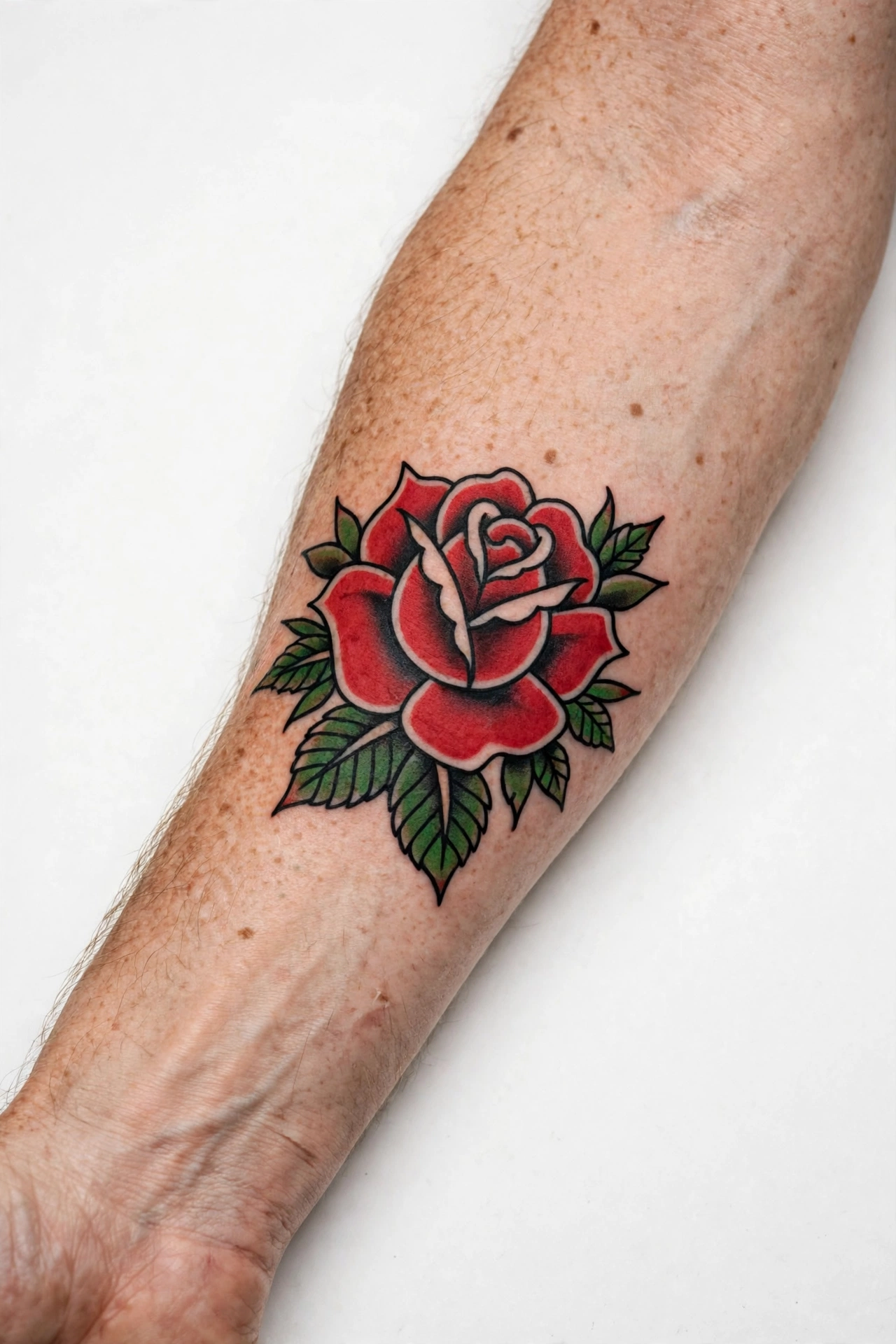
One afternoon sticks with me. A guy in his forties came in with a photo of a single red rose, a bit battered at the edges, and told the artist it was for his wife of twenty years. Not their wedding anniversary, not a big romantic gesture — just, as he put it, “she still puts up with me, and I wanted that on record.” The artist laughed, but you could tell he meant it. That rose wasn’t about the first flush of love. It was about the version that lasts after the arguments, the bills, the boring Tuesdays. If that isn’t a better definition of a rose tattoo, I don’t know what is.
So this guide is the whole thing, the way we’d explain it over the counter: what a rose tattoo means in general, what each color actually says (including the meanings people argue about), the designs that hold up, where to put one, what it hurts like, what it costs, and how to pick a rose that still feels like yours in twenty years, not just a flower you liked one summer.
What Does a Rose Tattoo Mean?
Start with the flower itself, because the symbolism isn’t invented — it grows straight out of how a rose lives. It blooms big and loud and impossible to ignore, and right underneath that bloom sit thorns sharp enough to draw blood. Every culture that ever wrote about roses noticed the same contradiction, and tattooing just kept it. A rose says two things at once, and that’s exactly why it works for so many different stories.
Love, in all its messy forms
Yes, red roses mean romantic love. Everyone knows that one, and it’s true as far as it goes. But tattoo roses carry the wider kind too: love for a parent, a child, a sibling, a friend who showed up when it mattered. I once watched a woman get a small pink rose on her wrist for her best friend — not because pink is the “friendship” color in some chart, but because they’d bought each other pink roses every birthday since they were sixteen. Charts are useful. Personal history beats them every time. If your rose means love, the question worth asking isn’t “which color is correct?” but “whose love, and what did it cost you both?” That answer picks the design for you.
Beauty that survived something
Roses don’t grow in perfect conditions. They get pruned back hard, they get pests, they get winters that look like the end of them, and then they come back anyway. That’s why so many people choose a rose after a hard chapter — an illness, a divorce, a year they’d rather forget. The bloom is the point, but so is the fact that it bloomed at all. A rose tattoo after a tough time isn’t saying “look how pretty I am.” It’s saying “I’m still here, and I didn’t come back smaller.” We hear that version a lot, and honestly, it’s one of our favorites.
The thorns are not a flaw
Some clients ask if they can have a rose without thorns, to make it “just beautiful.” You can, of course — it’s your skin. But think about it first, because thorns carry half the meaning. They say protection, boundaries, and the honest truth that love isn’t soft all the way down. A rose with thorns can mean “I love fiercely and I protect what’s mine,” or “this love hurt me and I remember that too.” A rose without thorns reads gentler: pure affection, innocence, a love with nothing to defend against. Neither is wrong. They’re just different sentences, and you should pick yours on purpose.
Loss and remembrance
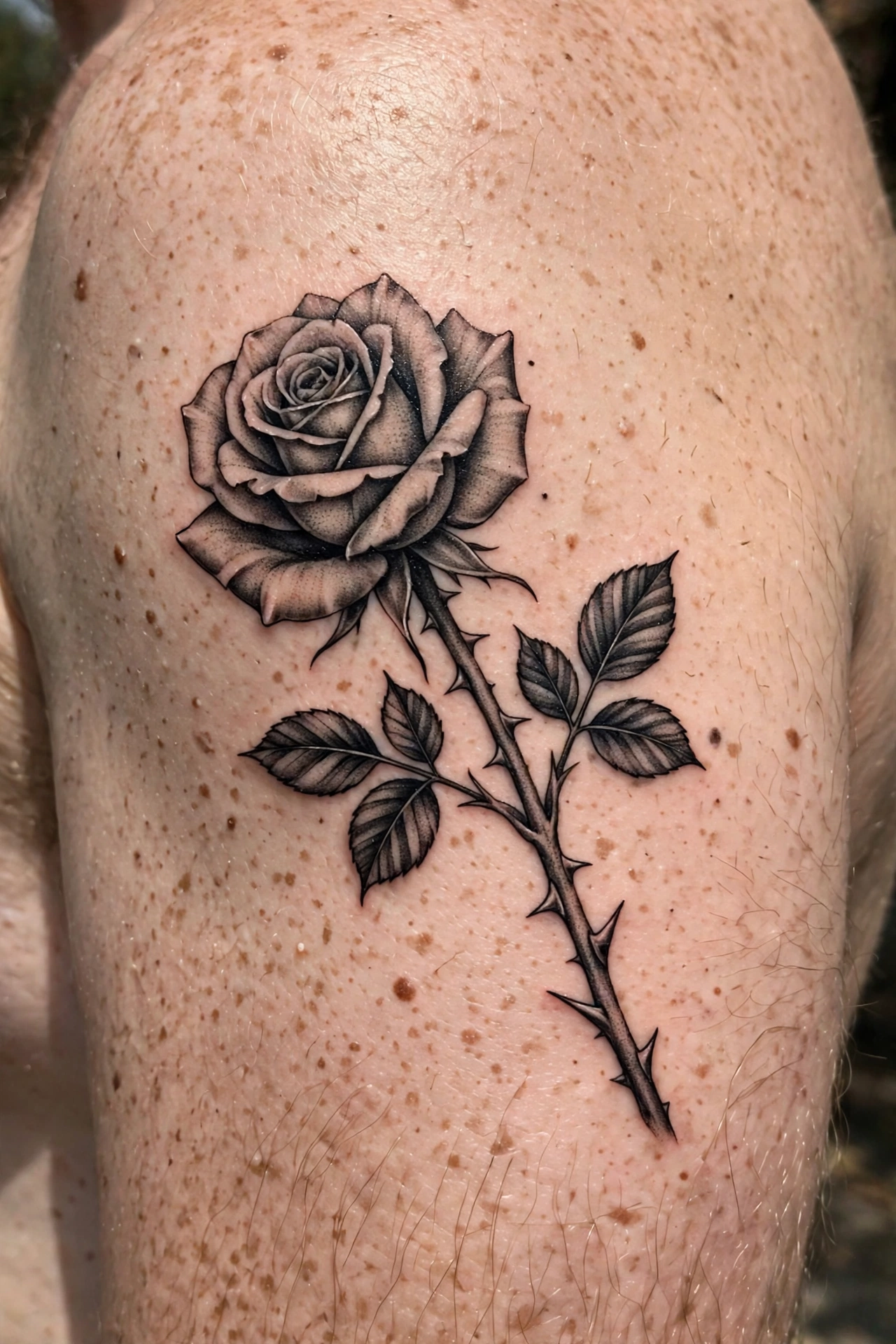
Roses show up at funerals for a reason, and memorial rose tattoos are some of the most common pieces we see. A single rose for someone who died, a rose with a name or a date tucked into the stem, a bouquet where each bloom stands for a different person. White roses lean toward remembrance and peace; red ones toward a love that hasn’t ended just because someone’s gone. Grief tattoos get talked about like they’re a separate category, but really they’re just love tattoos with an ache in them. If that’s your rose, take your time choosing. The design can wait. The person it honors isn’t going anywhere.
What Each Rose Color Means
Here’s where it gets fun — and where people get tripped up. Rose colors have meanings that go back centuries, through Victorian flower language and greeting-card tradition, and tattooing inherited most of them. But meanings shift, and some colors mean two opposite things depending on who you ask. Treat this section as a starting point, not a rulebook. Your artist won’t quiz you, and nobody at the beach is going to fact-check your petals.
Red rose: passion and deep love
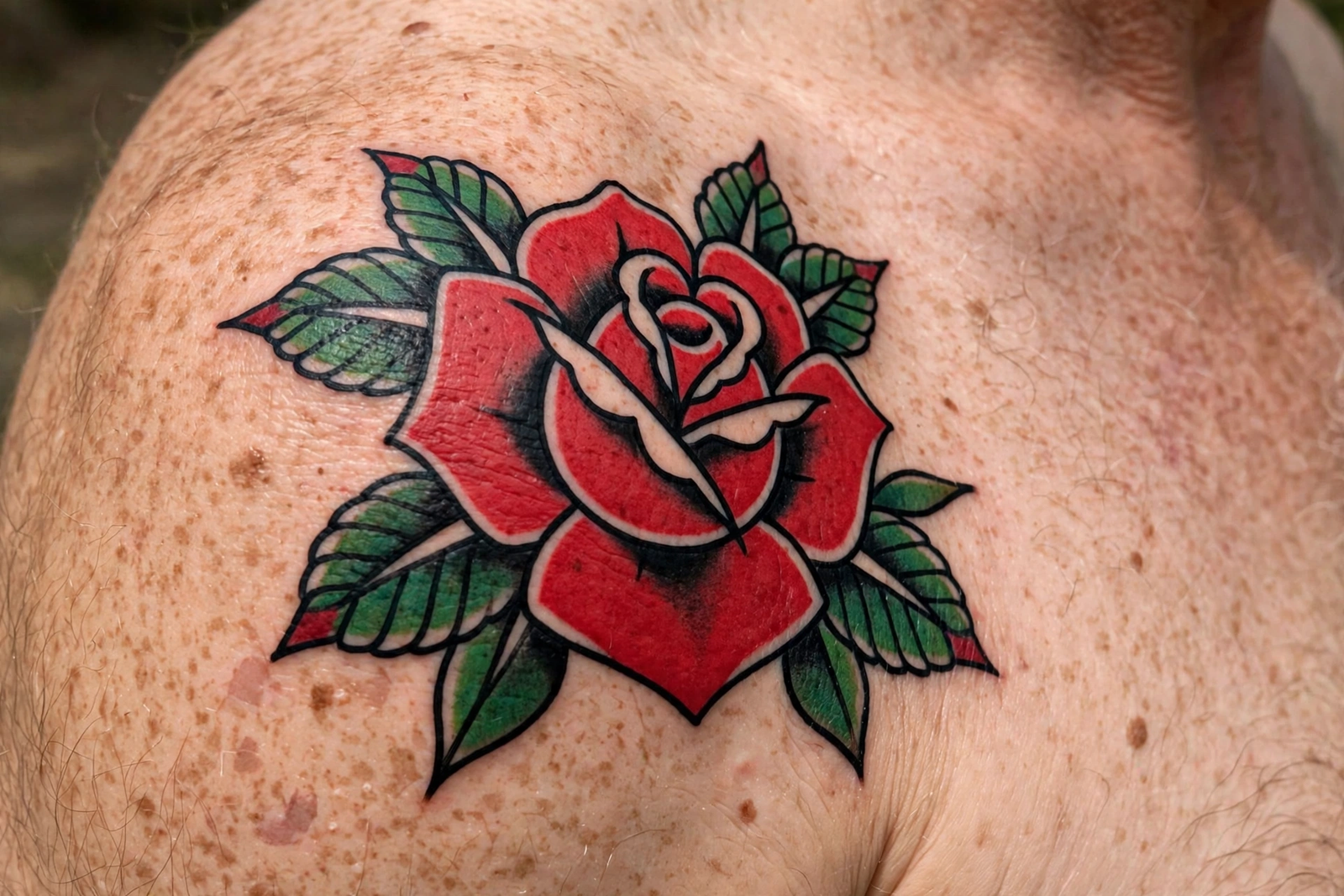
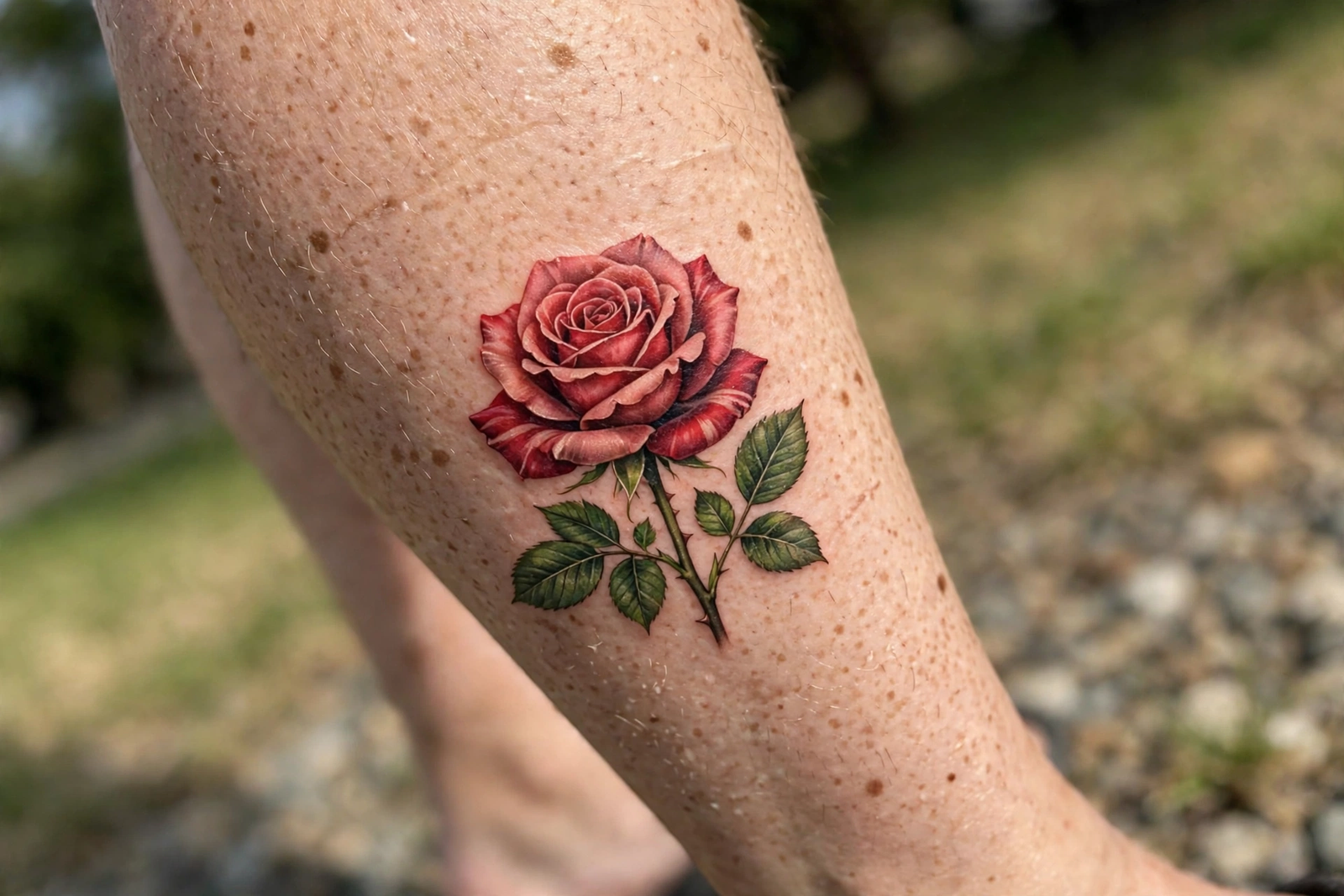
The big one. Red means romantic love, desire, passion, and devotion that runs deep. It’s the anniversary rose, the Valentine’s rose, the “I’d choose you again” rose. In tattoo form, a red rose also carries courage — there’s something bold about wearing the loudest color on your skin. Traditional American style loves red roses for exactly that reason: they hold their color, they read from across the room, and they age beautifully. If you want one rose and you want it to mean love without a footnote, red is your safest, truest bet. Just know you’ll be explaining it to exactly nobody, because everyone already gets it.
Pink rose: gratitude, admiration and gentle love
Pink softens everything red says. Light pink leans toward admiration, sweetness, and first love — the crush stage, the “I think you’re wonderful” stage. Hot or deep pink pushes closer to gratitude and appreciation: thank you for being in my life, thank you for staying. Pink roses are a popular pick for mothers, sisters, and close friends, and for people who want a love tattoo without the intensity of full red. They also photograph beautifully in fine-line and watercolor styles, where red can sometimes look heavy. If your love feels more like warmth than fire, pink probably fits better.
White rose: purity, new beginnings and remembrance
White is the color with the widest emotional range, which is worth knowing before you commit. On one hand it means purity, innocence, and fresh starts — weddings, new chapters, a clean slate after a hard year. On the other hand it’s the classic funeral flower, so a white rose tattoo often means remembrance: peace for someone who passed, or a love kept pure by distance or death. Same color, opposite ends of a life. Context does the work — a white rose with a wedding date reads completely differently from a white rose with a memorial date. Make sure the rest of the design tells people which one you mean, or be comfortable with the ambiguity. Some people like that it holds both.
Yellow rose: friendship, joy — and a warning
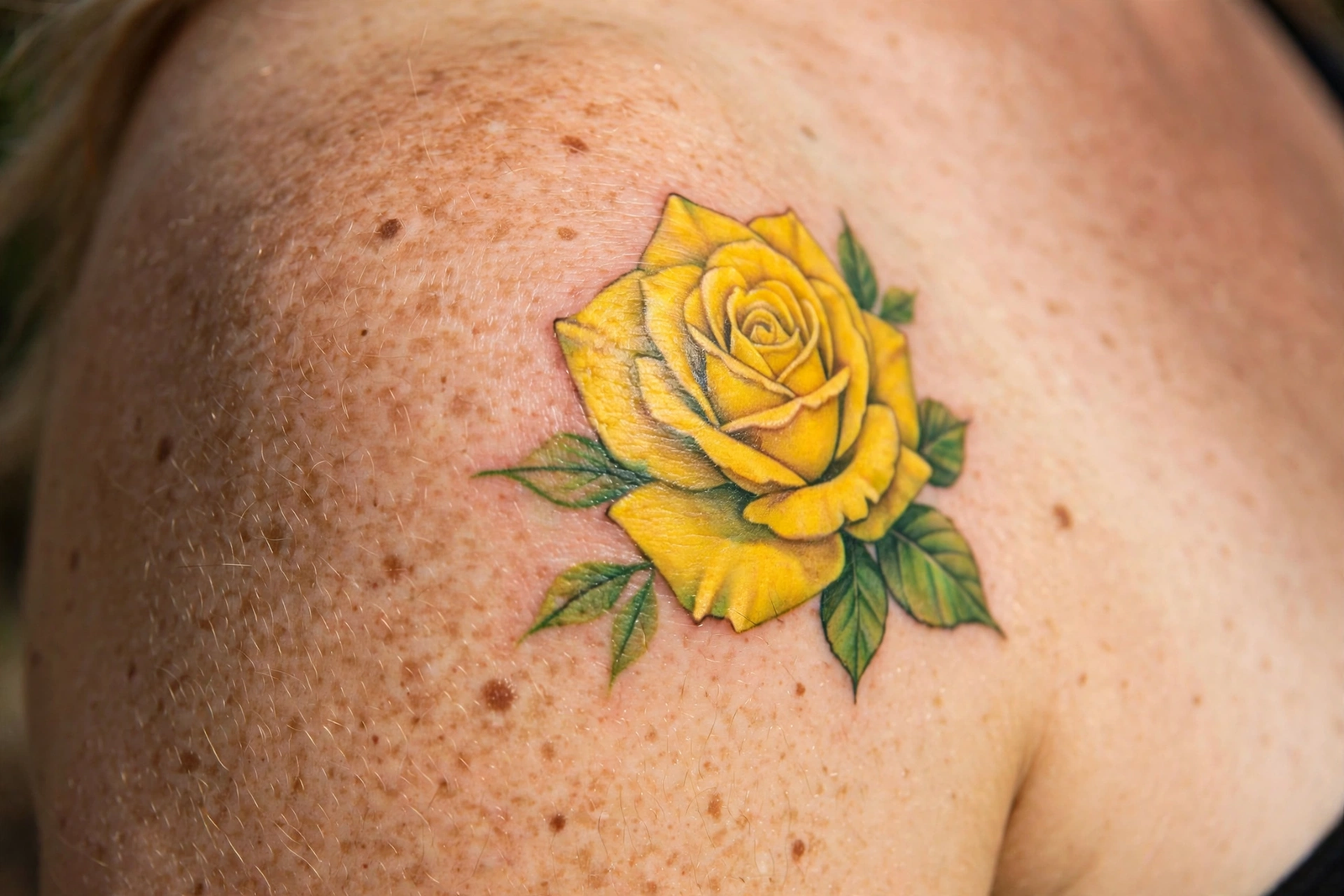
Yellow is the friendly one. Joy, warmth, friendship, the kind of happiness that’s more sunshine than fireworks. Yellow roses make lovely friendship tattoos and cheerful “I survived and I’m glad about it” pieces. But here’s the wrinkle: in older flower language, yellow roses also meant jealousy and fading love, the “I’m not sure about us anymore” flower. Most modern wearers ignore that older meaning entirely, and honestly, most people looking at your tattoo will too. Still, if you’re getting a yellow rose for a romantic partner, it’s worth knowing the old meaning exists — if only so you can laugh about it later. For a friend? Zero baggage. Go bright.
Black rose: grief, goodbye and rebellion
Black roses don’t grow in nature — they’re dyed, or very dark red in disguise — and that unreal quality is part of the appeal. A black rose tattoo usually means grief, loss, or the end of something: a relationship, a chapter, an old version of yourself. It can also mean rebellion and mystery, the gothic cousin of the red rose. Some people get a black rose after a breakup as a full stop, a way of closing the book on their own skin. Others get one because they love the look: blackwork roses are striking, they age well, and they suit people who don’t want a colorful flower. Either reason is valid. Just be ready for people to ask if you’re okay. They mean well, and they’ll ask anyway.
Blue rose: the impossible and the mysterious
Blue roses are fantasy flowers — they don’t exist naturally either, which makes them perfect for meaning “the impossible, the unattainable, or the mysterious.” A blue rose tattoo often says: I’m chasing something rare, or I loved someone I couldn’t keep, or I believe in things that shouldn’t be possible but are. It’s a favorite for dreamers, for people who feel a bit out of step with the ordinary, and for anyone whose story doesn’t fit a normal color. Blue also reads beautifully in watercolor and neo-traditional styles, where the unreal color looks intentional rather than odd. If red is “I love you,” blue is “I love something I can’t quite hold.”
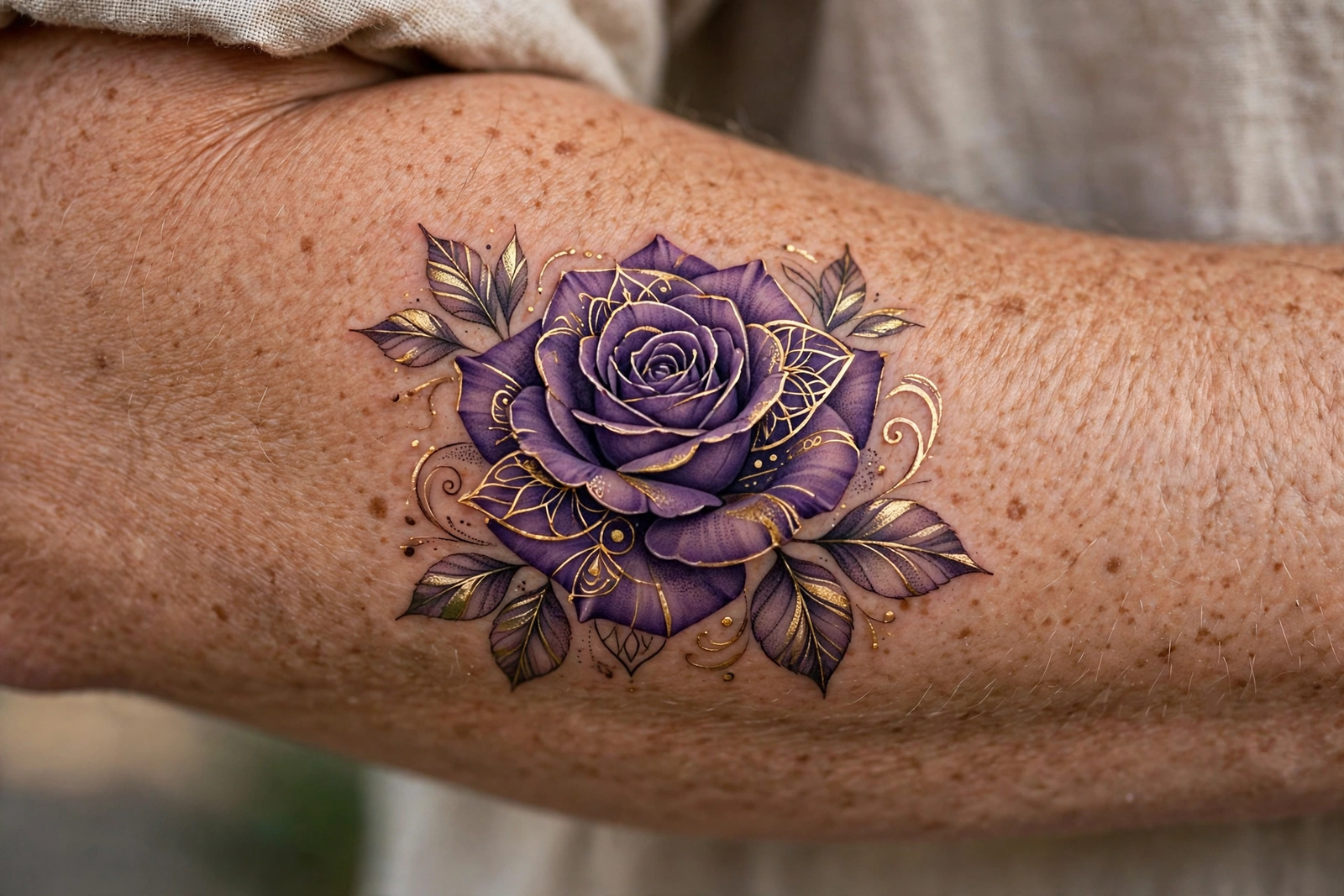
Purple and lavender rose: enchantment and royalty
Purple has always been the color of royalty, luxury, and a certain kind of magic, and purple roses carry that into tattoos: enchantment, fascination, love at first sight, and admiration with a bit of awe in it. A lavender rose softens that into something gentler — love that’s still new and a little spellbound. Purple roses are less common than red or black, which honestly works in their favor: they stand out, they start conversations, and they suit people who don’t want the same tattoo as everyone else in the waiting room. Pair them with gold or deep green and they look expensive in the best way.
Orange and peach rose: enthusiasm and gratitude
Orange roses bring energy: enthusiasm, passion with a playful edge, excitement about what’s next. They’re the “new adventure” rose, popular for fresh starts that feel fun rather than solemn. Peach roses are quieter — gratitude, sincerity, appreciation without the drama. A peach rose for a parent or mentor says thank you in a way that feels warm rather than formal. Both colors are underrated in tattooing, partly because people default to red, and that’s a shame. An orange rose on a forearm in summer looks like it belongs there, like it grew there. Sometimes the less obvious color is the more honest one.
What about a rosebud, or a wilting rose?
The state of the bloom matters as much as the color, and this is where rose tattoos get properly poetic. A tight rosebud means new love, youth, potential — something not yet fully opened. A full bloom means love in its prime, or beauty at its peak. A wilting or falling-petal rose means loss, fading love, or the honest acceptance that beautiful things end. And a rose with petals scattered around it? That can mean letting go, or a love that changed shape instead of dying. We’ve seen wilting roses chosen after breakups, after deaths, and — memorably — by a woman celebrating leaving a job that had drained her for a decade. She called it her “good riddance rose.” We loved that. Your rose doesn’t have to be perfect to be true.
Rose Tattoo Designs That Actually Hold Up
A rose is forgiving as a subject — it’s hard to make one look truly bad — but some styles suit it better than others, and the style changes the meaning almost as much as the color does. Pick the style that matches the feeling, not just the one trending on your feed this month.
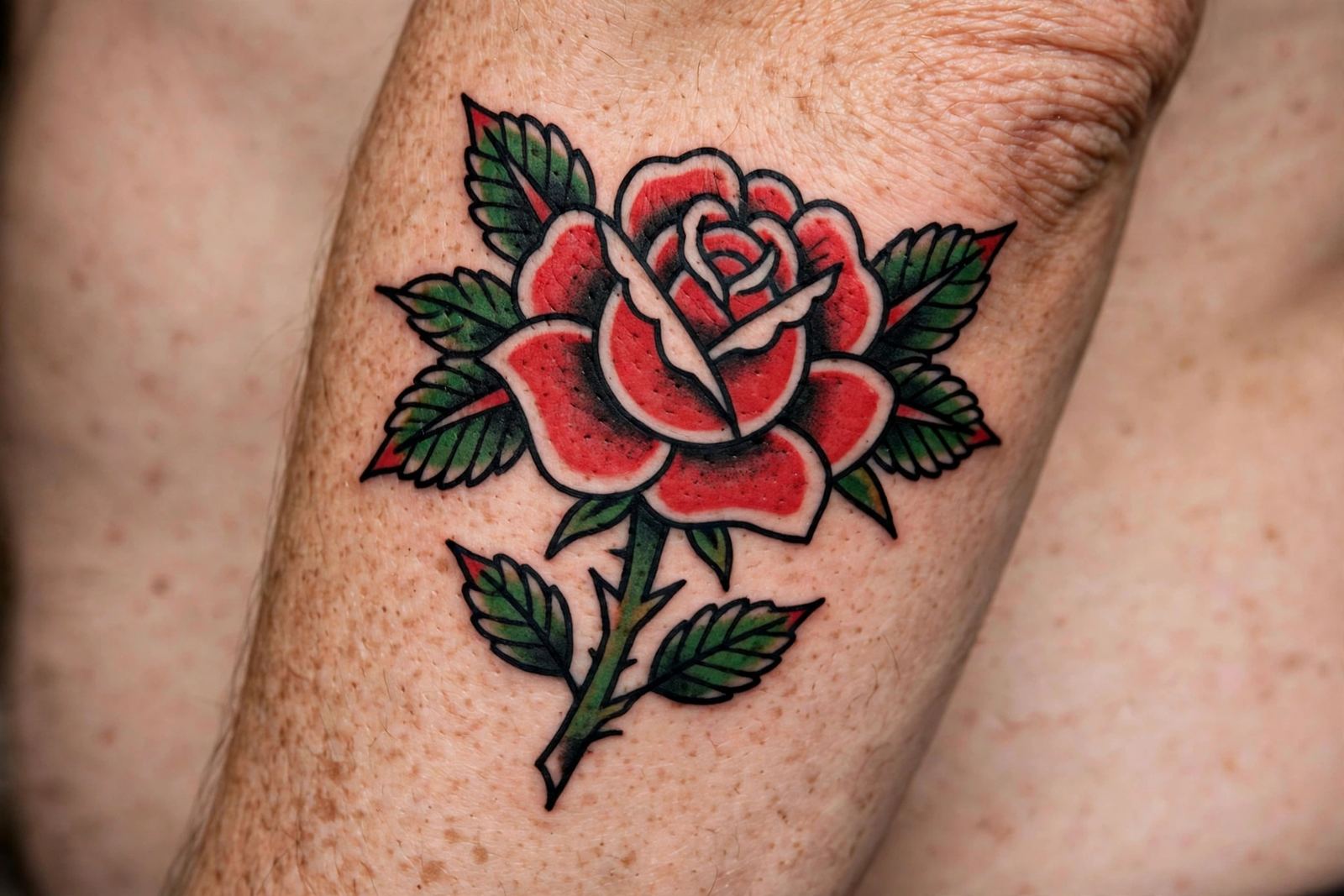
Traditional American rose
Bold black outlines, solid red, deep green leaves, a bit of yellow highlight. The sailor-and-biker classic, and still the most durable rose you can get. Traditional roses age better than almost any other style because the lines are thick and the color is packed in. If you want a rose that looks as good at fifty as it does at twenty-five, start here. It also carries a vintage, working-class romance — love as something earned, not decorated. There’s a reason your grandad’s generation and your generation both keep getting this one.
Realism rose
A rose that looks like a photograph: soft shading, layered petals, dew on the edge if you’re feeling fancy. Realism roses are stunning and they’re the hardest to get right, because a rose has dozens of petal folds and getting even a few wrong makes the whole thing look off. Choose an artist whose portfolio is full of healed realism flowers, not just one good photo. And give it size — a realism rose squeezed into a tiny space loses the detail that makes it realism. Forearm, thigh, shoulder: those are your friends here.
Fine-line rose
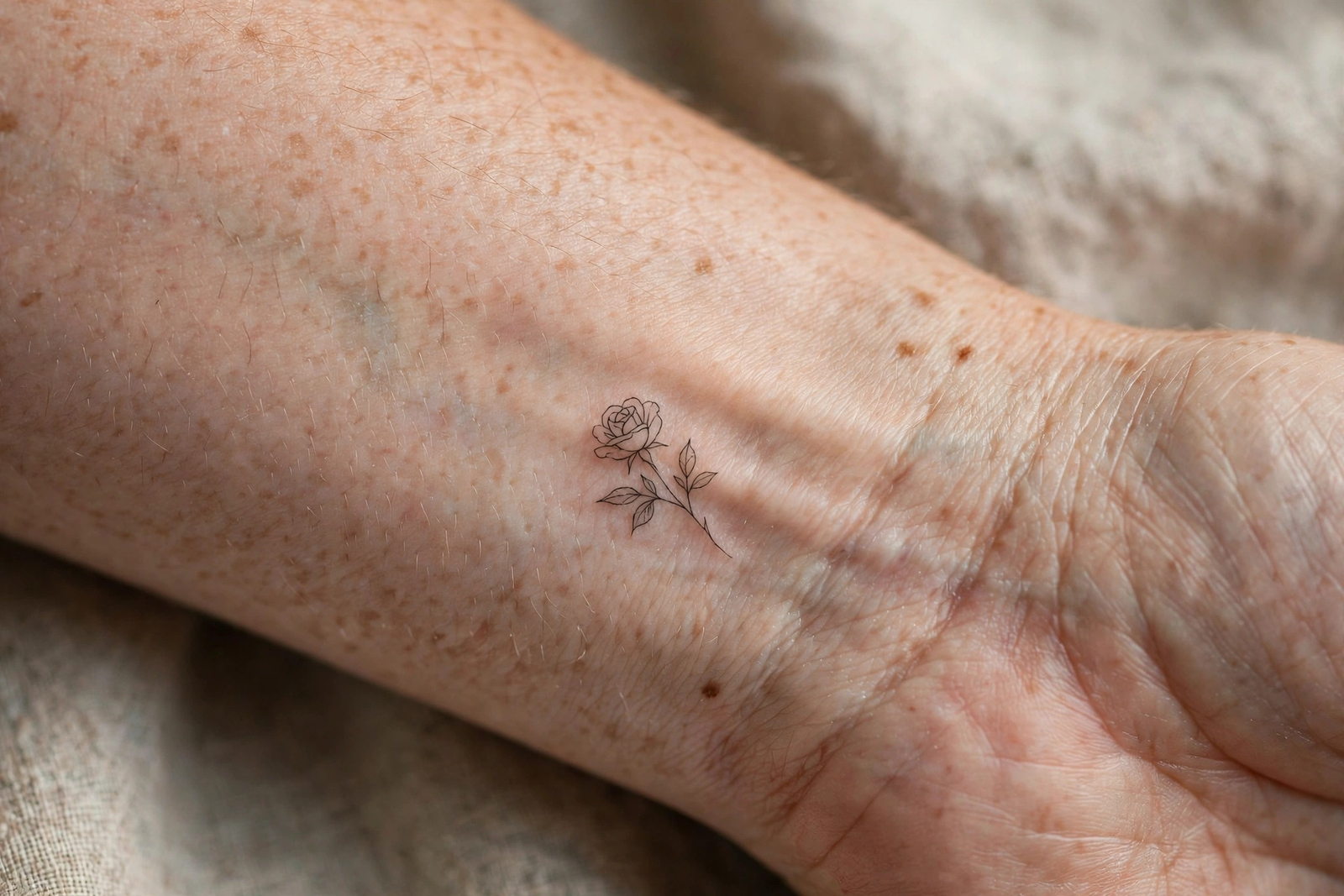
Delicate single-needle or thin-line work, often black ink only, sometimes with a whisper of color. Fine-line roses look elegant, minimal, and modern — perfect for wrists, ankles, collarbones, and behind the ear. The trade-off is aging: thin lines spread and fade faster than bold ones, so a fine-line rose will soften over the years. Many wearers like that — it ages like a pressed flower, which suits the subject. If you want it crisp forever, plan a touch-up every few years and don’t go smaller than your artist recommends. Tiny is tempting. Tiny is also temporary.
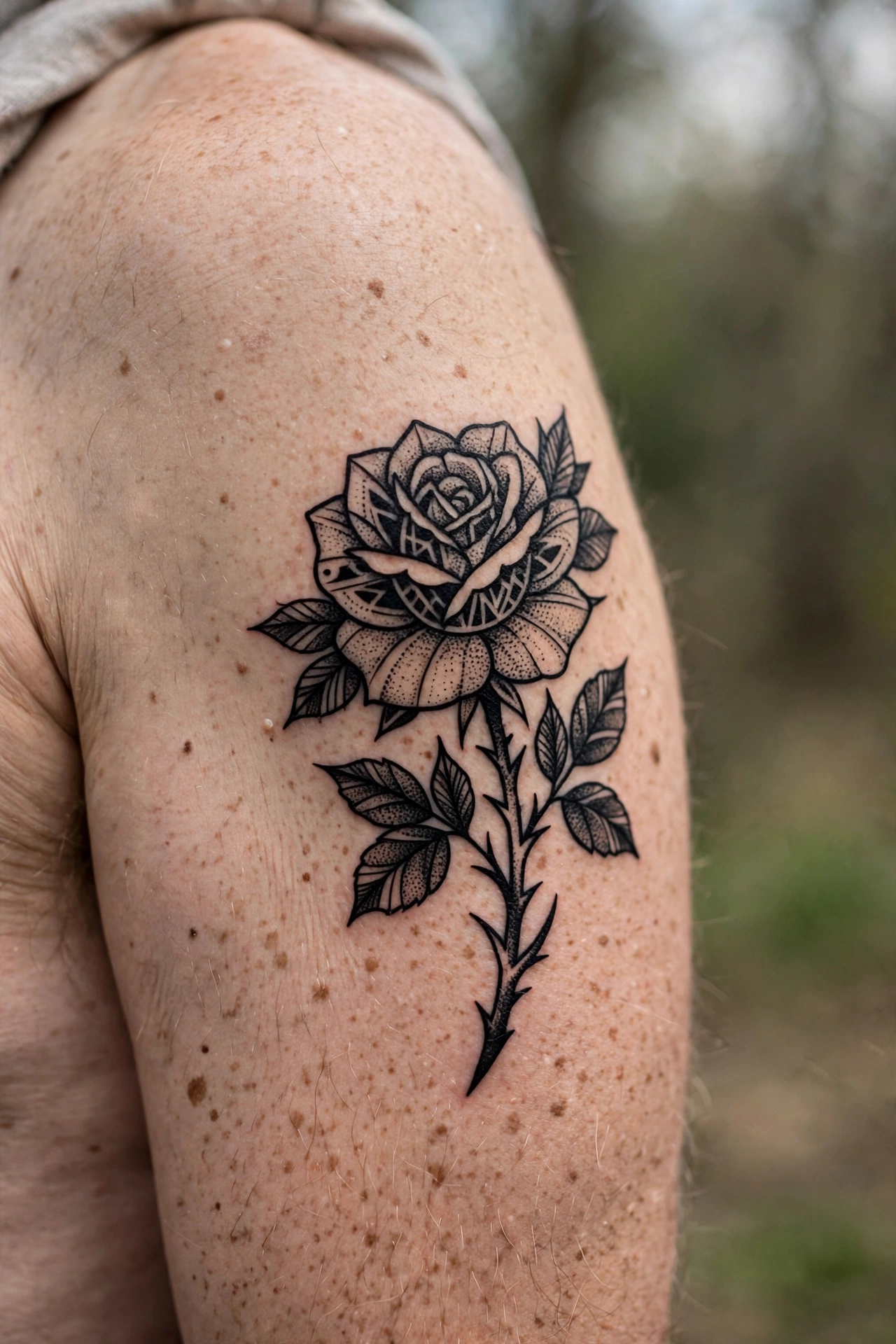
Blackwork and black-and-grey rose
No color at all, just black ink, shading, and negative space. Blackwork roses look dramatic, gothic, and timeless — and they suit every skin tone because they don’t rely on color contrast. Black-and-grey shading gives you the depth of realism without the color upkeep, and it pairs beautifully with script, dates, and memorial elements. If you’re torn between a black rose and a red one, black-and-grey is a lovely middle ground: all the romance, none of the color fading to worry about.
Watercolor rose
Splashes and bleeds of color with little or no outline, like paint on wet paper. Watercolor roses are gorgeous on day one — pink, purple, blue, all bleeding into each other like a dream. The honest catch: without outlines, watercolor fades faster than other styles, and colors soften into each other over time. A good artist will add a light black or grey outline to anchor it, even if you can’t see it at first. If you love the look, go for it — just go in knowing it will change, and that the change is part of the style, not a failure.
Rose with a stem, or just the bloom?
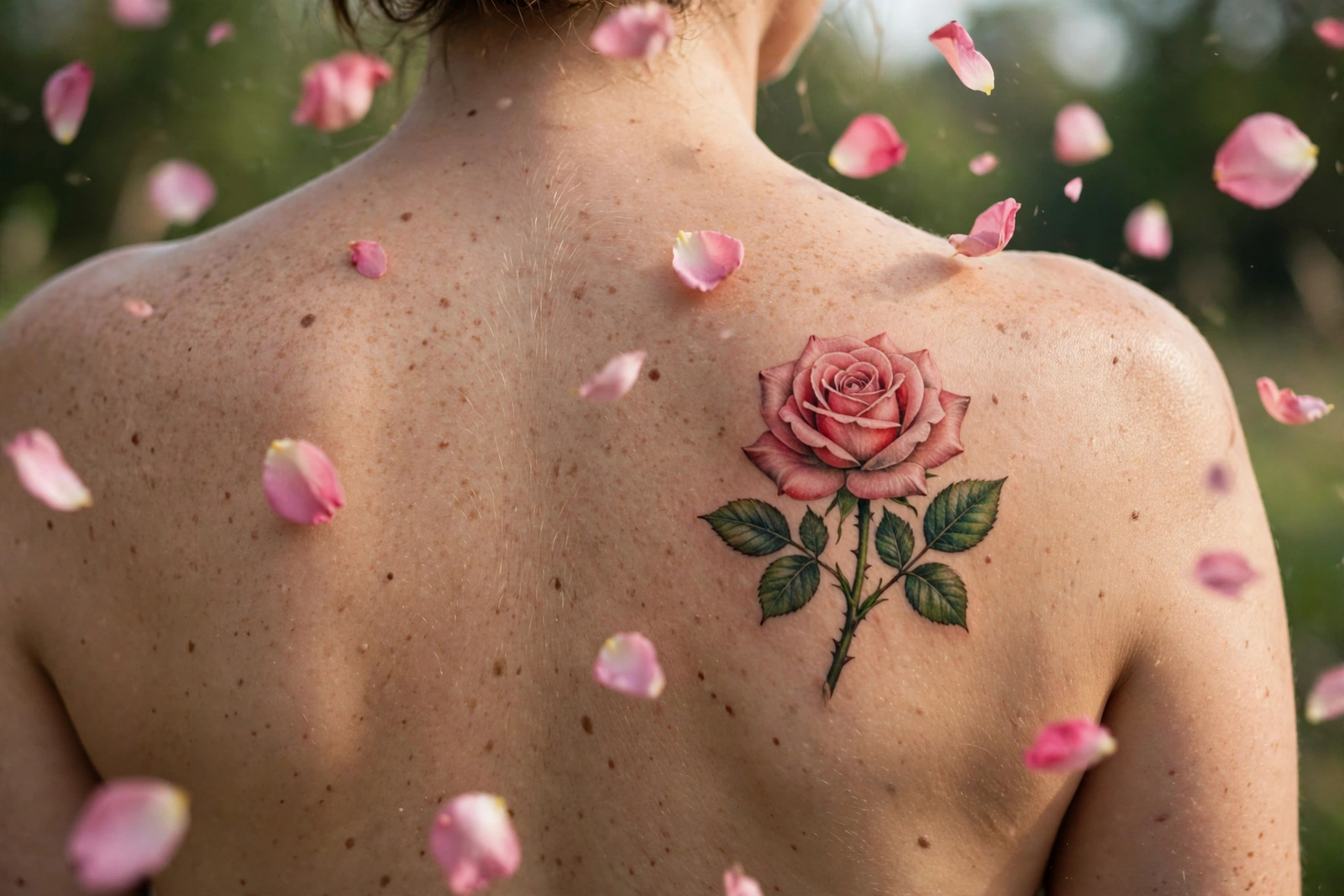
Small choice, big difference. A bloom alone is pure symbol: love, beauty, the idea itself. A rose on a full stem with leaves and thorns is a whole plant: love in context, with roots and defenses and growth. Stem roses suit longer placements — forearm, calf, spine — where the vertical line can follow the body. Blooms alone suit round spots: shoulder, chest, thigh. And a stem that wraps or curves can connect other tattoos into a sleeve over time, which is how a lot of collections grow: one rose becomes a garden, one garden becomes a story.
Rose Combinations and What They Add
Roses rarely travel alone. Pairing a rose with a second symbol layers the meaning, and some pairings are so common they’ve become their own language. Here’s the short version of what each one usually says.
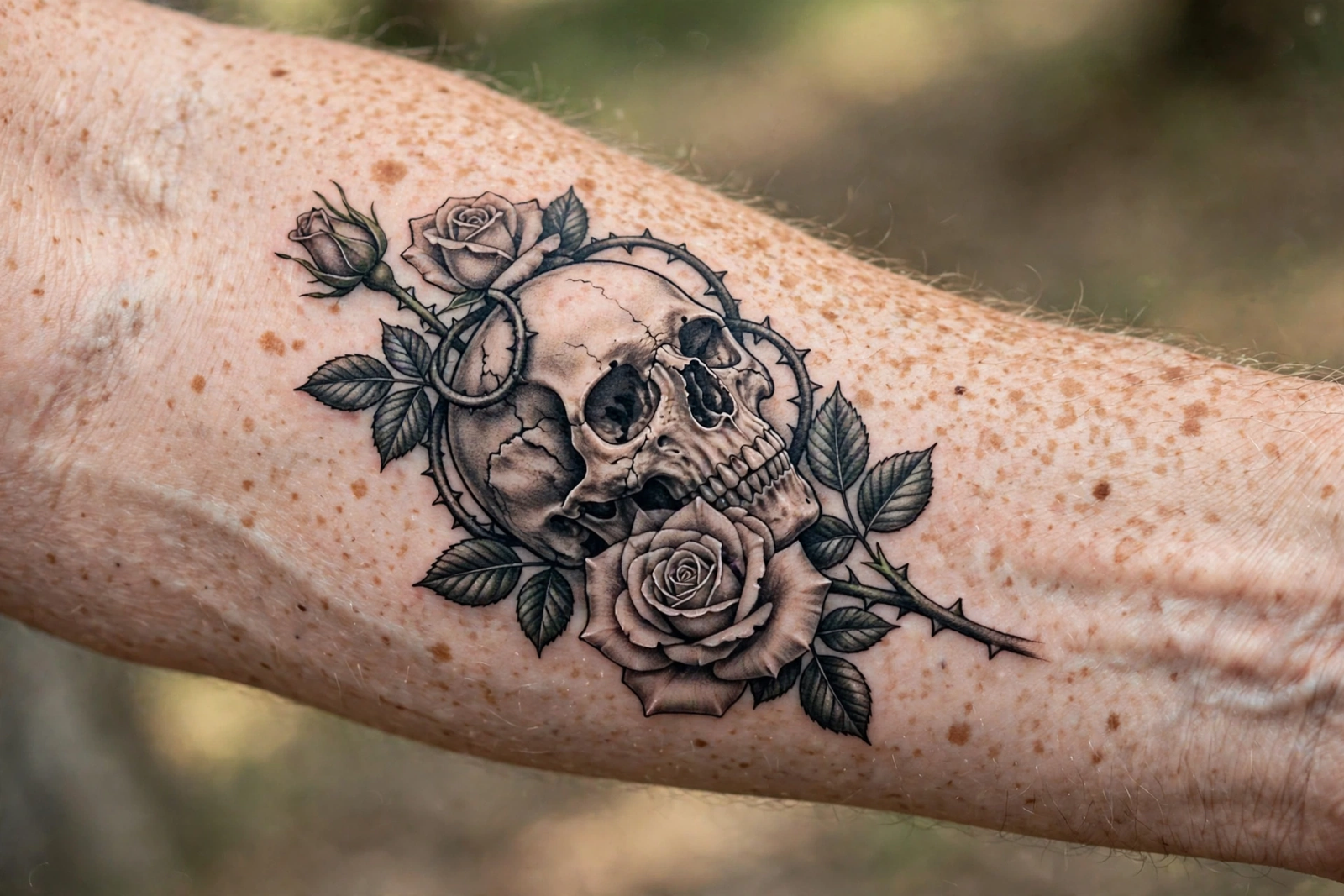
Rose and skull
Beauty and death, side by side — the classic memento mori. Life is short, love is precious, enjoy both while they last. It’s also a popular memorial pairing: the rose for the person, the skull for the fact that they’re gone. Dark, yes, but not hopeless. More like honest. If your rose is about someone you lost, this pairing says you haven’t prettied that loss up, and that’s a kind of respect.
Rose and dagger
Love that can defend itself, or love that hurt. The dagger through a rose is one of tattooing’s oldest images, and it still hits: passion with an edge, betrayal survived, a heart that’s learned to protect itself. Some people get it after a breakup as a “never again” piece; others get it as a couple’s tattoo, which is braver than it sounds. Either way, the dagger makes the rose less decorative and more of a statement. Don’t get this one by accident.
Rose and snake
Temptation, transformation, danger wrapped around beauty. Snakes shed their skin, roses bloom and fade — together they say change, rebirth, and the knowledge that beautiful things can bite. It’s a striking visual too: the snake’s curve against the rose’s roundness is one of those pairings artists love to draw. If your story involves a transformation that wasn’t gentle, this might be your combination.
Rose and butterfly or moth
Growth, change, and beauty that didn’t stay still. A butterfly with a rose leans toward joyful transformation; a moth with a rose leans toward quieter, nighttime growth. Either way, the pairing says your love or your life changed shape and came out more beautiful. It’s a popular choice for people marking recovery, new chapters, or a love that evolved instead of ending. Our tattoo meanings library has a full piece on moths if that pairing catches your eye.
Rose with a name, date or quote
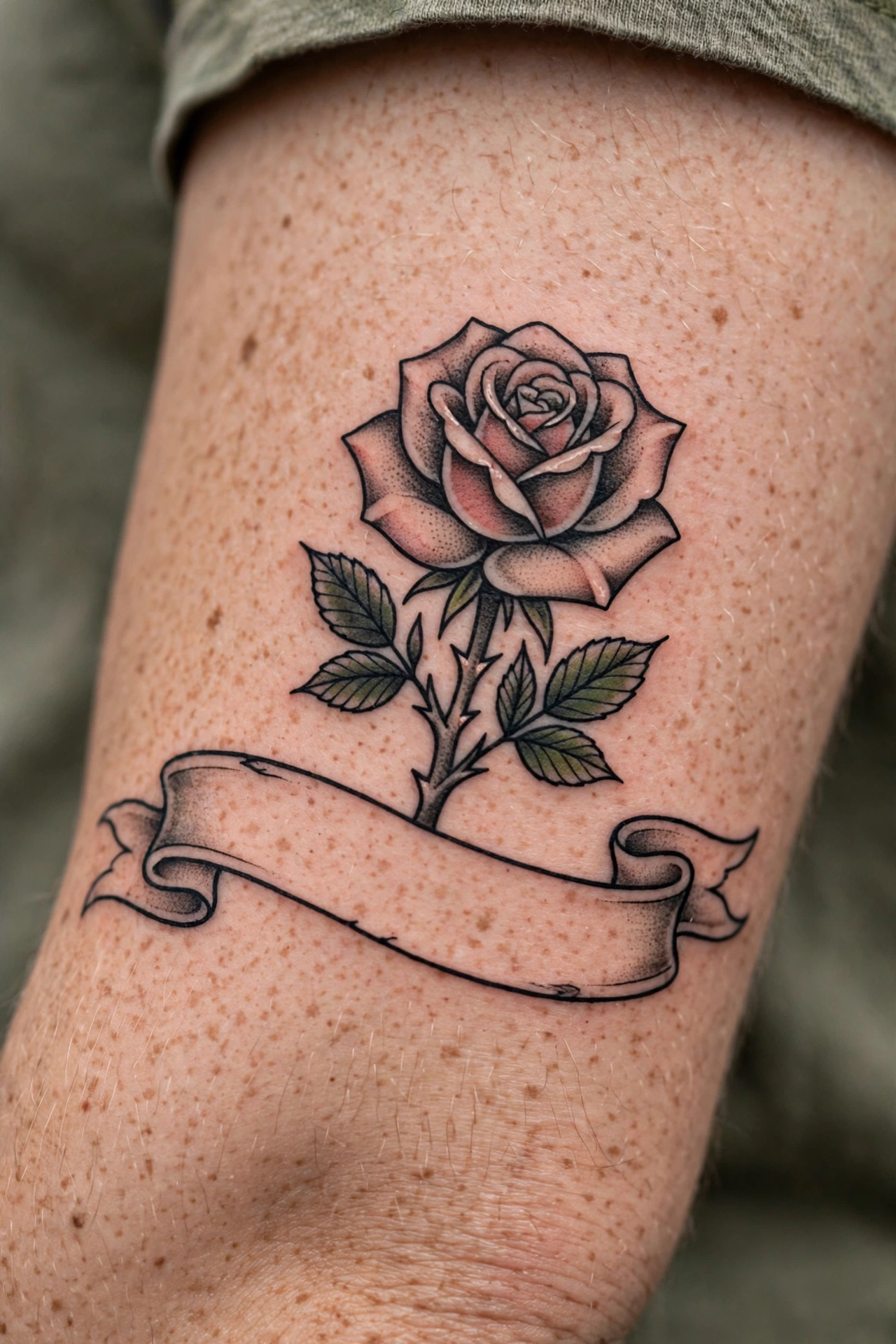
The most personal version, and the one to think hardest about. Names and dates make a rose unmistakably yours — a child’s birth, a wedding, a parent’s memory. Script woven through the stem or bannered underneath looks classic, but check the spelling three times and check the date twice, because tattoo artists have stories about both that you do not want to join. Quotes work best short: one line, not a paragraph. A rose plus eight words is a tattoo. A rose plus eighty words is a homework assignment on your arm.
Rose and clock, rose and compass
Time and direction. A rose with a clock often means a moment frozen — the time someone was born, the time they left, the time love started. A rose with a compass means love as guidance, or a journey with someone worth following. Both pairings suit larger pieces, and both look best when the rose stays the hero and the clock or compass plays supporting role. Let the flower lead; the hardware follows.
Best Placements for a Rose Tattoo
Forearm
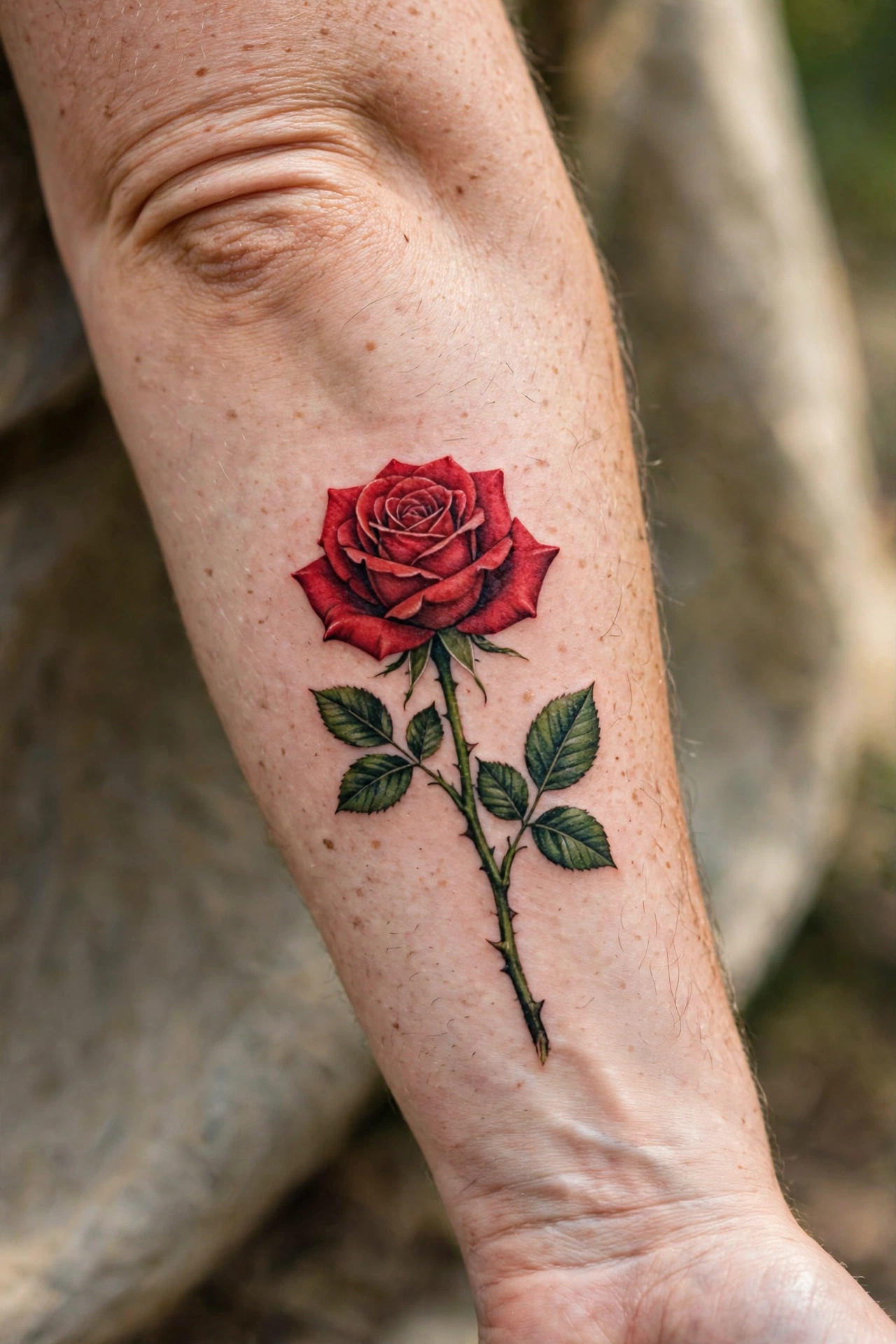
The classic rose spot, and for good reason. A rose on the forearm is visible, it follows the arm’s natural line beautifully (especially with a stem), and it heals well. Pain is gentle, around 3/10, and the size range is generous — a small fine-line rose or a large realism piece both work here. It’s also the easiest rose to show off, which matters if your rose is a love you want people to see. Just remember: visible means visible at work too, so check your workplace rules before you commit to the outer forearm.
Shoulder and upper arm
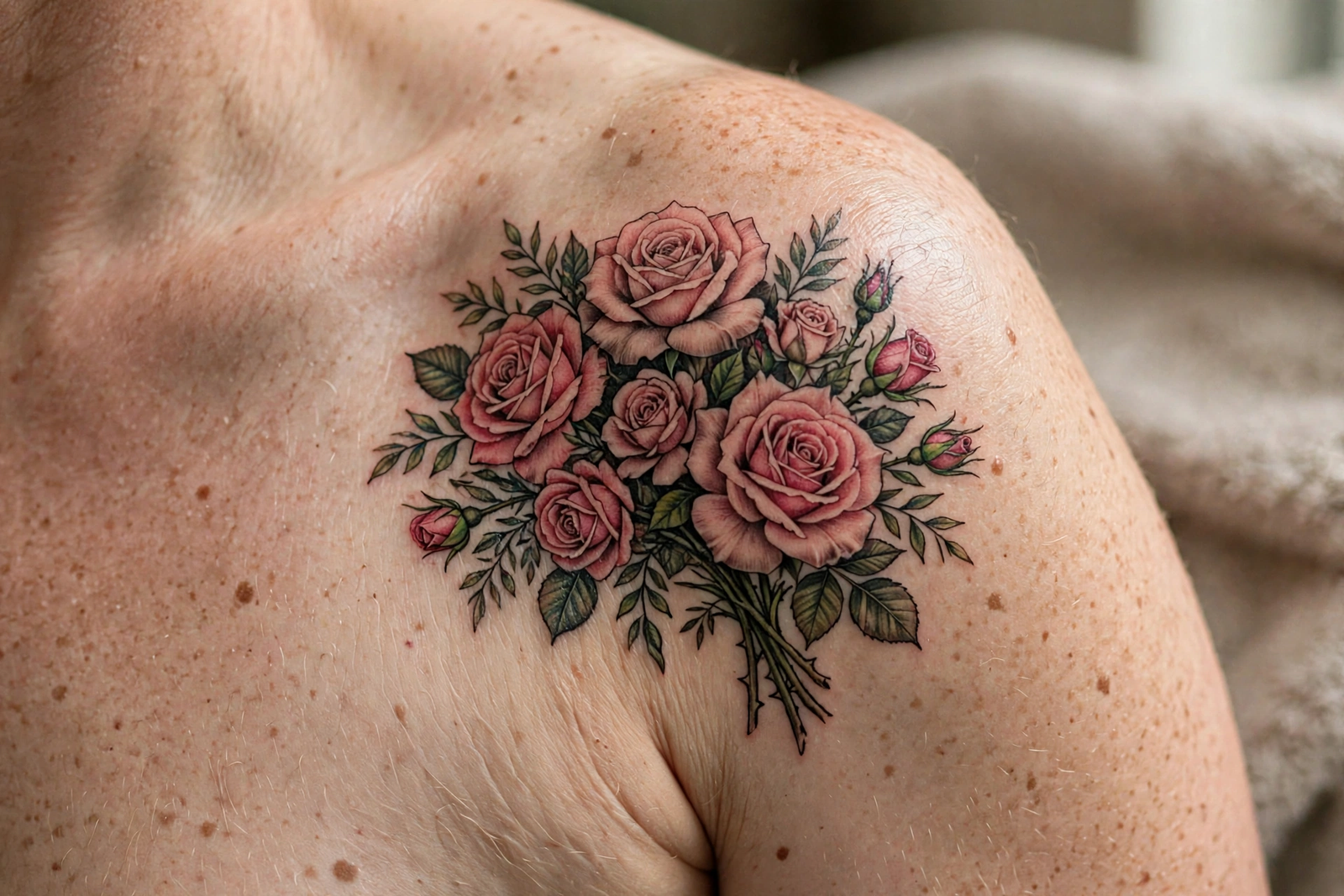
Room for a bigger bloom, easy to cover with a sleeve, pain around 3–4/10. Shoulder roses suit traditional and realism styles that need space, and they connect beautifully into a sleeve later — a rose on the shoulder becomes the anchor for a whole arm of flowers. If you’re planning a larger collection, start here. The shoulder is where gardens begin.
Hand and fingers
Small roses on hands look stunning and fade faster than anywhere else, because hands get washed, sun, and friction constantly. Pain is higher, around 5–6/10, and touch-ups are basically part of the deal. A rose on the hand says commitment — it’s the most visible spot you’ve got — so it suits people who really mean it. Just go in with your eyes open about fading, and pick a design with bold enough lines to survive the wear.
Chest and sternum
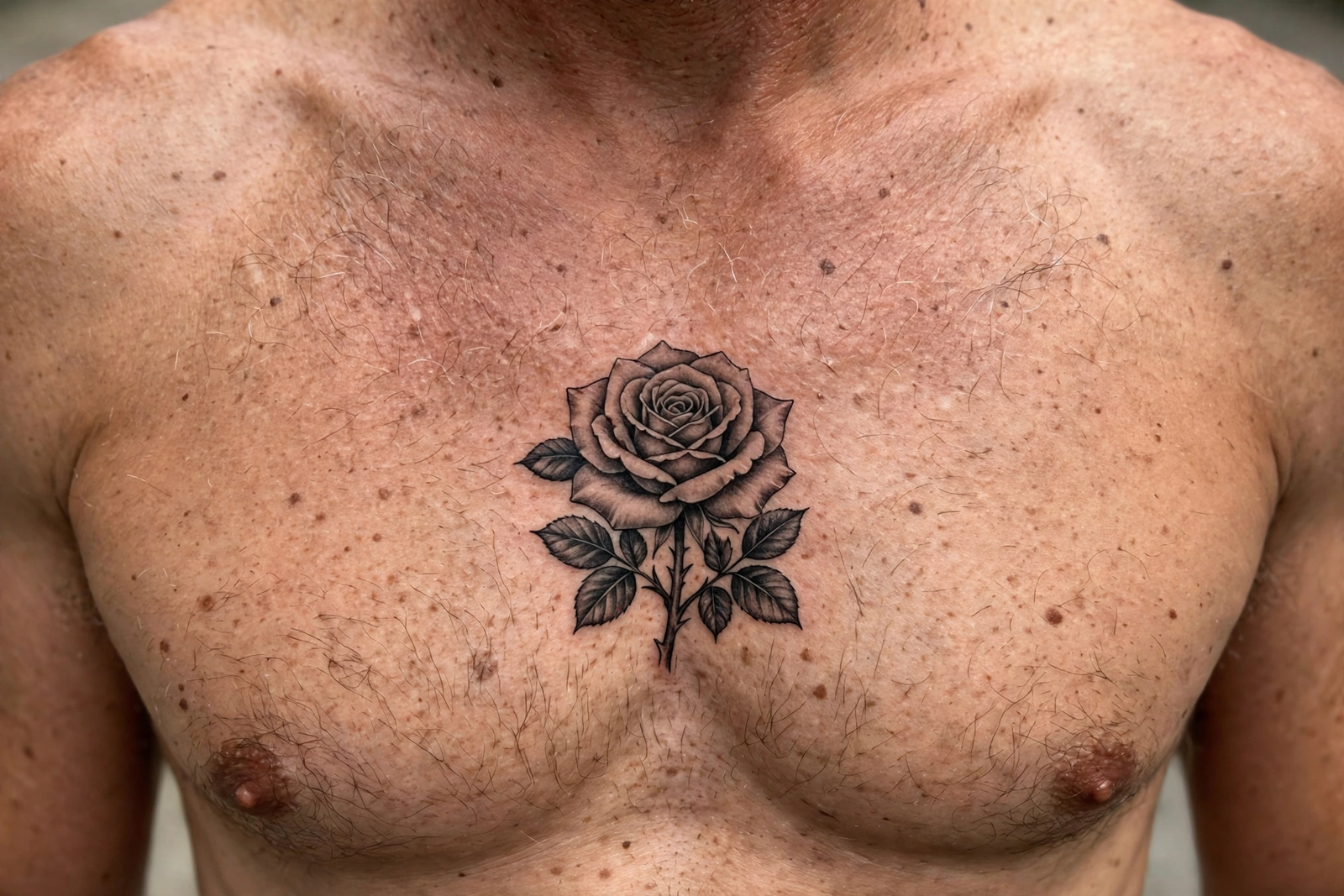
A rose over the heart is almost too perfect as a metaphor, which is why people keep doing it. Sternum roses, especially symmetrical or paired ones, look incredible — but pain is real, around 6/10, with bone close under thin skin. Chest roses suit larger, bolder designs; a tiny rose can get lost on a broad chest. If your rose is for a partner or a lost loved one, the chest placement adds a layer of meaning no other spot can match. It literally sits where you feel it.
Thigh and calf
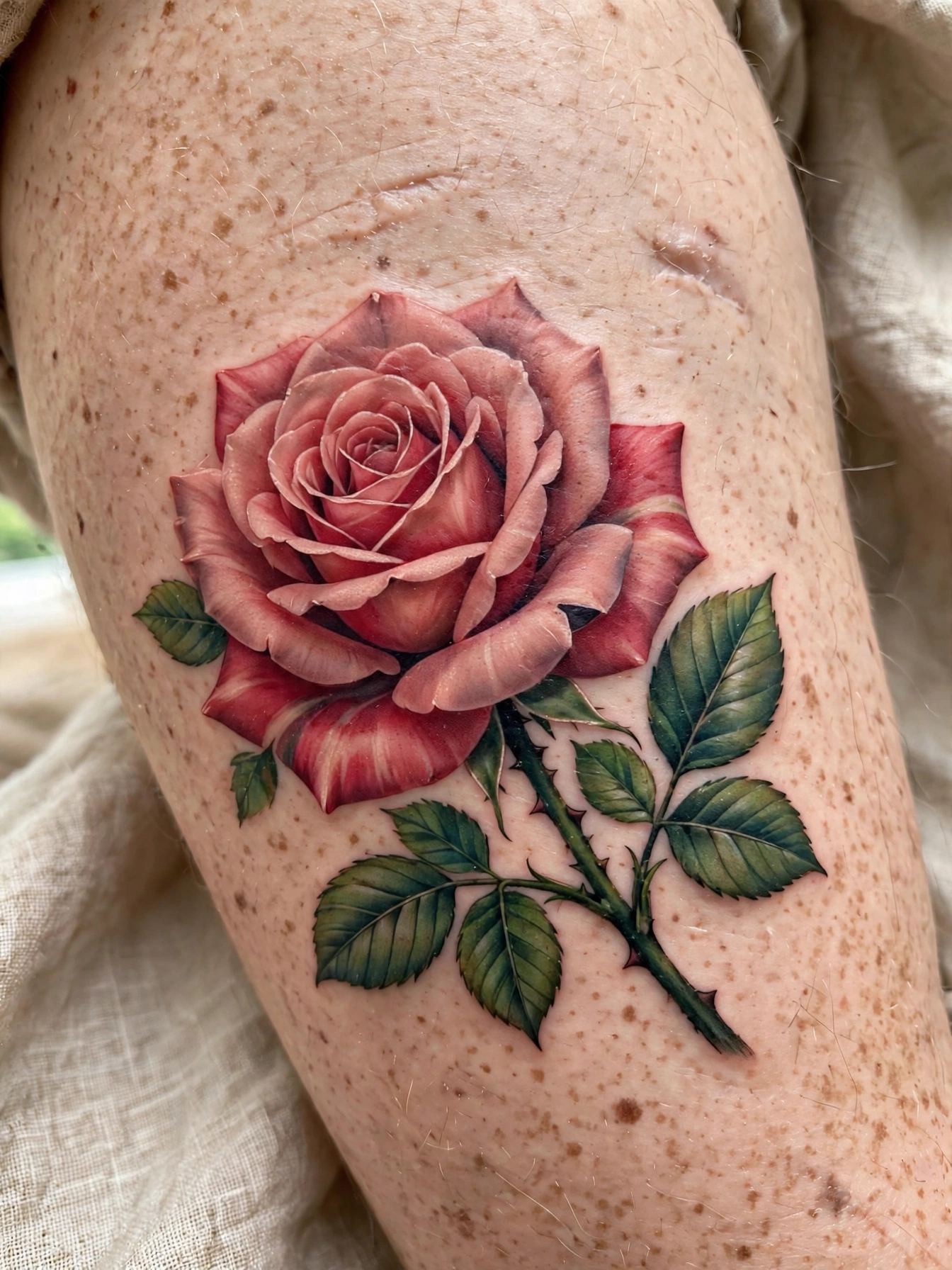
The big-canvas, low-pain options. Thigh pain is around 2–3/10, calf around 4/10, and both give you room for a full stem, leaves, and companion flowers. Thigh roses age well — less sun, less movement — and they’re easy to hide or show as you please. Calf roses follow the leg’s line nicely, especially vertical stems. If you want a large, detailed rose and you don’t want to wince through it, start with the thigh. Your future self will thank you.
Wrist, ankle and behind the ear
The small-and-private trio. Wrist roses are daily reminders you can glance at; ankle roses are subtle and pretty in summer; behind-the-ear roses are tiny secrets for people who like their tattoos close. All three suit fine-line and small traditional roses, all three fade faster than larger placements, and all three hurt a bit more than you’d expect for their size — wrist and ankle around 4/10, behind the ear around 5/10 thanks to bone and thin skin. Keep the design simple at this size. A rose’s detail is its charm, and detail needs room.
Size, Cost and Pain — Honestly
Small (3–5 cm): wrist, ankle, behind the ear, finger. Simple fine-line or tiny traditional roses. Cost: roughly $80–$150 in the US, often the shop minimum. Expect touch-ups sooner than larger pieces.
Medium (8–15 cm): forearm, shoulder, calf. Room for a proper bloom, a stem, leaves, maybe a second element. Cost: roughly $150–$400. This is the sweet spot for most rose tattoos — detailed enough to read as a rose, affordable enough to do well.
Large (15 cm+): thigh, chest, back, full sleeve anchor. Realism roses, bouquets, roses with skulls or clocks. Cost: roughly $400–$1,000+, and multi-session pieces can go higher. Ask for a quote per session, not just a total, so there are no surprises halfway through.
Pain follows the usual map, with one rose-specific note: most rose work is line and soft shading, not the heavy packed black that makes large pieces ache, so sessions tend to be shorter than you’d expect for the size. Bony spots sting; padded spots don’t. And here’s a tip from artists: the outline is the spicy part. Once that’s done, the shading feels like a relief. If you’re nervous, ask your artist to walk you through it — a good one will, and you’ll relax once you know what’s coming.
Choosing an Artist for a Rose
Roses look easy. They’re not. A rose has layered petals that have to read as a flower, not a cabbage, and the difference is in the shading — too flat and it looks like a sticker, too heavy and it looks muddy. So look for an artist with roses in their portfolio, and look at healed ones, not just fresh photos. Fresh roses always look good. Healed roses tell you whether the color held, whether the lines stayed clean, and whether the petals still read as petals after a year of sun and showers.
Bring reference photos of real roses, not just other people’s tattoos. The way a petal curls, the way light hits the outer edge — getting the flower right is what separates a rose tattoo from a generic flower tattoo. And talk about color honestly: red fades to pink-ish over many years, black stays black, watercolor softens. A good artist will tell you this before you ask. If yours promises a color will never change, find another artist. Browse our tattoo ideas and tattoo styles guides to narrow down the look before you book, and check our placements guide if you’re still torn on the spot.
Aftercare in Brief
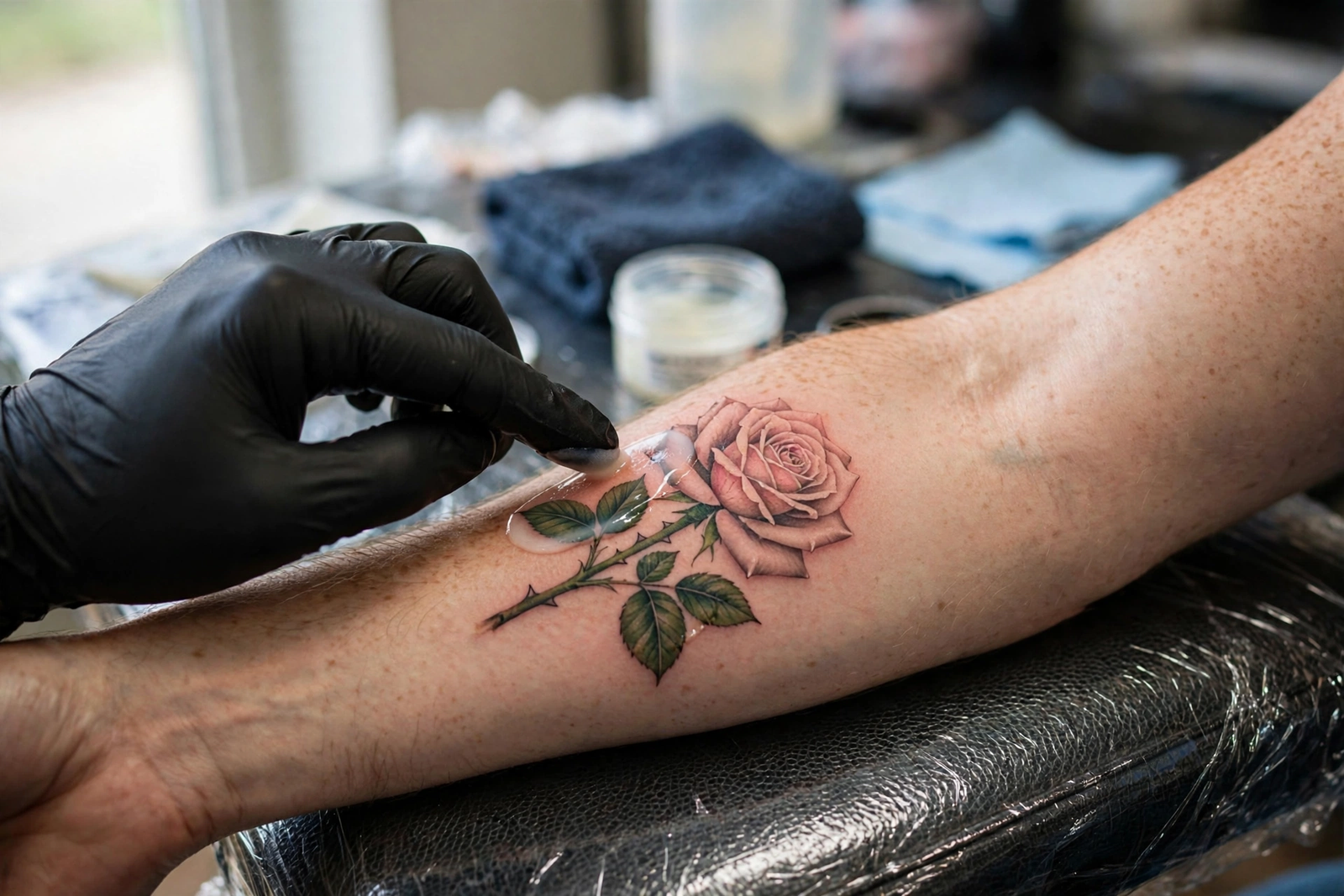
Wash gently twice a day, moisturize thinly — thin really does mean thin, a shiny greasy layer slows healing — don’t pick the flakes, and keep it out of pools, baths, and direct sun while it peels. Color roses show fading faster than blackwork, so sunscreen after healing isn’t a suggestion, it’s the difference between a rose that stays red and one that drifts toward a tired pink. The full routine, day by day, is in our tattoo aftercare guide.
Frequently Asked Questions
What does a rose tattoo mean?
Love, beauty, and resilience with the thorns left in — passion, loss, and survival in one flower. The color refines the meaning: red for deep love, white for purity or remembrance, black for grief or rebellion, and so on.
What does a red rose tattoo mean?
Romantic love, passion, and deep devotion. It’s the most direct love symbol in tattooing, and in traditional style it’s also one of the most durable designs you can get.
What does a black rose tattoo mean?
Usually grief, goodbye, or the end of a chapter — sometimes rebellion and mystery. Black roses don’t grow naturally, which adds to their “unreal, otherworldly” feeling.
What does a white rose tattoo mean?
Purity, new beginnings, or remembrance, depending on context. A white rose with a wedding date reads very differently from one with a memorial date, so let the rest of the design clarify which one you mean.
Does a rose tattoo hurt?
It depends on placement more than the design. Forearm and thigh roses are gentle (2–3/10); sternum, hand, and behind-the-ear roses sting more (5–6/10). Most rose work is line and soft shading, so sessions are usually shorter than expected.
How much does a rose tattoo cost?
Small roses run about $80–$150 in the US; medium pieces $150–$400; large detailed or realism roses $400–$1,000 or more, depending on the artist and the hours involved.
Do rose tattoos fade?
All tattoos fade somewhat, but color roses fade faster than blackwork, and fine-line and watercolor roses fade fastest of all. Sunscreen after healing, plus touch-ups every few years for small or light pieces, keeps a rose looking fresh.
Can I get a rose tattoo for a friend or family member?
Absolutely — roses aren’t only romantic. Pink and yellow roses are classic friendship picks, and roses with names or dates are among the most common family memorial tattoos. The color and the added elements tell people which kind of love you mean.
Love, With the Thorns Left In
Here’s what we keep coming back to with roses: they’re honest flowers. They don’t pretend love is only soft, or beauty is only easy, or that anything worth keeping didn’t cost something. A rose tattoo says you know all that, and you chose the flower anyway. That’s not a small thing. It’s a grown-up kind of romance — the kind that survives the boring Tuesdays, the arguments, the winters — and it’s worth wearing.
So pick your color like you mean it. Pick your thorns on purpose. Give the bloom room to breathe, find an artist whose healed roses you’d trust, and don’t rush the decision if it’s for someone you’ve lost — that rose can wait until it’s right, and when it is, you’ll know. Because the best rose tattoos aren’t the prettiest ones in the studio window. They’re the ones that, years later, still make you think of exactly one person, one moment, one love — and smile, thorns and all.
Browse our tattoo meanings library for more symbols with stories behind them, or check our placements guide if you’re still deciding where your rose should live.